
The short answer. From the United States, the simplest way to bring a group to the Moroccan Sahara is a nonstop overnight flight to Casablanca, a first night in Marrakech or Casablanca, then either the road south, about 8 hours 45 from Marrakech, or a domestic flight to Zagora followed by about 3 hours by 4x4. Plan seven to ten days in Morocco with three or four nights in the desert, ideally between October and April.
At a glance
| Nonstop flights | Royal Air Maroc to Casablanca from New York JFK, Washington Dulles and Miami; roughly seven hours from New York |
| Entry | No visa for US and Canadian citizens on a tourist stay of up to 90 days |
| Time difference | Morocco is five or six hours ahead of New York, depending on the time of year |
| Trip length | Seven to ten days on the ground |
| Nights in the desert | Three or four |
| Routes to the camp | Road from Marrakech, about 8 hours 45; flight Casablanca to Zagora, then about 3 hours by 4x4; helicopter from Marrakech, about 1 hour 40 |
| Group size | From 2 to 18 guests, up to 20 with extra beds |
| Season | September to June; October to April is the most pleasant |
Who this guide is for
We wrote it for the person in the group who ends up organising: a founder bringing friends for a milestone, two or three couples who travel together every year, the partners of a law firm or a medical practice, a forum of CEOs, a leadership team. The questions are the same in each case: how to get everyone there, how long to stay, and what to tell people before they leave.
Step one: the flights
Most American groups fly into Casablanca. Royal Air Maroc operates nonstop flights from New York JFK, Washington Dulles and Miami, and from Montreal to Casablanca for Canadian guests. Flights from the East Coast usually leave in the evening and land in the morning. Schedules change with the season, so check them when you choose your dates.
Groups coming from the West Coast or from other cities often connect through a European hub to Marrakech instead. Both work. What matters is that the group lands within a few hours of each other on the same day, so that everyone travels south together.
Step two: the first night
After an overnight flight, nobody should be put straight into a long drive. Plan a first night in Marrakech or Casablanca, a dinner together, and an early start the next morning. It is also the night that absorbs a delayed flight without breaking the programme.
Step three: reaching the dunes
Umnya Desert Camp is in Erg Chegaga, beyond M’Hamid El Ghizlane, the last village at the end of the road. There are three ways in:
- By road from Marrakech, about 8 hours 45. Over the Tizi n’Tichka pass, through Ouarzazate and the Draa valley, then sixty kilometres of piste, about an hour and a half by 4x4. Many groups break the journey with a night in Ouarzazate.
- By air via Zagora. A domestic flight from Casablanca to Zagora, where the team meets the group at the airport, then about 3 hours by 4x4. It saves most of the road, and suits groups landing in Casablanca. The flight runs on Fridays and Mondays, and sometimes on Sundays, so we check it against your dates.
- By helicopter from Marrakech, about 1 hour 40, landing at the camp’s helipad. See helicopter to the desert.
Every route is set out on how to get to Erg Chegaga. For the vehicles, arrival windows and luggage of a larger group, read moving twelve to twenty people to the Sahara.
A shape that works: eight days
- Day 1. Overnight flight from the US.
- Day 2. Land in Casablanca, connect to Marrakech, dinner together.
- Day 3. Road south over the Atlas, night in Ouarzazate. Or fly from Casablanca to Zagora and reach the camp the same day.
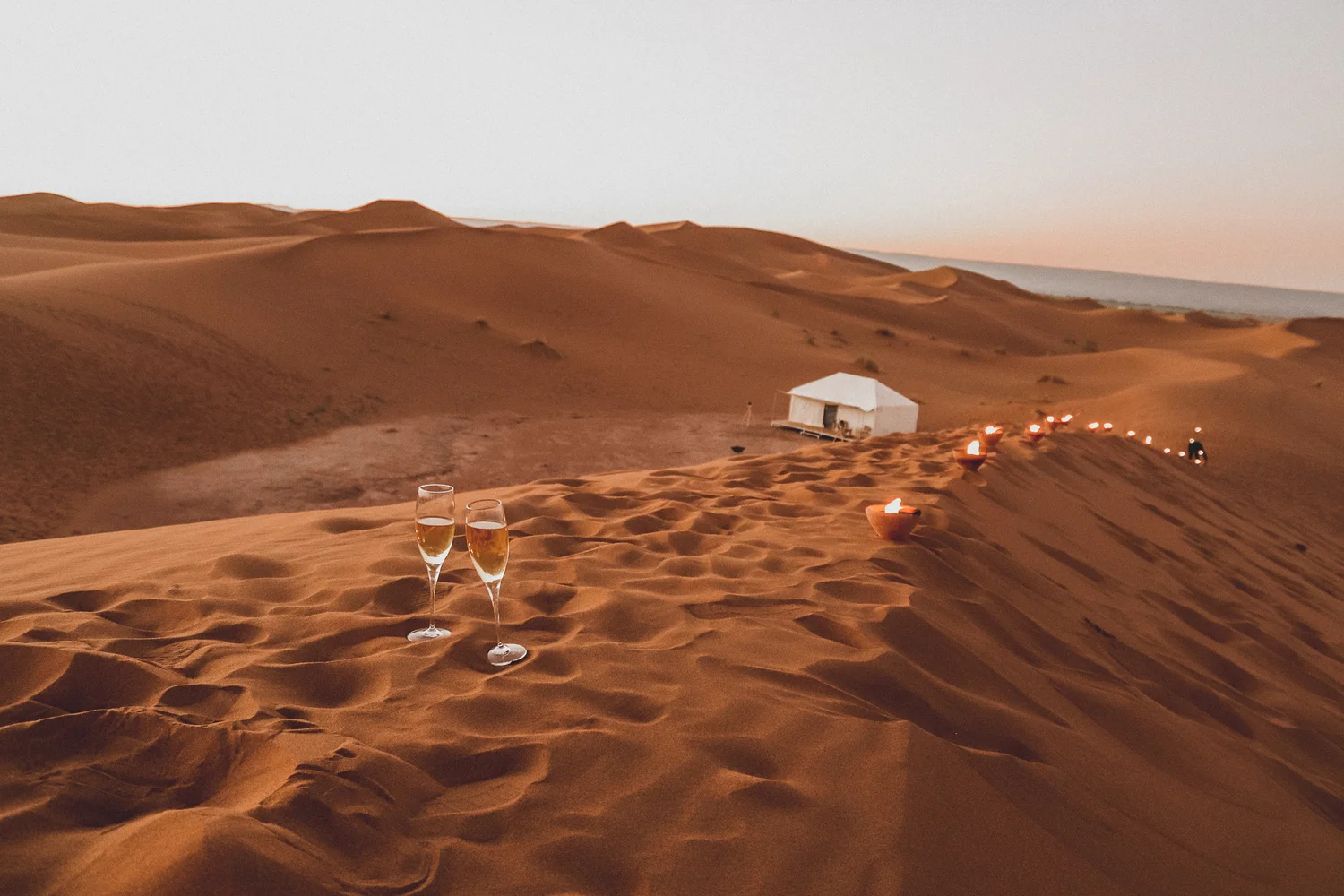
- Days 4 to 6. Three nights at the camp: sunrise walks, a camel ride at sunset, sandboarding, a day with a nomad guide, long dinners and a Bortle 1 sky.
- Day 7. Back to Marrakech, last dinner in the medina.
- Day 8. Flights home.
For how long to stay in the dunes, see how many nights in the Sahara.
Shared camp or the whole camp
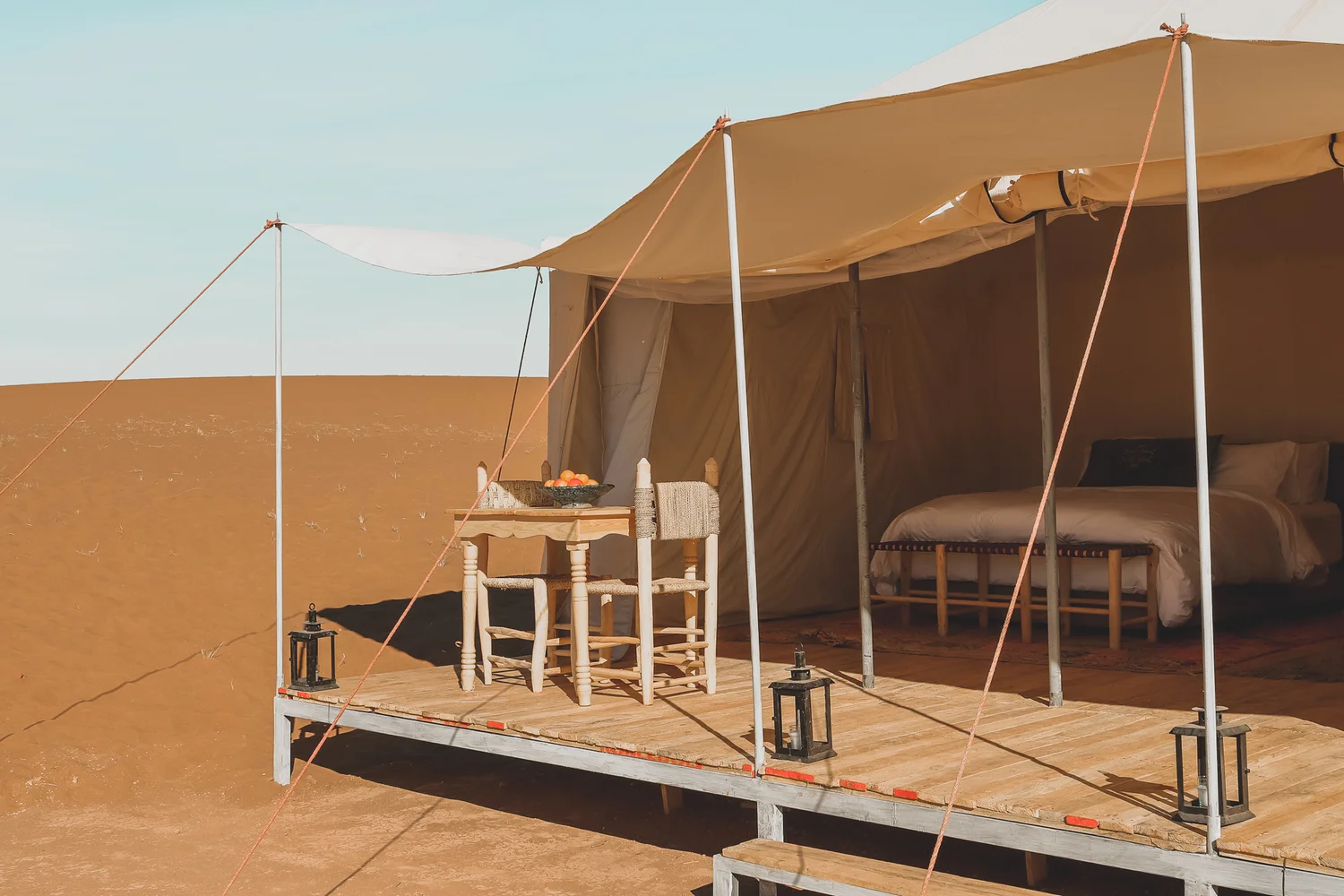
The camp has eight tent suites, each with a private bathroom and hot shower. It is shared by default: each guest books a tent and shares the camp with a few other guests. For a group that wants the place to itself, privatisation of the whole camp is possible for any request, subject to availability, and quoted on request. See private camp buyout and group trip to the Sahara.
What to tell the group before they leave
- No network at the camp. No wifi and no mobile signal. A signal can be found a short walk away, about twenty minutes there and back. Tell families and offices in advance.
- Plugs. Morocco uses European two pin sockets at 220 volts. Bring adapters.
- Layers. Days are mild from October to April and evenings in the desert are cool; a warm layer for dinner outside is enough. Our packing list covers the rest.
- Food and preferences. Tell us about allergies and diets in advance. Halal meat, an alcohol-free stay on request, the qibla direction and a space for prayer are available.
- Discretion. A non-disclosure agreement is available on request, and guests are never photographed.
- Safety questions. Many American travellers ask first; we answer them on Morocco safety for US travelers.
Dates American groups often choose
Thanksgiving week and the end of the year are natural windows for friends and families, and spring breaks for groups with older children. See Thanksgiving in the Sahara and Christmas and New Year in the Sahara. Leadership teams and forums usually prefer October, November, February and March.
Next step
Send us your preferred dates, the number of travellers and the city most of them fly from, at reservations@umnyadesertcamp.com or through the contact page. We reply with a written proposal within 24 hours, including the route we would suggest for your group.