
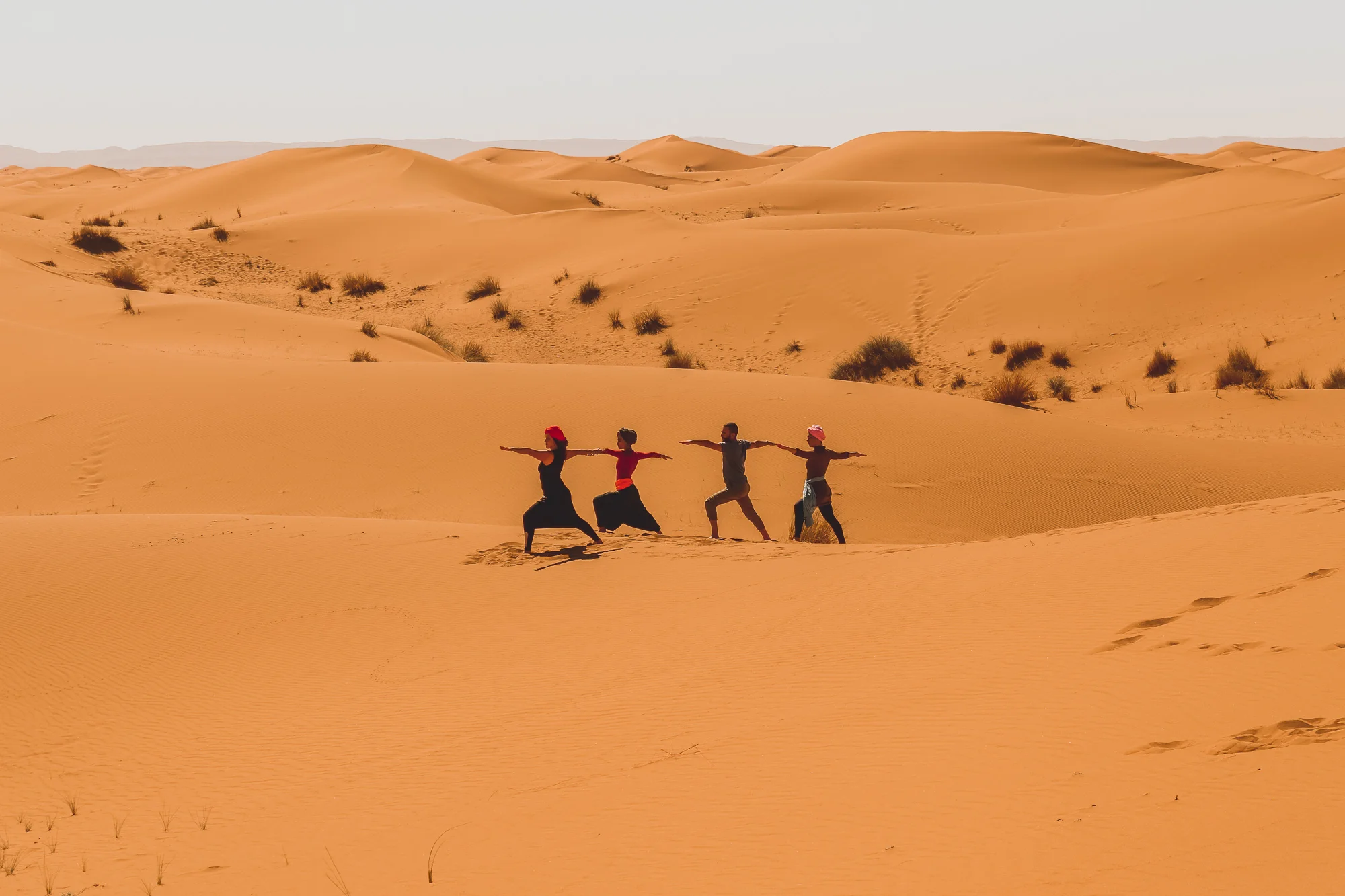
Sahara training camps for clubs, gyms and teams
A private base in the largest dune field in Morocco, with the whole camp, the vehicles and the team built around your training
Why the desert
Ground you cannot recreate at home, and nothing to do but train.
Sand changes the way an athlete moves. Running and walking on dunes make the body work harder for every step, strengthen the muscles that keep it stable and spare the joints the pounding of the road. Around the camp, the dunes of Erg Chegaga approach 300 metres, the piste is hard enough for tempo work and gravel riding, and the rocky hamada gives technical ground for the days in between.
The camp sits sixty kilometres past the last paved road. There is no town to wander into, no signal to scroll and, with the whole camp taken, no other guests. A group arrives, trains, eats, recovers and sleeps, and by the third day it moves like a team.
Last reviewed 2026-09-17.
Who comes to train
Built for groups that train together
Running and trail clubs
Sand conditioning, dune repeats and long runs on hard piste with a vehicle alongside. The specific work that desert ultras and multi-stage races demand, with a real bed at the end of every day.
Gyms and fitness communities
The trip your members talk about all year. Sessions on the dunes at first light, conditioning on the sand in the afternoon, and a whole camp that belongs to your community for the week.
Teams before the season
A squad and its staff, away from phones and routine. Conditioning in the morning, tactics in the shade, and the kind of shared effort that turns a group into a team.
Cycling and gravel groups
Hard-packed desert piste in every direction, no traffic at all, and a support vehicle carrying water, spares and nutrition on every ride.
Coaches with a following
You bring the programme and the people who trust you. We run everything on the ground, so the only thing you manage during the week is the training.
Trekking and expedition clubs
Stages on foot or with camels, using the camp as the start line, the finish line or the comfortable base between two nights out in the erg.

Your base for the week
Everything around the training is handled
The whole camp
Eight canvas suites with private bathrooms, hot showers and real beds, for up to twenty athletes and staff. With the whole camp taken there are no other guests, so early starts and late debriefs disturb nobody.
A kitchen for athletes
Our chef cooks for your group only. Breakfast is ready before the dawn session, meals follow the training load of the day, and dietary requirements sent before arrival are part of every menu.
Vehicle support
Our 4x4s follow long runs, rides and stages with water, nutrition and first aid, mark out loops and bring back anyone who needs it. Routes are planned with your coach before you arrive.
Recovery
A massage therapist and a yoga teacher can join the camp for your dates. Afternoons are quiet, and evenings end by the fire under a Bortle Class 1 sky, the darkest classification there is.
Safety in the deep desert
Every supported session has first aid on board, and a medic can stay on site on request.
Full attention
No Wi-Fi and no mobile signal at the camp. A signal can be found a short walk away, about twenty minutes there and back. Athletes make the walk once a day if they need to, and the rest of the time their attention stays on the training.
A sample week
Five nights, adapted freely by your coach
Every camp is written with its coach. This is one way the week can run.
- Day one
- Arrival by 4x4 convoy, or by helicopter from Marrakech for part of the group. Kit check, an easy shakeout on the nearest dunes at sunset, and the briefing over dinner.
- Day two
- Sand technique on the dunes at first light. Recovery or an easy spin on the piste in the afternoon, then a guided look at the sky after dinner.
- Day three
- The long session, with a vehicle alongside, water drops and a marked course. Rest, mobility and massage in the afternoon.
- Day four
- Dune repeats or a tempo session on the piste at dawn. A navigation exercise or a camel-supported trekking stage in the late afternoon.
- Day five
- The expedition day: a point-to-point stage across the erg, with the vehicles bringing everyone home. A celebration dinner by the fire.
- Day six
- An easy run or walk at sunrise, breakfast, the debrief, and the convoy back towards Marrakech.
For organisers
Your community, your programme, your price.
Training camps are usually brought by someone: a club committee, a gym owner, a coach, a team manager. The organiser designs the training, sets the selling price of a place for their own community, and keeps the relationship and the branding.
We quote the whole camp for your dates as a net rate, and we run everything on the ground: transport from Marrakech, food, vehicles, staff and safety. We never contact your members afterwards and never sell to them.
How the numbers work for an organiser and how other trades bring their community.
October to April
Best training window
Up to 20
Athletes and staff
3 to 7
Nights recommended
Questions
Before you plan the camp
Can a club, a gym or a team book the whole camp for a training camp? +
What terrain is there for training around Erg Chegaga? +
Is there vehicle support during long sessions? +
What do athletes eat during a Sahara training camp? +
How does a group of athletes reach the camp? +
Is there mobile signal or Wi-Fi at the camp? +
What medical cover is there so far from a city? +
When is the best time of year for a training camp in the Sahara? +
Is Erg Chegaga good preparation for a desert ultra such as the Marathon des Sables? +
Can a coach or a gym sell places on the camp to their own community? +
Can we photograph or film the training camp? +
How many nights should a Sahara training camp last? +
Tell us the sport, the dates and how many of you.
You will receive a written proposal for the whole camp, with a draft week, within 24 hours.
Plan your training campRelated: bringing your community, team building, group trips, arriving by helicopter, getting to Erg Chegaga.
Private buyout
Ask for your dates
The whole camp for your group, from two guests to eighteen. Tell us when and how many of you: a written proposal for the whole camp comes back within 24 hours, with no commitment.
-
2019
Open since
-
4.8★
TripAdvisor
-
8 tents
The camp to yourselves
-
24h
A written proposal, no commitment
For groups
Other ways to take the whole camp
- Private caravan and celebrations Three days or more, a chef, a butler and a night in the dunes
- Team building No signal, one table, real effort and nothing to escape to
- Bring your community Studios, gyms, clubs and companies selling places to their own people
- Group trips Up to twenty travelling together, with the whole camp to yourselves
- A family buyout Three generations, the whole camp, the sleeping map sent before you book
- Executive offsites A leadership team, two or three nights, no signal and one long table
- Board offsites Confidentiality, close protection and arrival by helicopter
