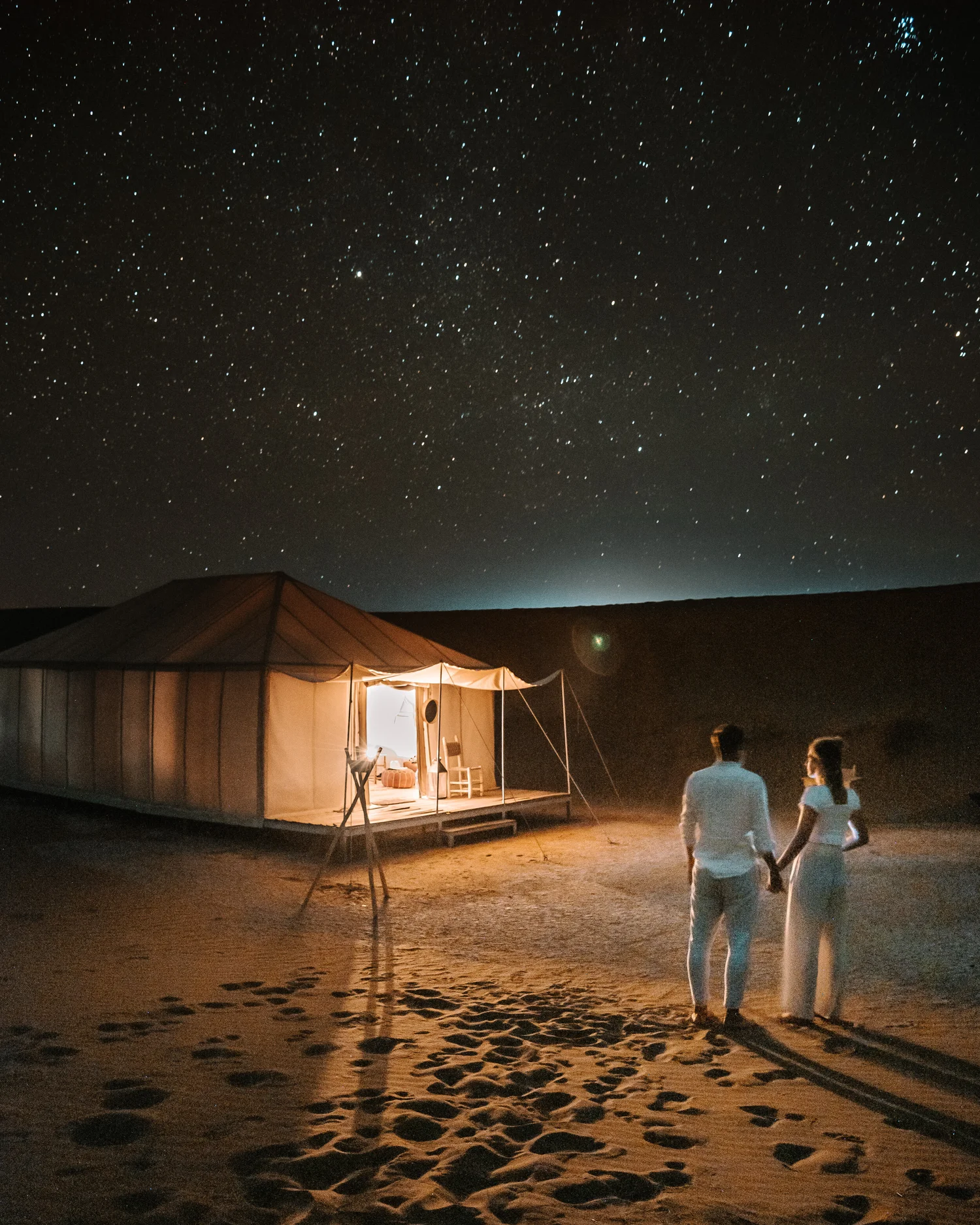
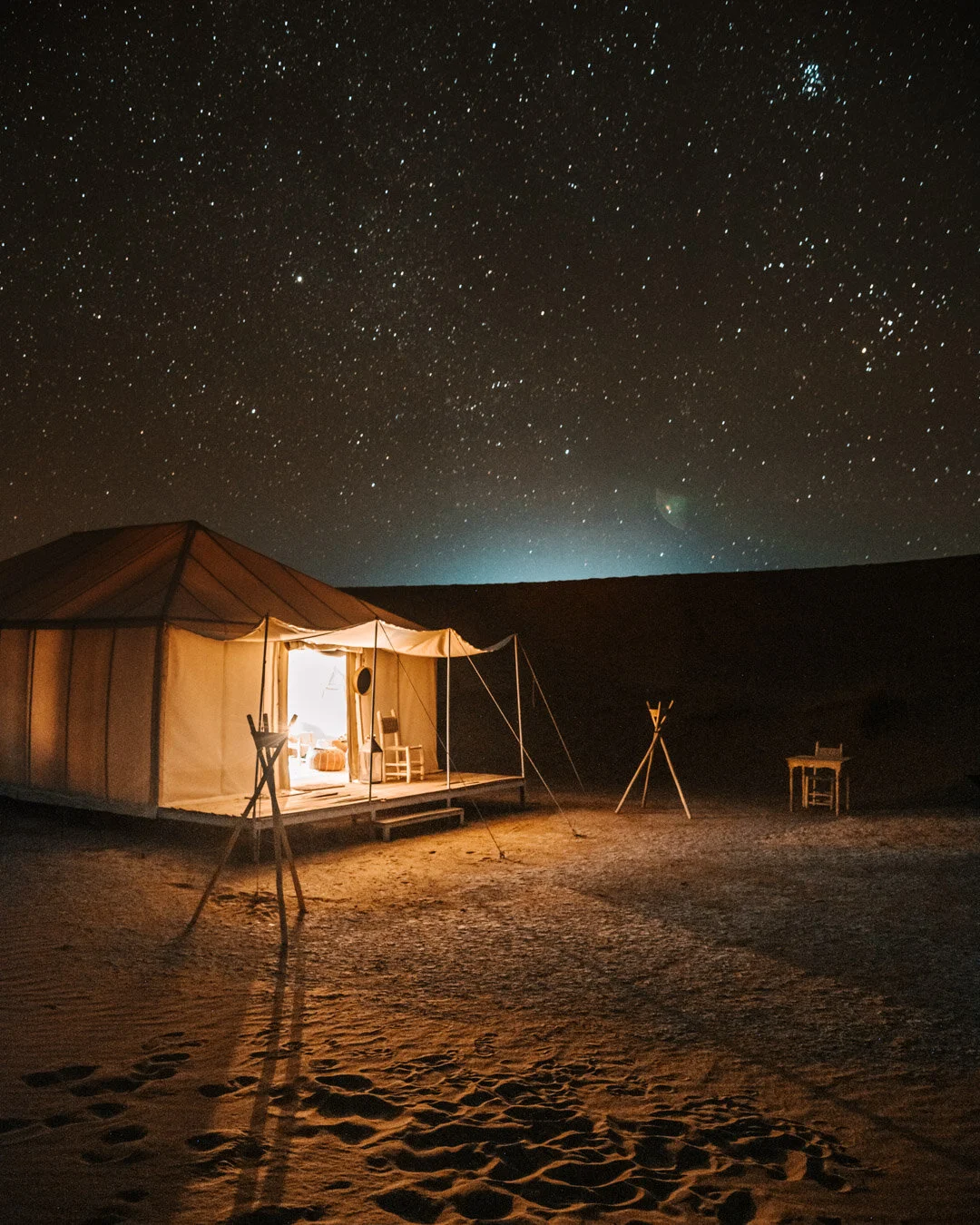
The Geminids are the best meteor shower of the year. Not the most famous, which is the Perseids in August, but the most reliable and, in a good year, the most generous. Under a dark sky, the peak rate can reach 120 meteors an hour.
On the night of 13 December 2026, the Moon will set in the early evening. By the time the sky is fully dark, there will be nothing to dim the Geminids over the Erg Chegaga, one of the darkest skies on Earth.
What the Geminids are
Every year in December, the Earth passes through a stream of debris left behind by the asteroid 3200 Phaethon. As those particles hit the atmosphere at around 35 kilometres per second, they burn up and leave the bright trails we call shooting stars.
Most meteor showers come from comets. The Geminids are unusual: their parent body is an asteroid, which is why their particles are denser and produce brighter, slower meteors than most showers. They appear to radiate from the constellation Gemini, which is how they got their name.
The shower runs from about December 4 to 20, with a sharp peak around December 13 to 14.
Why 2026 is a good year
The Geminids are consistent, but whether you see them well depends on the Moon. A full or gibbous Moon can cut the number of visible meteors by half, washing out the fainter ones with its light.
In December 2026, the Moon is a thin waxing crescent at the time of the peak. It is about 15 percent lit and sets before 20 h 00 local time. By the time the sky is properly dark, the Moon is below the horizon and the Geminids have the whole sky to themselves.
This combination happens less often than you might think. The last time the Geminids had a Moon this cooperative was 2023.
What a Geminid looks like
Geminids are slower than the summer Perseids, which makes them easier to track across the sky. Many are bright enough to leave a brief trail. Some are coloured: white, yellow, occasionally red or green, because of the different minerals in the asteroid’s debris.
Around the peak, one or two meteors cross the sky every minute on average. Some minutes nothing moves. Then three cross in quick succession. This is not a continuous performance: it is an ongoing probability, which is part of what makes it compelling.
What the Sahara adds
At Erg Chegaga, the nearest town is M’Hamid El Ghizlane, 60 kilometres of desert piste away. There is no artificial light on the horizon in any direction. The sky is rated Bortle 1, the darkest class on the international dark sky scale.
Under a Bortle 1 sky the Milky Way is not just visible: it is structural, a dense band that casts a faint shadow on the sand on a good night. The zodiacal light appears. Stars you have never seen before fill the gaps between the familiar constellations.
A meteor shower over such a sky is a different sight from the same shower over a suburban garden. Not more meteors, but each one against a background that makes it mean something.
How to watch
The Geminids radiate from Gemini, which rises in the east in the early evening and climbs to its highest point around midnight. The shower is worth watching from about 21 h 00 onwards, and the peak rate tends to come between midnight and 2 h 00.
Lie back rather than sit. The sky is a dome, not a wall, and you want to see as much of it as possible. Keep your eyes adapted to the dark: no phone screens, no torches with white light. If you need a torch, use a red-light model or cover it with a red cloth.
No binoculars, no telescope for the shower itself. The field of view of a telescope is far too narrow for a moving meteor. Use the telescopes before or after the shower for the planets and the deep-sky objects.
Cold, and worth it
December nights in the Sahara are cold. At Erg Chegaga, temperatures drop to 2 or 3 degrees Celsius before dawn. The same conditions that bring the cold, a dry, still, stable atmosphere, produce the clearest, most transparent sky of the year.
Bring a warm base layer, a fleece, a down jacket, a hat and gloves. The tent is heated in the evening and has thick blankets. The Stargazing Night is under the open sky: dress for winter, not for a desert.
The cold keeps people honest about the sky. After an hour in a sleeping bag on the sand, watching Geminids cross the band of the Milky Way, the cold stops being something you are managing and becomes part of the experience.
The 2026 programme at Erg Chegaga
We run a three-night stay from Friday 11 to Monday 14 December, with the Stargazing Night on the peak night of December 13. A professional astronomer from Marrakech brings two Celestron 8-inch telescopes and spends the night with the guests: the shower itself, then the planets, the clusters, and the nebulae in the winter sky.
The rest of the programme is the same as any stay: the welcome ceremony with the nomads, Berber bread baked in the sand, the sunset camel ride, dinners by the fire, and a slow breakfast with the dunes in the morning light.
See the December Geminids programme and request dates