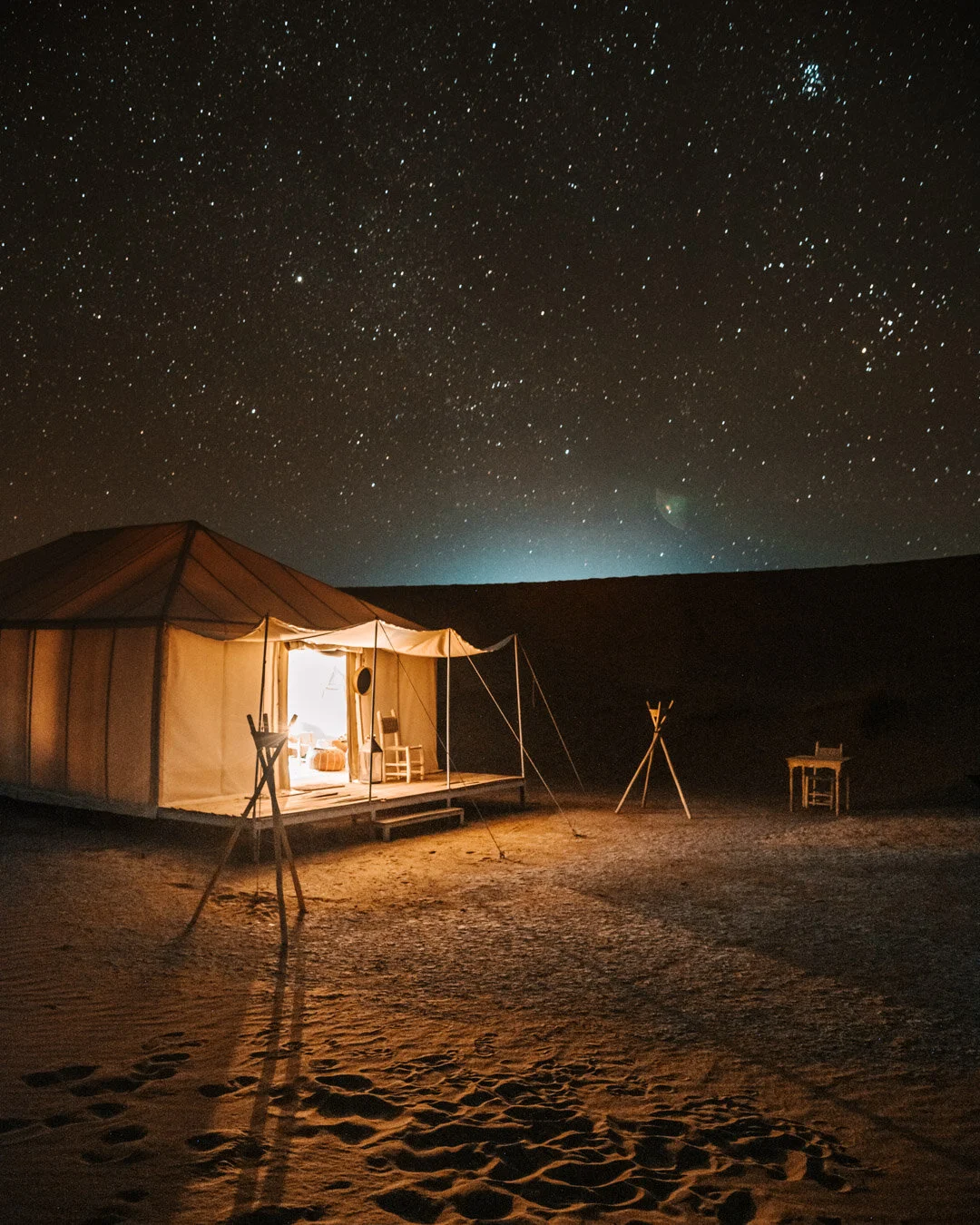
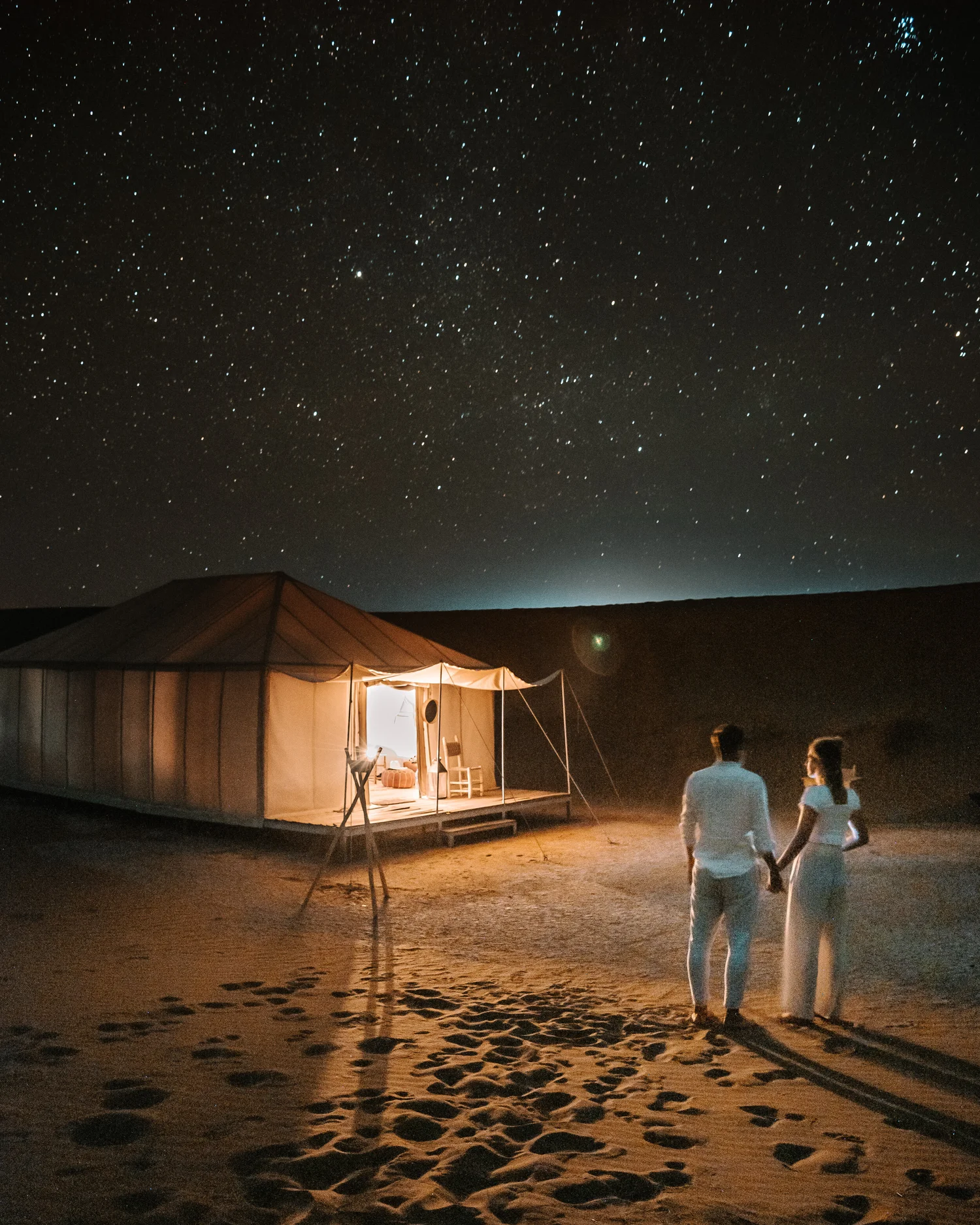
A proposal under shooting stars sounds like a matter of luck. In the Sahara it is mostly a matter of the calendar, and of the Moon. Choose the right night and a dark sky does much of the work for you.
Erg Chegaga holds the darkest sky classification there is, Bortle Class 1. There is no town, no road and no artificial light for tens of kilometres. On any clear night a few meteors cross the sky each hour, and around the main showers there are many more. Here are the dates of the 2026 to 2027 season, with the state of the Moon for each, because the Moon decides more than the shower does.
Why the Moon matters more than the shower
A meteor shower is announced by its peak rate, a number that assumes a perfectly dark sky. A bright Moon removes most of the fainter meteors, and with them the sense of a sky full of movement. A thin crescent, or no Moon at all, gives you the sky the number was calculated for.
So the useful question is not “which shower is strongest” but “which strong shower falls on a dark night”. For the coming season, three of them do.
The calendar, September 2026 to June 2027
The camp is open from September to June. In that window, these are the showers worth planning around.
Northern Taurids, around 11 to 12 November 2026. Few meteors, but often bright fireballs. The Moon is a thin crescent, about 4 percent lit, so the sky is dark all night. A quiet date, for those who prefer a subtle sky.
Leonids, around 17 to 18 November 2026. About 10 to 15 meteors an hour under a dark sky in an ordinary year. The Moon is at first quarter on 17 November, half lit, and sets around midnight. After that, the sky is dark.
Geminids, 13 to 14 December 2026. Usually the strongest shower of the year, with up to about 120 meteors an hour under a dark sky. The Moon is a thin crescent, about 15 percent lit, and sets in the early evening. It is the best Moon of the season, and the Geminids begin early in the evening, which makes them the most practical shower for a proposal followed by dinner.
Quadrantids, 3 to 4 January 2027. Around 25 an hour on average, and in a good year a short peak above 100, in the last hours of the night. The Moon is a thin waning crescent, about 18 percent lit, rising late. The New Moon falls on 7 January. The nights are cold, and the sky rewards it.
Lyrids, around 21 to 23 April 2027. About 10 to 15 an hour under a dark sky. The Full Moon falls on 20 April and its light hides the fainter meteors. We would not choose this date for the shower. A moonlit dune is, however, a spectacle of its own, silver instead of black.
Eta Aquariids, 5 to 6 May 2027. About 10 to 30 an hour, in the hours before dawn. The New Moon falls on 6 May, so this is the darkest sky of the spring. Late for a proposal after dinner, perfect for one at the very end of the night.
Dates and Moon phases come from the American Meteor Society calendar and the EarthSky guide to the 2026 to 2027 showers, both consulted on 2 November 2026. A peak can shift by a day. The Perseids, the best-known shower of the year, peak in August, when the camp is closed.
Our two choices
If the date is yours to choose, we would point to the Geminids in mid-December and the Eta Aquariids in early May. Both come with a thin or absent Moon. The first is a colder, longer night with the richest shower. The second is a mild night and a quiet sky, for a proposal at the end of the evening.
The Quadrantids in early January and the Leonids in mid-November are good second choices, and the Moon is on their side too.
What the sky does between the showers
A shower is a bonus, not a condition. Between showers, a Bortle Class 1 sky still shows the Milky Way as a structured arch, planets as steady lights, and an occasional sporadic meteor. If your dates are fixed and fall on a bright Moon, say so when you write to us. We will tell you which hours are darkest and whether a nearby night is better.
Practical advice for the evening
Let the eyes adapt. Dark adaptation takes about 20 minutes, and a single bright light resets it. Plan the moment so that the two of you have been out of the light for at least that long.
Leave the phone behind. The screen ruins your night vision, and the camp has no mobile network in any case. If you want photographs, a photographer can be arranged on request and briefed to keep a distance.
Dress for the night, not the day. In December and January the days stay around 18 to 24 degrees and the nights fall to between 2 and 8. Bring warm layers, a hat and closed shoes. We provide rugs and blankets and light the fire.
Lie back, look wide. Meteors appear anywhere in the sky. Look at the middle of it rather than at one spot, and let your eyes rest on the whole.
Keep the evening slack. Nothing about a meteor shower can be scheduled to the minute. Leave room around the moment, with the fire lit and the table waiting.
A proposal built around the sky
A typical evening runs in four stages: arrival, tea and the fire, the setup on the dune at sunset, then the moment under the stars. An astronomer and the camp telescopes can join on request, and a photographer too, placed in advance. Dinner follows on the sand.
Everything is arranged in confidence, with you alone as our point of contact. The full outline is on the proposal page, where you can ask for your dates. For the broader picture, the complete guide to proposing in the Sahara covers locations, timing and keeping the surprise, and the guide to stargazing in the Sahara explains what a Bortle Class 1 sky looks like.
If you are still choosing between destinations, where to propose in Morocco compares the Sahara with the nearer options.