
Buggy Raid: Zagora to Erg Chegaga
The day the palm grove runs out
Between Zagora and M’Hamid the Drâa makes its last stand. It is the longest palm grove in Morocco and this is its final ninety-eight kilometres: the villages get further apart, the green narrows to a ribbon, and somewhere past Tagounite it simply stops. After that there is only sand.
Watching that happen through a windscreen is one thing. Riding it is another. This is the day people describe afterwards as the moment the trip changed.
The ride, in two halves
Morning, ninety-eight kilometres to M’Hamid. You are met at Zagora, fitted and briefed, and given a practice loop before anything begins. The route runs the pistes and tracks alongside the palm grove rather than the tarmac, through Tamegroute and its potters, past ksour built of mud that are still lived in, and out through Tagounite where the last real village sits.
Lunch is laid out on rugs under the palms. There is shade, cold water, proper plates and time. This is the point of the day, not an interruption to it.
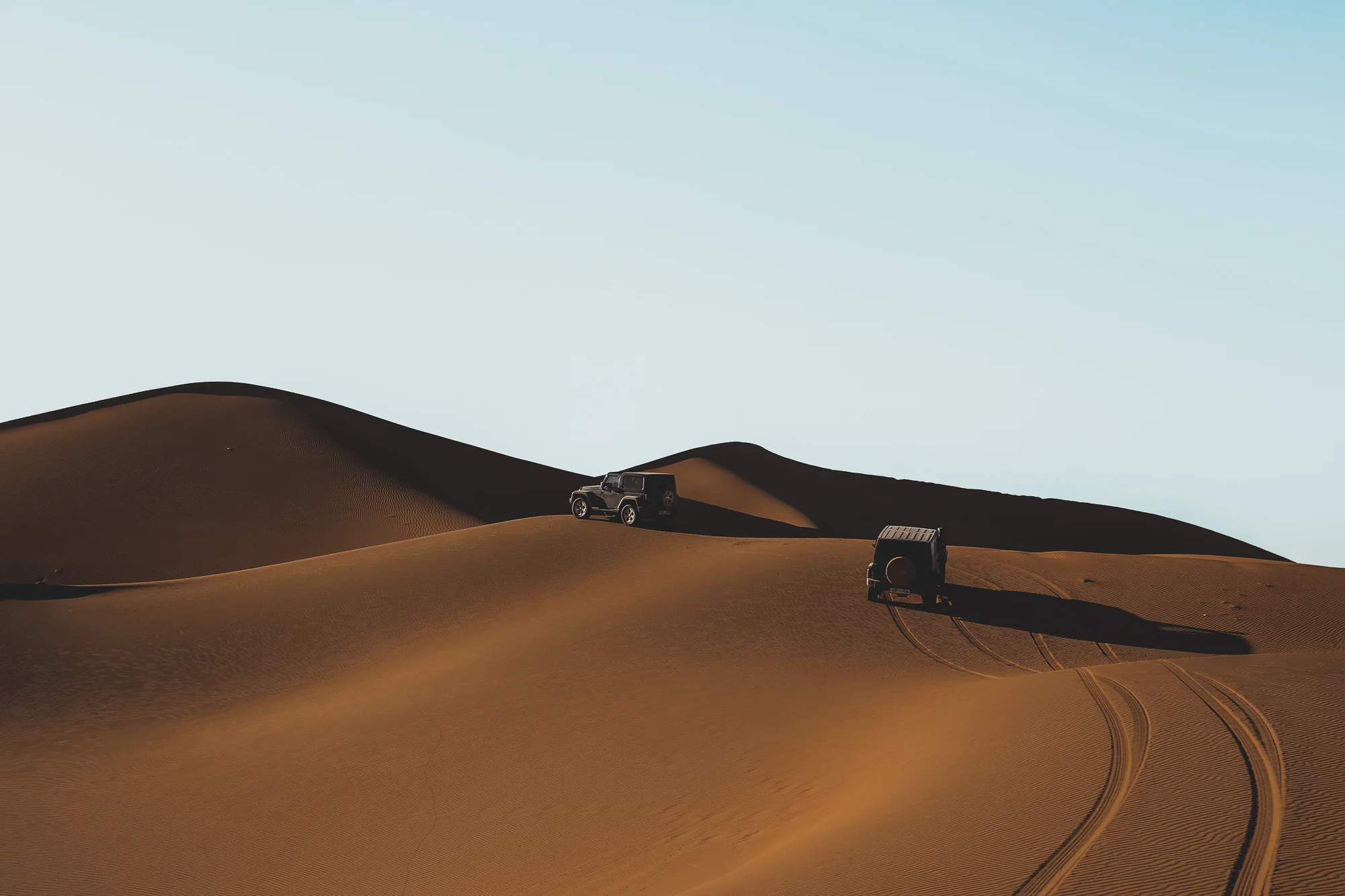
Afternoon, sixty kilometres into the erg. Past M’Hamid the tarmac ends for good. Flat hamada first, then the Lehoudi dunes, then Erg Chegaga proper, with the guide picking the line through the soft ground. You reach the camp in the late afternoon.
Throughout, a guide leads and a mechanic closes. A 4x4 carries water, spares, tools, a medical kit and your luggage, which reaches your tent before you do. Six buggies maximum, so nobody spends the day riding in someone else’s dust.
The buggies are two-seat side-by-side machines with roll cages and harnesses. No previous experience is required, only a driving licence.
Three nights in the erg
Three nights at the camp follow. Eight tents, each with its own bathroom, and only a few other guests at most. If your group would rather have the camp to itself, it can take the whole camp, and then it is yours alone.
After dark. A telescope and an astronomer, working from whatever you want to look at rather than a script. Erg Chegaga holds a Bortle Class 1 sky, the darkest rating there is. Then a fire, and usually Berber musicians beside it.
In daylight. Bread buried in the sand and dug out again at the right moment. Sandboarding down the steep faces. A walk with nomad guides who read dune shape and wind instead of a screen. A camel ride timed to put you on a crest as the light goes.
Do all of it or none of it. The second day is often the one people spend doing nothing, and that is a legitimate use of a desert.
Why it is quoted rather than priced
The number of buggies, riders per machine, the season, and whether the return is ridden or driven all change the figure. We put the whole thing in writing, in one document, before anything is paid.
Tell us your dates and how many of you there are.
Other retreats at the camp
- Astrophotography Retreat
- Buggy Raid: M'Hamid to Erg Chegaga
- Custom & Bespoke Trips
- Desert Bike Tour
- Enduro Motorbike Retreat
- Holistic Wellness Retreat
- Iriki-Foum Zguid 4x4 Raid
- Literature & Poetry Retreat
- Nomad Trekking Retreat
- The Long Raid: Ouarzazate to Erg Chegaga
- The Phone-Free Week, Sahara
- The Silence Retreat
- Women's Empowerment Retreat
- Women's Sahara Expedition
- Yoga, Fitness & Pilates Retreat
Frequently asked questions
How many nights does the Buggy Raid: Zagora to Erg Chegaga last?
How many people join the Buggy Raid: Zagora to Erg Chegaga?
When does it run?
What is included?
What level does it ask for?
How is it quoted?
Is there phone signal?
Private buyout
Ask for your dates
The whole camp for your group, from two guests to eighteen. Tell us when and how many of you: a written proposal for the whole camp comes back within 24 hours, with no commitment.
-
2019
Open since
-
4.8★
TripAdvisor
-
8 tents
The camp to yourselves
-
24h
A written proposal, no commitment
