
Women's Adventure Retreat Morocco
The difference between looking at a desert and crossing one
Almost every desert itinerary in Morocco is built around arriving. You drive in, you climb a dune at sunset, you photograph it, you sleep, you drive out. The desert is scenery, and scenery is something you stand in front of.
Five nights on foot is a different proposition. On the second morning the camp is behind you and there is nothing ahead but dune, and the only way to the next water is your own legs. That changes the relationship. The desert stops being a view and becomes a thing you are inside, negotiating with, reading.
This is the version of the Sahara that almost nobody sells, because it takes five days and a camel caravan and a team willing to sleep out with you.
The shape of the five nights
Night one, at the camp. You arrive at Umnya from M’Hamid El Ghizlane, sixty kilometres of piste beyond the last paved road. Your own tent, your own bathroom, and a camp of only eight tents. You eat well, you sleep long, and a telescope comes out after dinner. Nobody walks anywhere yet.
Days two, three and four, walking. Roughly fifteen to eighteen kilometres a day across Erg Chegaga, starting at first light while the sand is still cold and stopping through the worst of the afternoon. The camel caravan carries the water, the bedding, the kitchen and your bags. You carry a daypack. The route runs east to west through the high dunes, past the Iriki salt flat and two oases that do not appear on any map sold in Marrakech.
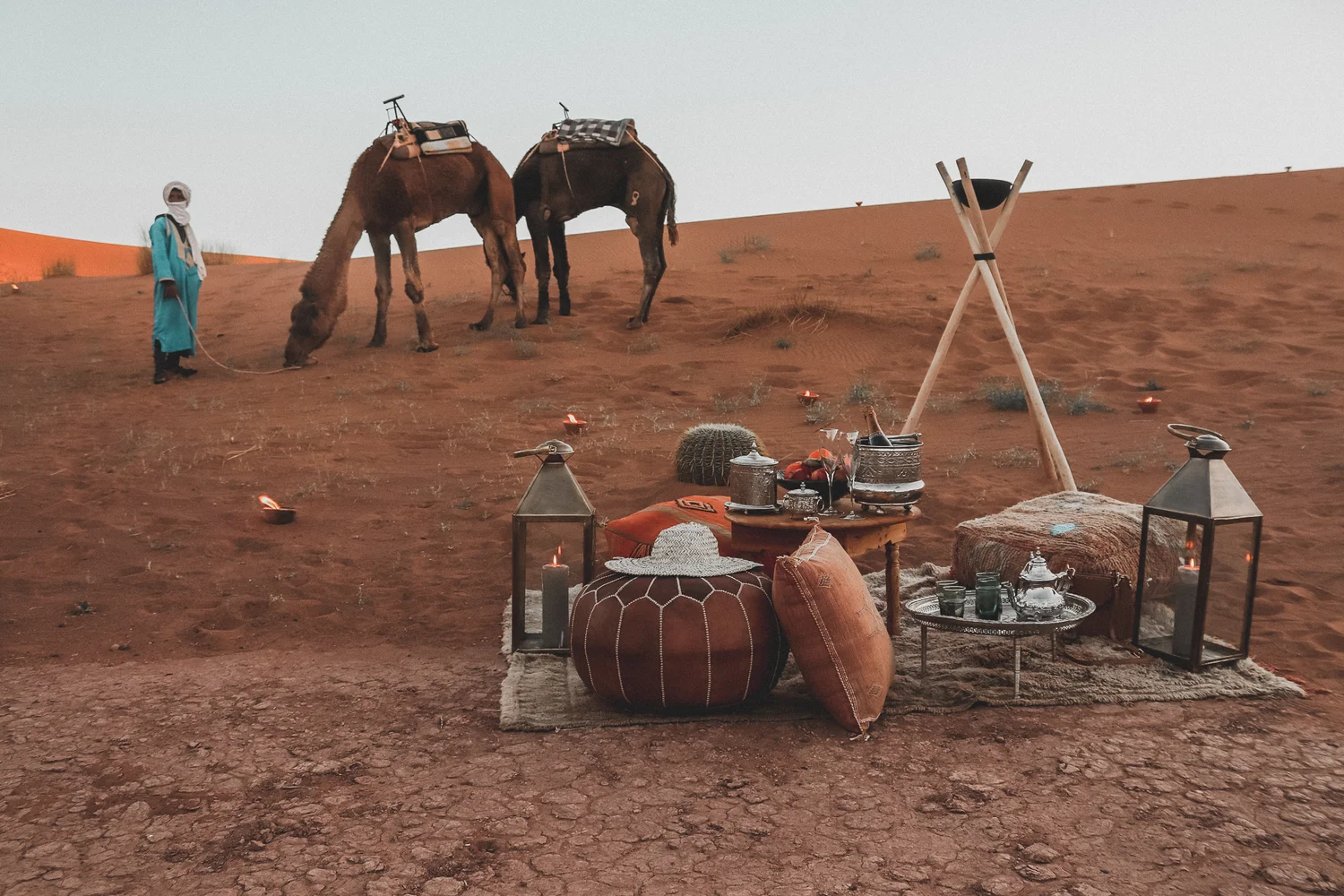
The three bivouac nights. No structures. Bedding laid in the lee of a dune, a fire, dinner cooked where you stopped. This is the part that people come back for.
Night five, back at the camp. Hot water, your own bathroom again, and a dinner that is properly a celebration.
The bivouac, honestly
The question every woman asks first, and the one most operators answer vaguely, is what happens about washing and privacy for three nights in open dunes.
The straight answer. At the camp, on the first and last nights, each tent has its own bathroom with a hot shower. During the three bivouac nights there is no shower. There is warm water each morning and evening for washing, in private, behind a screened enclosure we carry and set up at every stop. There is a second screened enclosure used as a lavatory, moved and buried each day. It is dignified and it is properly private, and it is not a bathroom.
We say this plainly because the women who do this trip are exactly the women who would rather know. Three days without a shower, in dry desert air, is far less unpleasant than it sounds. But it is three days without a shower, and anyone for whom that is the wrong holiday should take the shorter stay at the camp instead, which is a genuinely lovely trip and not a lesser one.
Who walks with you
Two Berber guides from M’Hamid families, who navigate by dune shape and wind direction rather than by GPS, and who have done this crossing since they were teenagers. A cook, who walks the whole way and produces meals out of a fire and a caravan that are better than they have any right to be. Cameleers with the animals.
And a woman from our camp team, who walks the entire route with the group. Not as a guide and not as a chaperone. She is there so that at any hour of any night there is a woman in the group who works for us, speaks the languages, knows the ground, and can be woken.
Our team’s conduct with women travelling together is something we would rather you check yourself than take from our description: read the reviews on TripAdvisor.
What the body does
Day two is the hard one. Soft sand takes about thirty percent more effort than firm ground, and legs that are used to pavement notice this by mid-morning. Nobody enjoys the last hour of day two.
Day three, something adjusts. The gait changes, the pace settles, and the walking stops costing attention. By day four the body has adapted. This is a very ordinary physiological adaptation.
You do not need to be an athlete. You need to be able to walk for five to six hours across uneven ground, with breaks, on consecutive days. Groups have included women in their sixties and women who had never carried a daypack before.
The sky from a bivouac
Erg Chegaga holds a Bortle Class 1 rating, the darkest classification there is. From a bivouac, with no camp lanterns anywhere, no tent canvas and no structure between you and it, it is something else again.
You sleep with your face to it. The Milky Way is not a smear but a banded, structured, faintly coloured object with visible depth. Several women each trip decide, at some point on the second or third night, to move their bedding away from the fire and sleep apart from the group. We plan for that.
Who this is for
Women who want the desert to ask something of them. Groups of friends who have done the beach version of this trip and want the real one. Colleagues or a cohort who would rather arrive somewhere together than sit in another room together. Solo women, who make up a good share of every departure and who tend to know within a day that they made the right call.
It is not for anyone hoping to be looked after in comfort for five days. That trip exists here too, and we run it very well, at the camp, with hot water every night.
How to come
The expedition runs September to June, for groups of four to twelve. The first and last nights are spent at the camp, in its eight tent suites. Tell us your dates and how many of you there are, and we will send the full route, the kit list and the terms in writing before anything is paid.
Other retreats at the camp
- Astrophotography Retreat
- Buggy Raid: M'Hamid to Erg Chegaga
- Buggy Raid: Zagora to M'Hamid
- Custom & Bespoke Trips
- Desert Bike Tour
- Enduro Motorbike Retreat
- Holistic Wellness Retreat
- Iriki-Foum Zguid 4x4 Raid
- Literature & Poetry Retreat
- Nomad Trekking Retreat
- The Long Raid: Ouarzazate to Erg Chegaga
- The Phone-Free Week, Sahara
- The Silence Retreat
- Women's Empowerment Retreat
- Yoga, Fitness & Pilates Retreat
Frequently asked questions
How many nights does the Women's Adventure Retreat Morocco last?
How many people join the Women's Adventure Retreat Morocco?
When does it run?
What is included?
What level does it ask for?
How is it quoted?
Is there phone signal?
Private buyout
Ask for your dates
The whole camp for your group, from two guests to eighteen. Tell us when and how many of you: a written proposal for the whole camp comes back within 24 hours, with no commitment.
-
2019
Open since
-
4.8★
TripAdvisor
-
8 tents
The camp to yourselves
-
24h
A written proposal, no commitment
