The Dakar Is Coming to the Moroccan Sahara
On 30 October 2026, the organiser of the Dakar announced where the 49th edition will take place. After the decision to leave Saudi Arabia for 2027, the rally will start in Portugal and race across Morocco, from 9 to 23 January 2027. Saudi Arabia is due to host the 50th edition in 2028.
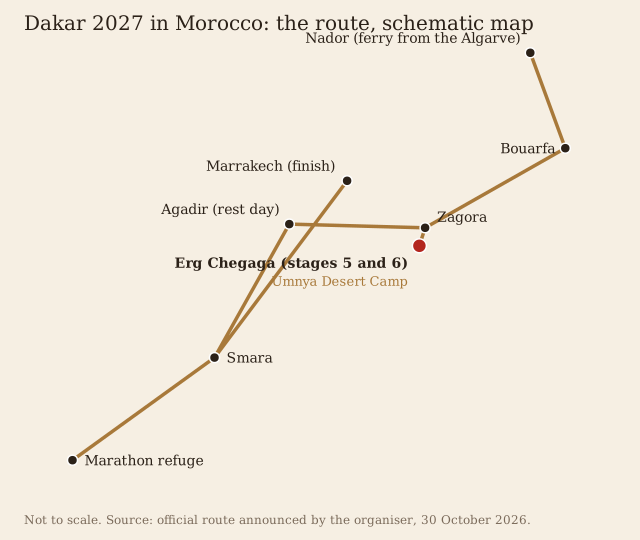
The route turns south along the Atlas Mountains, passes through Zagora, then Agadir, before heading to the far south of the country near Dakhla and returning north along the Atlantic to Marrakech, where the rally finishes. It is a Dakar that “discovers Morocco from one end to the other”, in the words of the race director.
For us, one detail changes everything: two of the twelve stages are run in the Erg Chegaga, the dune massif where Umnya Desert Camp stands.
The Route, Stage by Stage
Dates and distances are those published by the organiser. “Special” is the distance raced against the clock.
| Date | Stage | From and to | Special |
|---|---|---|---|
| Sat 9 Jan | Prologue | Loulé (Algarve, Portugal) | 29 km |
| Sun 10 Jan | Stage 1 | Loulé, then overnight ferry to Nador | 100 km |
| Mon 11 Jan | Transfer | Nador to Bouarfa | none |
| Tue 12 Jan | Stage 2 | Bouarfa loop | 390 km |
| Wed 13 Jan | Stage 3 | Bouarfa loop | 410 km |
| Thu 14 Jan | Stage 4 | Bouarfa to Zagora | 490 km |
| Fri 15 Jan | Stage 5 | Zagora loop, through the Erg Chegaga | 365 km |
| Sat 16 Jan | Stage 6 | Zagora to Agadir, with more dunes | 365 km |
| Sun 17 Jan | Rest day | Agadir | none |
| Mon 18 Jan | Stage 7 | Agadir to Smara | 500 km |
| Tue 19 Jan | Stage 8 | Smara to the marathon refuge | 355 km |
| Wed 20 Jan | Stage 9 | Marathon refuge to Smara | 390 km |
| Thu 21 Jan | Stage 10 | Smara loop | 470 km |
| Fri 22 Jan | Stage 11 | Smara to Marrakech | 455 km |
| Sat 23 Jan | Stage 12 | Marrakech loop | 22 km |
In total, the rally covers 4,341 km of special stages. The dates are those announced by the organiser and remain subject to the usual approvals.
Stages 5 and 6: The Erg Chegaga
On stage 5, the organiser describes Zagora as a crossroads for trading caravans in times gone by, “52 days’ walk from Timbuktu”, and the gateway to Morocco’s largest dune massif. The Erg Chegaga, also the wildest, lies at the heart of the special stage, with around fifty kilometres of dune crossings, divided into two sections with a rocky interlude. It is a pure desert special: tyres will not touch tarmac even once.
Stage 6 repeats the distance, 365 km, and adds another fifty kilometres of dunes on the way to Agadir. A grain of Chegaga sand, as the organiser puts it, may still be under the competitors’ eyelids when they reach the first rest day.
These dunes rise to around 300 metres. They are the same ones you see from the tents at Umnya, at dawn and at dusk.
From Paris-Dakar to Morocco, Again
The rally was born in 1978 as the Paris-Dakar, a race through the Sahara from Europe to the Senegalese coast. It crossed Africa until the 2008 edition was cancelled the day before the start. The Dakar then moved to South America in 2009, and to Saudi Arabia in 2020.
In 2027, following recent developments in the region, it comes back to the continent that gave it its name, and to a country that has always stood out, in the organiser’s words, for the quality of its deserts. For anyone who grew up with the legend, it is a rare chance to see it in the sand where it belongs.
We Are Preparing a Stay for These Dates
We are preparing a stay around the passage of the Dakar, for those who want to follow it in real desert conditions: nights in the dunes of the Erg Chegaga, the desert as the racers know it, and local guides who read this terrain.
Access to the course is set by the organiser and the Moroccan authorities, for everyone’s safety, so we will tell you precisely what is possible and where, as soon as the spectator guidance is published. What we can already say is that the camp is open in January, that it has eight tent suites, and that a stay can be planned for a group of friends, a team or a family, between the 14th and the 17th of January.
Getting here: from Marrakech, the camp is about 1 h 40 by helicopter, which lands at the camp, or about 8 h 45 by 4x4. From Zagora, count about three hours, including an hour and a half of desert track.
If you would like to be among the first to know, write to us with your dates and the number of people. We will come back to you with what we are building.