Nomad Trekking Retreat Erg Chegaga
Walk the erg as no road can take you
There are places in the Erg Chegaga that no 4x4 reaches. Not because the terrain is impassable, but because there is no reason to go there: no camp, no track, no destination. The only way in is on foot, at the pace the nomads have used for centuries.
This is what the Nomad Trekking Retreat is.
The route
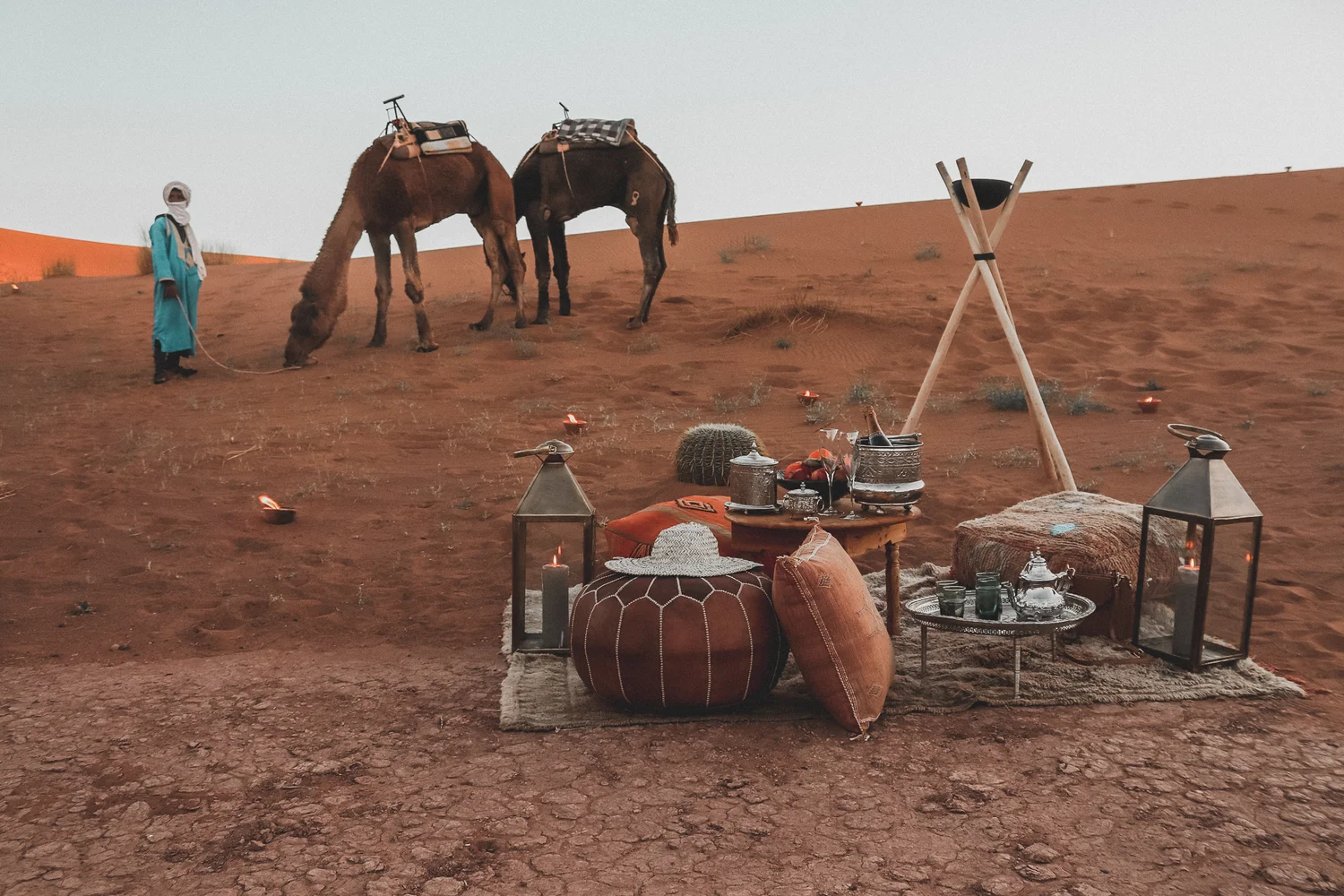
Erg Chegaga extends roughly 40 kilometres east to west and 15 kilometres north to south. The highest dunes rise to nearly 300 metres. Crossing it on foot takes four to five days of walking, seven to eight hours per day including breaks. You carry nothing but a daypack. A camel caravan carries everything else: bivouac equipment, food, water, sleeping bags.
Every evening, while you complete the final kilometres of the day, the cook and the camel driver set up camp in a hollow between dunes. When you arrive, there is a fire, tea, and dinner already underway.
Core itinerary (5 days):
Day 1 Arrive at Umnya base camp. Briefing with your guide. Dinner. Stargazing with the telescope. Kit check and preparation.
Day 2 First trekking day. Enter the dunes from the western edge, walking east through the dune corridors. Lunch in a sheltered hollow. First bivouac under open sky.
Day 3 The deepest day. The erg reveals its full scale: no visible landmark for hours. Your guide navigates by sun position, wind direction and dune morphology. Second bivouac.
Day 4 Iriki detour (seasonal). The ancient salt lake, flat white and vast to the horizon, one of the strangest surfaces on Earth. Return to dunes for third bivouac.
Day 5 Final morning trek back to Umnya. Hot shower, real bed, lunch at base camp. Afternoon rest. Dinner and a final stargazing session. Transfer to M’Hamid the following morning.
Extended 7-day routes are available for groups who want to reach the most remote sections of the erg.
The guides
Our guides are Berber, from M’Hamid families who have lived alongside this erg for generations. They do not navigate by GPS. They read the dune morphology, the wind patterns, the angle of the sun. Walk with one for a day and you will understand what it means to truly know a landscape rather than simply move through it.
Their knowledge is practical: which dune faces hold firm in the morning cold, where the fennec tracks appear after dawn, which dry bush marks water ten metres below the surface. What appears empty to visitors is, to them, a landscape dense with information.
The gastronomy
No other trekking operator in the Sahara brings a cook into the field.
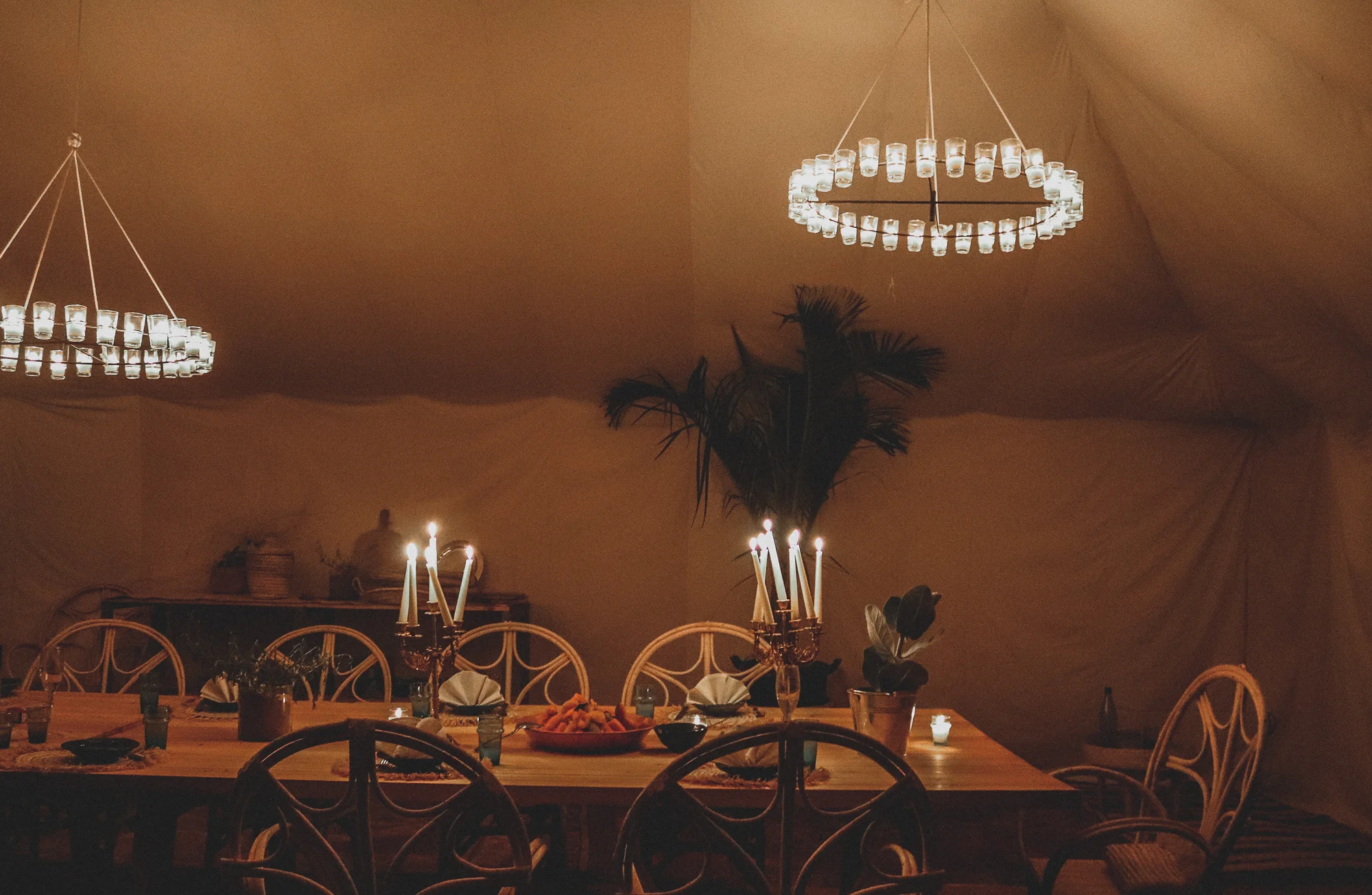
Every morning: flatbreads baked in the coals, honey, argan oil, mint tea. Lunch on the route: harira or a cold salad with preserved lemon and olives. Dinner: a proper two-course meal served on rugs in the dunes, by candlelight. Mechoui lamb cooked in a sand oven. Kefta with tomatoes and herbs. A meal that, in a restaurant, you would consider excellent. Here, with no address, no walls, and the Milky Way above you, it becomes something else entirely.
The night sky
The Erg Chegaga sits in one of the few remaining Bortle Class 1 zones on Earth: no light pollution within 200 kilometres. On a moonless night, the Milky Way is bright enough to cast a faint shadow on white sand. In bivouac, there is nothing between you and this sky. No tent wall, no camp light. Just the sleeping bag and stars that have been here longer than any road you have ever walked.
Who this is for
The Nomad Trekking Retreat requires physical readiness: 6 to 8 hours of walking per day on soft sand for 3 to 4 consecutive days. It requires comfort with true remoteness: once inside the erg, the nearest road is 90 km away. And it requires willingness to disconnect completely: no phone signal, no way to charge devices during the bivouac days.
It is designed for active travellers who find standard luxury travel passive. Couples and close groups who want a shared challenge. Solo travellers looking for a specific kind of clarity. Anyone who has trekked and wants to do it in a landscape unlike any other.
Minimum age: 16. Maximum group size: 8. Every departure is private.
The base camp difference
You begin and end at Umnya: real beds with linen, en-suite bathrooms with solar-heated showers, a chef, a private sundeck facing the dunes. The night before the trek is a preparation night. The night after is a recovery night. The contrast with what you have just lived makes both the trek and the luxury sharper, by comparison.
Inquire about dates and availability via the booking page. All departures are private and confirmed against availability.