
Literature & Poetry Retreat Sahara
Why writers keep coming to this desert
Saint-Exupéry crashed in the Libyan Sahara in 1935 and wrote his way out of it. Paul Bowles spent decades in Morocco and set his best work in its emptiness. Théodore Monod walked the Sahara for fifty years and filled notebooks with what he saw. The desert has a literary history that is not decoration: it is a place that has repeatedly produced work.
The reason is unglamorous. A desert removes almost everything a writer uses to avoid writing.
The condition, not the programme
There is no mobile signal at Umnya, because there is no tower within range. No notifications, no research rabbit holes, no messages that need answering first. The camp is yours alone, so nobody knocks.
This is a residency more than a course. We do not tell you when to write. What we provide is the one thing that is genuinely difficult to arrange elsewhere: several consecutive days in which nothing can interrupt you.
The shape of a day
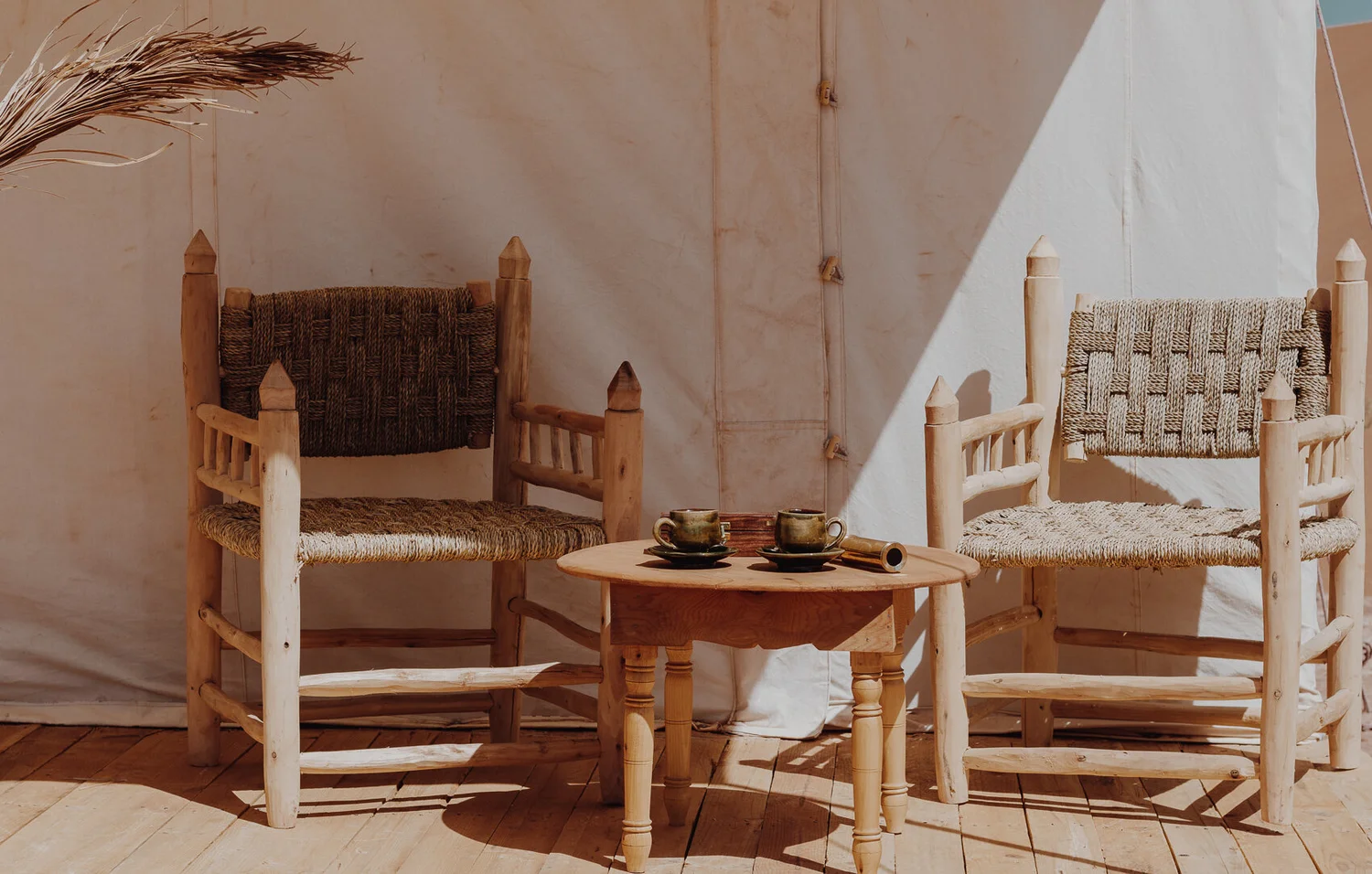
Writing happens in the morning, from first light until the heat arrives, which is roughly six until eleven. Most people work in their tent, which has a desk and a door. Some work outside on the shaded side of a dune. One guest last season wrote on the roof terrace of the lounge tent every morning and refused to move.
Lunch is late and long. The afternoon is yours: sleep, walk, read, or keep going if the work is moving.
Evenings are for reading aloud, if the group wants it. This is optional and about half of groups do it. Those that do usually say it was the best part.
What we can arrange
A facilitator or a published author to lead the group, brought from Marrakech or Europe at cost, if you would rather have structure than a residency.
Silence hours, agreed by the group on the first evening and respected by the staff. When a group asks for silence until two in the afternoon, the kitchen works around it.
A printer, paper and a decent desk lamp in each tent, which sounds trivial and is not.
Berber storytellers from M’Hamid on one evening, telling the oral tradition of this specific stretch of desert rather than a folklore performance.
What it will not do
It will not fix a book that has a structural problem. Four nights of silence gives you concentration, not answers. Come with something to work on.
Who this suits
Individual writers, small groups of two to eight, university writing programmes, and publishing houses running an editorial retreat. It also suits people finishing a doctorate, who make up a surprising share of every season.
How to come
Three to seven nights, October to April, with the camp privatised for your group. Tell us your dates and the size of the group, and we will send the full programme and the terms in writing before anything is paid.
