
The question comes up often in early conversations: why the Sahara instead of the Maldives, the Seychelles, or Bali? The answer is hard to put into words until you arrive on the dunes.
This guide is written from Erg Chegaga, 60 kilometres south of M’Hamid El Ghizlane. It is meant for couples planning a honeymoon who are looking for something irreducible, not a hotel facing the sea with a welcome cocktail, but an experience that stays with them.
Why the Sahara and Not the Islands
The Silence That Islands Cannot Offer
The Maldives are beautiful. They are also shared with hundreds of other honeymooning couples, at resorts that treat exclusivity as a pricing tier. At Erg Chegaga, silence is structural. The nearest camp is several kilometres away. There is no road. There is no lobby. There are no other guests if you privatise.
The silence at 60 kilometres from the nearest village is not a marketing abstraction. It is a physical phenomenon. Some couples describe it as unsettling in the first hours, before they realise it is exactly what they came for.
A Bortle Class 1 Sky
Erg Chegaga holds a Bortle Class 1 classification, the darkest rating on the international light-pollution scale. For a honeymoon, this means the Milky Way above your bed, not as a photograph but as a three-dimensional river of light. Shooting stars you count. Saturn visible to the naked eye. Images you take from your tent with an ordinary smartphone that you will not believe.
The Seychelles have a beautiful sky. But not Bortle Class 1. Tropical humidity creates a permanent atmospheric diffusion. The Sahara in winter is dry, cold at night, with an exceptionally transparent atmosphere.
Authenticity That Is Not Performed
Berber hospitality is not a show. Mint tea is served because that is how guests have been welcomed here for generations, not because it appears in the programme. The Berber dinner under the stars is not an entertainment offering: it is what families in this region of Morocco eat. The distinction is perceptible.
The Best Season for a Sahara Honeymoon
October to November: The Ideal Window
Daytime temperatures around 28 to 30 degrees Celsius, nights at 10 to 12 degrees. Perfectly clear skies. Late-afternoon light that turns the dunes to gold. This is the high season for a reason: conditions are close to perfect. The dunes of Chegaga, at 300 metres tall, reach their full colour range at the golden hour, ochre, rose, almost violet.
December to January: Cold and Spectacular
Nights can drop to -5 degrees Celsius or below. This detail puts off many couples, which is precisely its advantage. You will be alone. Snow occasionally falls on the dune crests in rare years, a sight almost no traveller has witnessed. Camp fires take on an entirely different dimension when it is genuinely cold outside. Pack warm layers, but the tents themselves are heated.
February to March: The Quiet Season
Less well known and often overlooked. Temperatures are rising, the sky stays perfect, and crowds are minimal. This is the period when certain desert plants flower briefly: the desert is never entirely dormant.
April: The Last Ideal Month
Heat begins building from May onwards. April remains pleasant, with daytime temperatures around 32 to 35 degrees and cool nights. After that, the camp progressively winds down as summer temperatures approach 50 degrees.
The Private Tent Experience
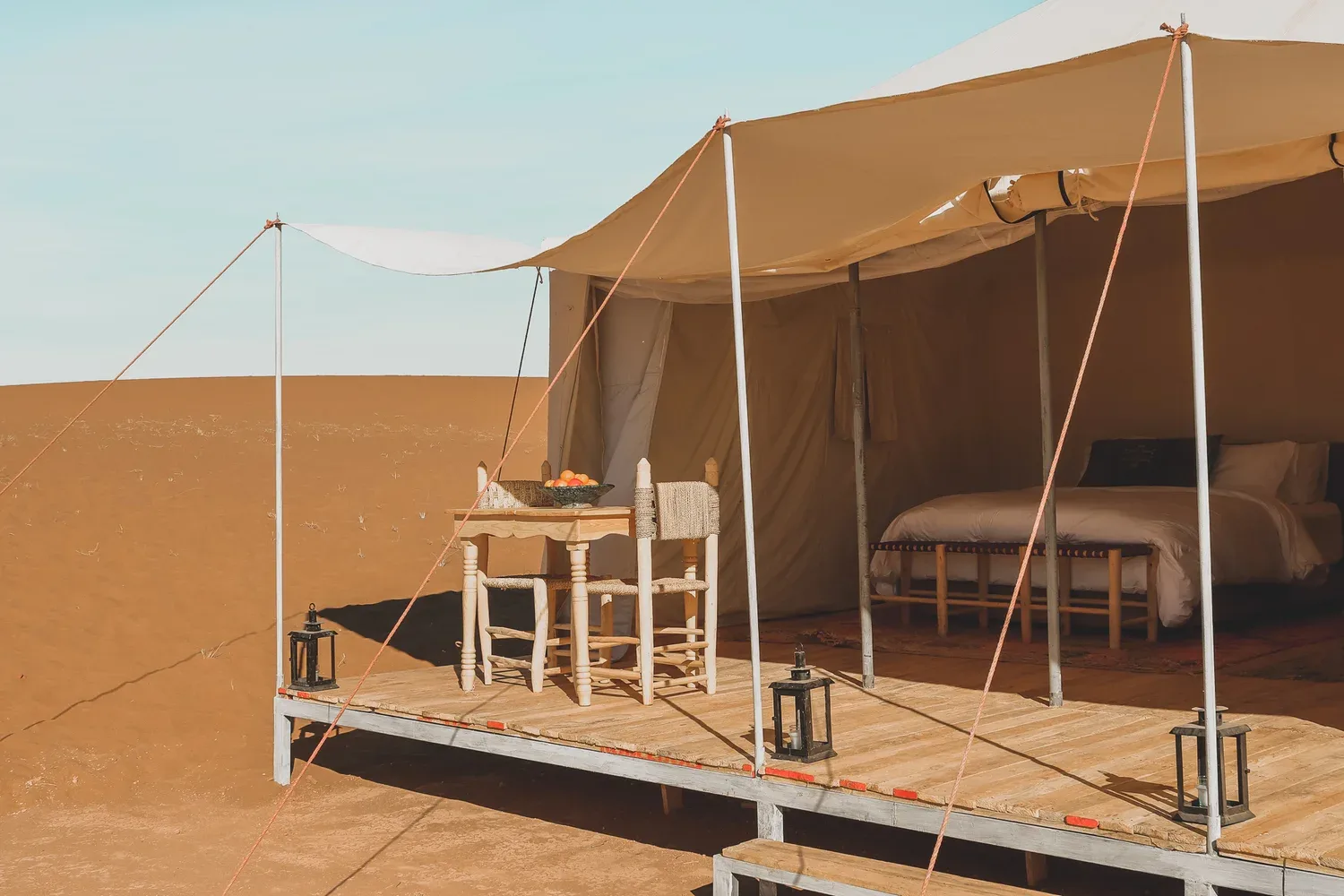
The suite tents at Umnya are comparable in space to a four-star hotel room. A high bed with hotel-quality linen, warm oil lighting, and a private outdoor terrace facing the dunes. The outdoor bathtub, set on that terrace and filled in the late afternoon, holds its warmth into the evening: a genuinely private moment as the stars appear above the dune line.
There is no grid electricity in the conventional sense: lighting runs on solar energy, which preserves the night-time darkness that makes the Bortle Class 1 sky possible.
For a honeymoon, the full private buyout is the configuration that makes sense. No other guests at the camp. The entire space, all 8 suite tents, is yours. The team is present but invisible unless you need them. The programme is entirely yours to design.
A Sahara Honeymoon: Day by Day
Day 1. Arrival by helicopter or 4x4 from Marrakech. Welcome with mint tea. Settle into the tent. A camel ride at sunset across the dunes, the light shifting through its full orange-to-violet spectrum. A Berber gala dinner: a table set on the sand, lanterns, an oud player in the background.
Day 2. Sunrise on the dunes, optional (no one is expected anywhere). Breakfast served in the tent. A free morning. An afternoon excursion by 4x4 to the fossil zones of the region. Sunset from the crest of a 300-metre dune. Astrophotography session if you want a guide through the constellations.
Day 3. Berber spa experience: a private hammam in a separate tent, argan oils, a tailored massage. A final dinner under the Milky Way. Departure the following morning.
Getting There: Logistics Made Simple
From Marrakech
Direct flights connect to Marrakech from most European cities. From Marrakech, the camp is about 8 hours 45 by private 4x4, crossing the High Atlas mountains and following the Drâa Valley south through 200 kilometres of continuous palm groves.
For a honeymoon, many couples choose the helicopter option: a 100 minute flight from Marrakech, over the Atlas, the Drâa, and across the dunes to a direct landing at the camp. The rotors fall silent. You step out. You are in the Sahara. It is one of the most memorable arrivals in luxury travel.
Practical Notes
Passport and visa. Citizens of the EU, UK, USA, Canada, and most Western countries do not need a visa for Morocco: free entry for stays up to 90 days. A valid passport is required.
Currency. The Moroccan dirham is not convertible outside Morocco. Exchange at Marrakech airport on arrival. At the camp, everything is prepaid: no transactions on site.
Temperature range. The Chegaga dunes sit at roughly 400 metres altitude. The day-to-night temperature swing can reach 20 degrees Celsius in winter. Even in October, a warm layer for evenings is essential.
Health. No mandatory vaccinations for Morocco from most countries. Consult your doctor for personal recommendations.
What Couples Remember
The feedback from couples who have honeymooned at Umnya consistently converges on two things not mentioned in any brochure. The first is the silence, described as unlike anything they had experienced before. The second is the quality of time: the feeling that three days here are worth two weeks somewhere else, that the desert slows time down in a way that a resort schedule cannot replicate.
For couples who wonder whether the Sahara is “romantic enough” in the conventional sense: the answer depends on what you mean by romance. If it is a pool bar and a nightly buffet, no. If it is two people alone in front of a landscape that dwarfs them, surrounded by silence and an unlimited sky, the Sahara does that better than anywhere.
Begin Planning Your Sahara Honeymoon
Umnya works directly with couples on every aspect of the stay, from tent arrangement and dining preferences to transfer coordination and any special requests. For honeymoon stays, we are happy to arrange small personal touches: local flowers, a handwritten note on arrival, a particular wine for the first dinner.
Full details on honeymoon experiences and what to expect are on our honeymoon page. To start a conversation and check availability for your dates, contact us here: we reply within 24 hours.


