
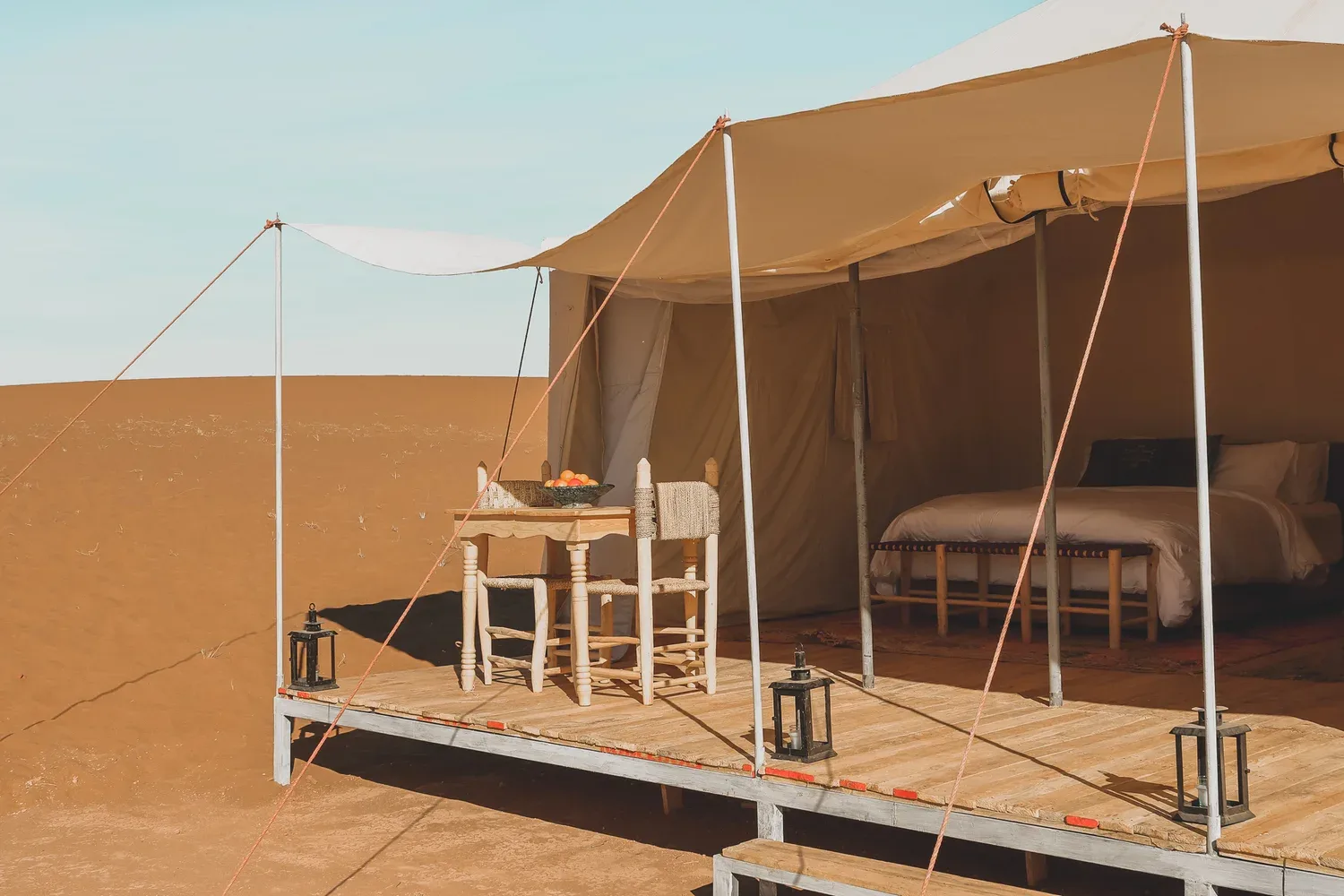
The Moroccan Sahara is one of the few great landscapes on earth that a traveler based in Paris can reach within a single day. No overnight connection, no visa, no time zone shift. Just a three-hour flight and a road that crosses the Atlas mountains, the Draa Valley, and opens onto the dunes of Erg Chegaga.
This guide is written for travelers based in France approaching this journey for the first time and looking for concrete information, without padding.
The flight from Paris
The standard departure airport is Paris Charles de Gaulle (CDG). The destination is Marrakech Menara (RAK), Morocco’s main international hub.
Flight time is approximately 3 hours. Several airlines operate this route:
- Air France, with early morning and early afternoon departures
- Royal Air Maroc, with multiple daily rotations
- Transavia and easyJet for travelers looking to keep the flight segment cost low
From Lyon, Bordeaux, Toulouse, or Nice, Royal Air Maroc and other carriers offer connections to Marrakech via Casablanca or direct depending on the season.
French passport holders receive 90 days in Morocco on arrival. No prior application is required.
From Marrakech to Erg Chegaga: the southern road
This is the part of the journey that many people underestimate and that, on reflection, is often cited as one of the highlights of the trip.
Marrakech to M’Hamid el Ghizlane is roughly four to five hours by road, depending on pace. The standard route passes through:
- The Tizi n’Tichka pass in the High Atlas (2,260 m), with views across the ridges and Berber villages clinging to the slopes
- Ait Benhaddou, a ksar on the UNESCO World Heritage list and filming location for numerous international productions
- Ouarzazate, the crossroads town between the Atlas and the desert
- The Draa Valley, the longest palm grove in Morocco, stretching nearly 200 kilometres southward
From M’Hamid, the camp lies approximately 90 kilometres across open piste and desert, roughly 50 to 60 minutes by 4x4. The transfer from M’Hamid is coordinated by the camp.
Options for this leg:
- A private car with driver from Marrakech (the most comfortable option, around 5-6 hours of easy driving with stops)
- A private 4x4 transfer arranged by the camp from Marrakech or Ouarzazate
- Self-drive to M’Hamid, then the camp handles the final piste section (strongly recommended)
The piste between M’Hamid and the camp requires local knowledge of the terrain. A standard road car is fine as far as M’Hamid. The final section is handled by the camp team.
Which season to choose
For a traveler based in France, the ideal windows align well with school and professional calendars:
- October and November: warm days (22 to 28 degrees C), cool nights, golden light on the dunes. Excellent.
- December to February: the best period of the year. Days between 18 and 22 degrees C, cold nights (4 to 10 degrees C). Clearest skies. The Christmas and February school holidays fall squarely in this window.
- March to April: excellent. Occasional dust wind possible but the experience remains remarkable.
- June to September: avoid. Daytime temperatures regularly reach 42 to 48 degrees C.
Why the Sahara over other destinations
The question comes up often among French travelers weighing options. The answer is straightforward.
Provence, Corsica, and the Ardeche are beautiful places. But they are familiar, well-mapped, frequented. Silence there is relative.
Erg Chegaga is rated Bortle Class 1, the darkest category on the international light pollution scale. The Milky Way is visible to the naked eye as a solid band across the sky. The nearest other camp is out of visual range. There is no road, no electrical hum, no notifications. Silence is a physical presence, not merely the absence of noise.
For three hours’ flying from Paris CDG, this degree of remoteness has no equivalent in Europe.
What to book in advance
The camp has only eight private tented suites. Key periods (Christmas, February, spring holidays) fill months ahead, particularly for group privatizations.
It is worth confirming dates as soon as the flight is booked. The camp then coordinates transfers and the programme according to your preferences.
For December dates and French school holiday periods, it is common to see the last availability go by September for the winter season.
Practical information for travelers from France
- Currency: Moroccan dirham (MAD). Day-to-day price levels run at roughly one third of Paris.
- Language: French is widely understood across Morocco, in Marrakech and in the M’Hamid region.
- Health: no compulsory vaccines required from France. Travel insurance is recommended.
- Phone: a Moroccan SIM card is useful for the road. The camp has no Wi-Fi, which is intentional.
Questions about dates or organizing the transfer from Paris? Contact our team.


