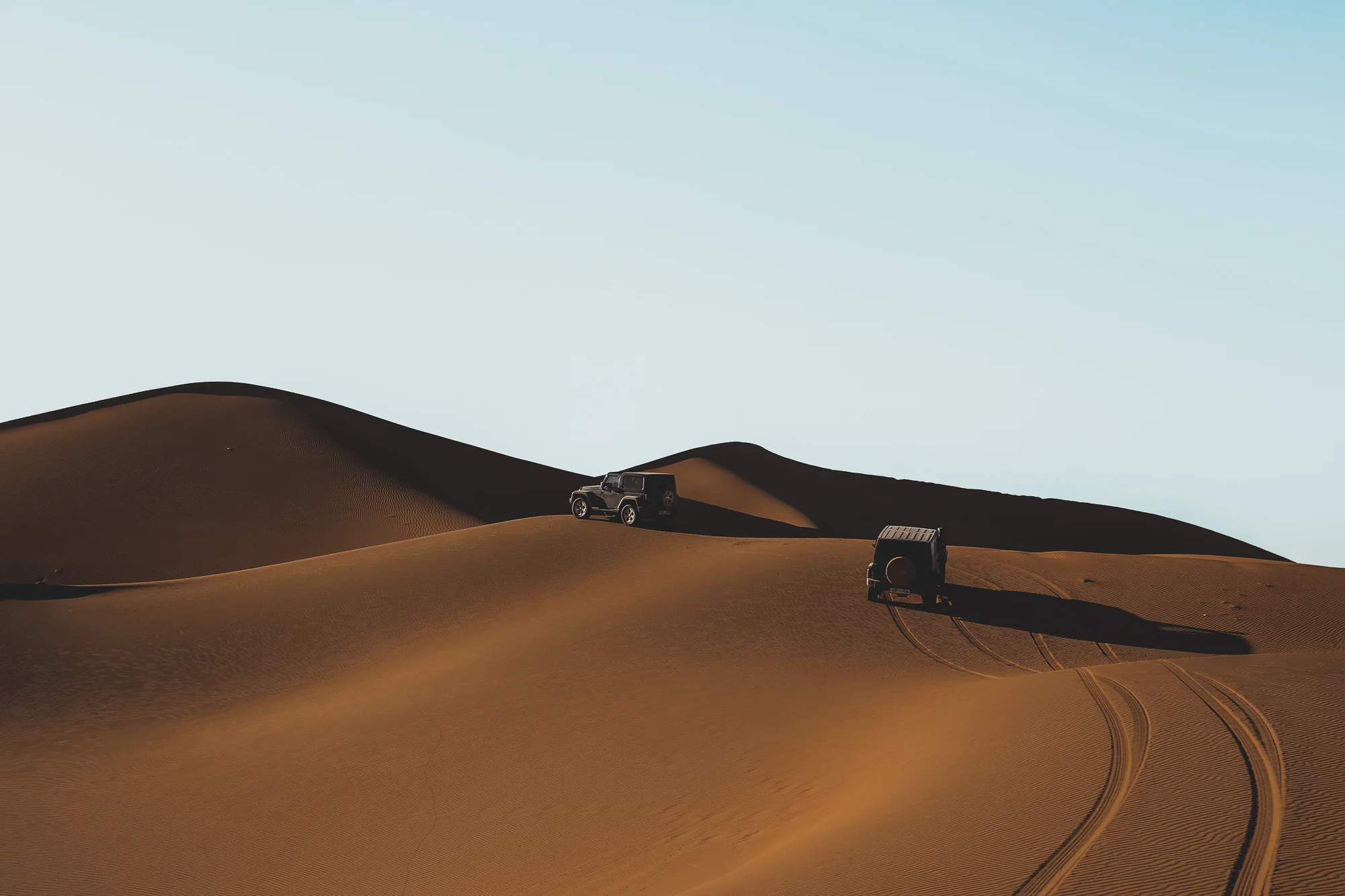
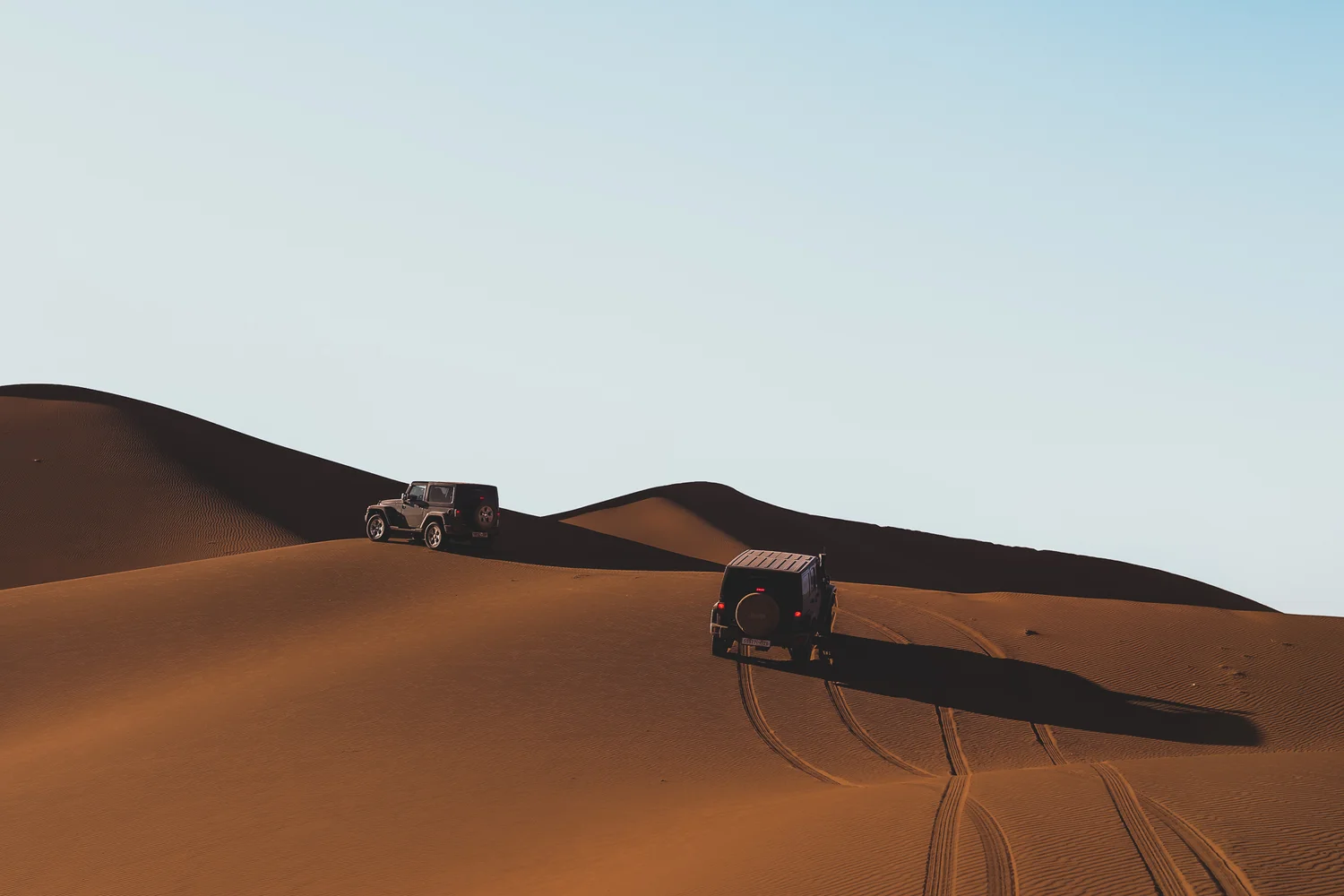
Every good motorcycle tour through Morocco ends up pointing at the same place: the deep south. Once you have crossed the High Atlas, ridden down the Draa valley and left the last tarmac behind M’Hamid El Ghizlane, you are on the edge of Erg Chegaga, the largest and wildest sea of dunes in the country. Sixty kilometres of piste after the village, no road, no town, no power grid.
For tour operators and self organised groups, this place has always been the scenic high point of the route and, at the same time, its logistical weak spot. The overnight options came down to basic bivouacs: shared tents, shared washrooms, machines left standing in open sand. After eight hours of piste and corrugation, that is a wasted night.
Umnya Desert Camp closes exactly that gap. A private luxury camp at Erg Chegaga that takes riding groups as an exclusive stage, with what riders and machines need at the end of a desert day.
Why Erg Chegaga belongs on every Morocco route
Erg Chebbi near Merzouga is better known, busier and full of quads. Erg Chegaga is the opposite: further out, bigger, emptier. The approach is part of the experience, whether you come along the piste from M’Hamid or take the legendary run across Lake Iriki from Foum Zguid, one of the finest offroad passages in North Africa. Our piece on the 4x4 route across Lake Iriki covers that ground in detail, and the description holds for motorcycles just as well.
On an enduro or a big trail bike you find everything within a short radius: stony hamada, fech fech, the first dune ridges, and at the end of the day a backdrop that justifies the whole trip. If your interest is pure sand work and dune riding, our article on riding enduro in the Sahara is worth a look.
The problem with the last night, and the fix
At the end of a desert day, a riding group has three needs that a basic bivouac does not meet: real rest, security for the machines, and somewhere to work on the bikes. The camp covers all three.
Real beds, private bathrooms
Eight tented suites, each with a proper bed, its own bathroom with hot shower and WC, power and a private terrace. The camp takes two to eighteen guests, twenty with extra beds. The difference between a night in a shared bivouac and a night in your own suite shows up the next morning on the piste: concentration is a function of sleep, and in the desert concentration is safety. The page on the camp gives a sense of the standard.
Secure parking for the machines
The bikes spend the night on a firm, watched parking area inside the camp, not somewhere out in open sand. The camp is staffed around the clock and the team keeps the machines in view. For operators running customer bikes or rental fleets, that is an insurance and liability argument, not only a comfort one.
A work area for maintenance and repairs
After a day in sand, there are air filters, chains and tyre pressures to deal with. The camp provides a work area with light, power, water and the basics, so the group can work in the evening or early in the morning instead of improvising in the dark next to a tent. Specialist tools and spare parts come with the group as usual, and support vehicles can be loaded and unloaded at the camp itself. There is no workshop and no mechanic on site: the area is a place to work, the hands are yours.
The whole camp for the group
The camp takes one group at a time, so a riding group never shares the place with wellness guests. There is no minimum number of riders and no threshold to cross: the camp is taken exclusively by whoever is booked. In practice that means:
- No other guests, and nobody to make allowances for in either direction
- Meal times set by the group’s own schedule, early breakfast before departure included
- Briefings and map sessions in the dining tent or around the fire
- The evening can be as loud or as quiet as the group wants it
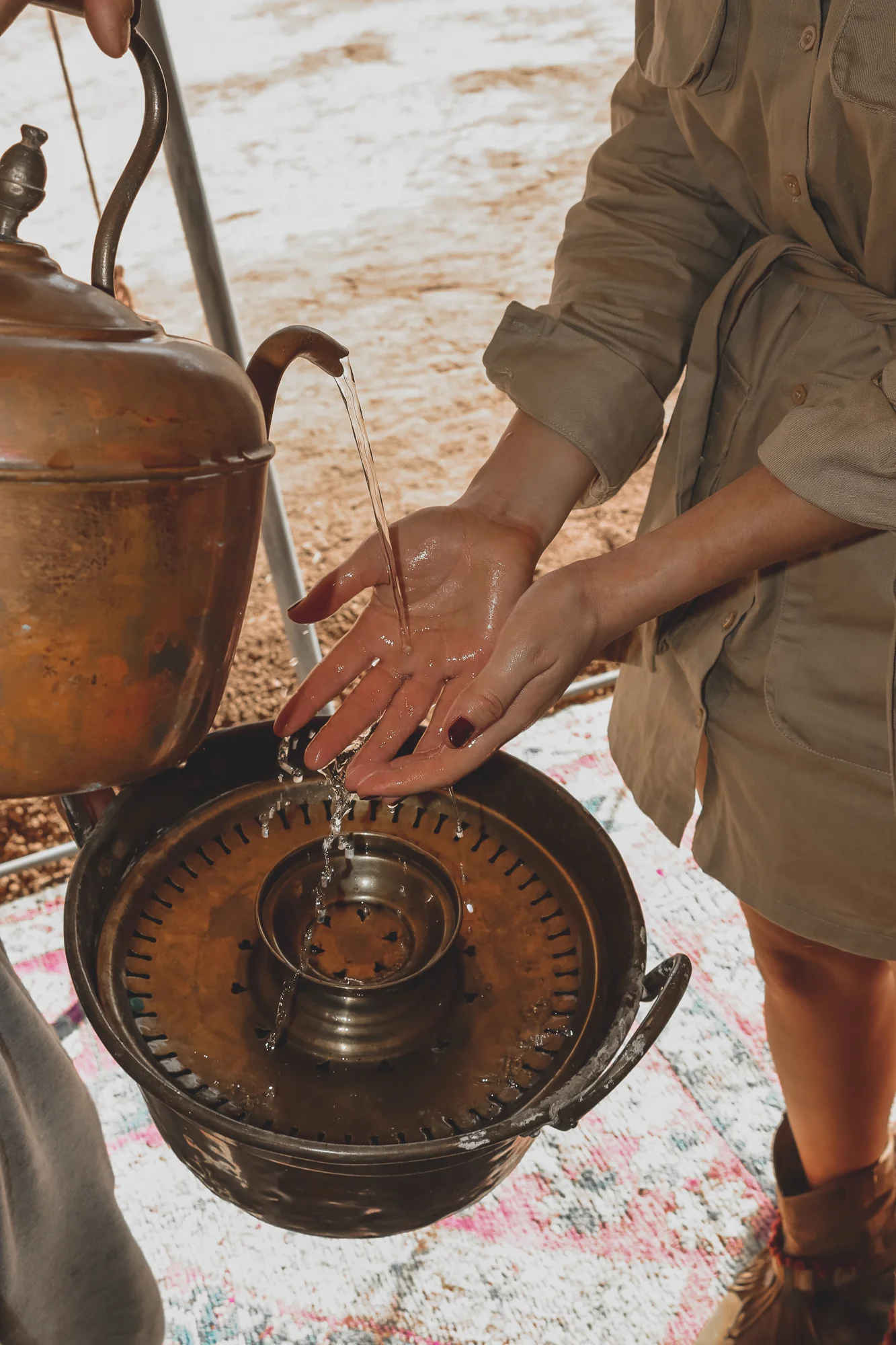
The team works to roughly one host per two guests. For an operator, that means client care at the end of the stage is fully taken off your hands, from the welcome tea to the packed lunch for the next day.
The evening that sells the next tour
Operators know it: clients book the next trip because of single moments. The evening at Erg Chegaga delivers several of them. Sunset from the dune crest over an ocean of sand. A several course Moroccan dinner at one long table, which has nothing to do with bivouac cooking. Then the fire, and above it a Bortle 1 sky, the darkest class there is. For a lot of riders, that night is the point where a hard tour turns into a great journey.
Route logic: how the camp fits into your tour
Combinations that have proved themselves with groups coming from Europe:
The classic southern loop: Marrakech, Tizi n’Tichka, Ouarzazate, the Draa valley, M’Hamid, Erg Chegaga (one or two nights at the camp), Lake Iriki, Foum Zguid, Taznakht and back to Marrakech. The desert stage sits in the middle, and the camp is the rest point and the high point at once.
Two nights instead of one: The day in between belongs to the dunes, riding without luggage, sand practice, or simply a rest day in the quiet. On tours of eight to ten days, one fixed day without a stage lifts the mood of the group noticeably.
Support vehicles: A 4x4 carrying luggage and spares reaches the camp without trouble, the access track is established for loaded off roaders. Details on the approach are on the page how to get to Erg Chegaga.
The season runs from September to June. From October to April the mornings are cool, the air is clear and the sand is firm in the early hours, with daytime temperatures between 18 and 28 degrees.
Getting the group to Morocco: Most groups either ship their own machines to Tangier or rent enduros in Marrakech or Ouarzazate, both established routes with reliable providers. Riding rental bikes saves the ferry logistics and starts the tour at the foot of the Atlas. For the return to Marrakech, the western loop over Taznakht works well, strong scenery on tarmac, a good cool down after the sand days.
Riding reality: what Erg Chegaga asks of a group
A few honest notes from the ground, so the stage works for everyone:
Sand is skill, not nerve. The pistes up to the camp are well within reach of practised riders on trail bikes. The deep sand inside the dune sea itself belongs in experienced hands, or in a guided session. Groups of mixed ability do best to plan it this way: come in on the firmer pistes, and whoever wants to go deeper into the dunes does that on the middle day, without luggage and with a local guide out front.
Tyre pressure and water. Drop the pressures well down before the sand sections; there is compressed air at the camp for pumping back up. Three litres of water per rider per riding day as a minimum, with the reserve carried in the support vehicles.
Navigation. There are no signs past M’Hamid. Groups without local knowledge are best off riding the last stage behind a local lead vehicle, which we can provide from M’Hamid on request. Operators get the camp coordinates and a briefing on the piste by email beforehand. Plan on being out of signal: the only connection at the camp is 4G from the top of the big dune, about twenty minutes there and back, plus the team’s satellite link for emergencies.
Information for operators
For tour operators, the camp offers dependable procedures and a direct contact by email. The price is a single figure for the whole camp, set case by case for each request, never per rider. Recurring dates across the season can be held, so the Erg Chegaga stop goes into the catalogue as a fixed item, confirmed with a 20 percent deposit. First information for partners is on the page for trade partners.
And for private groups, the same applies as for professionals: if you are planning the queen stage of your Morocco tour, do not leave the night after it to chance. Write to us with your route, your dates and the size of the group, and you will have a written reply within 24 hours.