
The bread arrives wrapped in a clean cloth and it’s still warm.
It baked in the embers since evening prayer. The outer crust is lightly ashen, the crumb has that dense, moist texture you don’t find from an oven. You break it with your hands. There is no bread plate.
This is the first thing to understand about Berber cooking in the desert: it is not presented. It is served. The distinction matters.
The logic of cooking without refrigeration
In a camp in the middle of Erg Chegaga, there is no grid electricity. A generator handles essentials. But the cooking operates the way it has always operated in the desert: through mastery of fire, time, and ingredients that require no refrigeration.
Vegetables arrive from the M’Hamid market several times a week. They are fresh, local, and seasonal in the strict sense: not as a trend, but because this is what’s available. In winter: squash, carrots, turnips, potatoes. In spring: courgettes, peppers, the first tomatoes. Freshly cut herbs shift with the garden.
Meat is purchased the same day or the day before, prepared by M’Hamid’s butcher according to halal practice. Lamb is the foundation. Sometimes chicken. Rarely anything else.
This constraint is not a limitation. It is a discipline that produces more direct cooking than what you eat in the city.
The tagine: time as the primary ingredient
The clay tagine is not a serving dish. It is a cooking system. The conical lid captures steam, condenses it, and redistributes it over the ingredients. Heat circulates from below and from the inside outward simultaneously. The result after two hours over slow coals is meat that falls apart without a knife, vegetables that have dissolved into themselves, a sauce with nothing watery about it.
Camp cooking does not produce simpler tagines than a restaurant. It produces different ones. The chef knows when the fire is too hot by holding his hand 20 centimetres from the coal. He knows when the tagine is ready by listening to the change in the steam sound. This knowledge is physical, not written.
Cumin, ginger, saffron, cinnamon, ras el hanout: spices in Morocco are not measured by spoon. They are adjusted by nose, by batch, by season, by what the chef learned from his mother who learned from hers.
What you actually eat
Dinner, served at dusk, follows a sequence that is also a rhythm.
The salads arrive first, seven or eight small plates arranged at the centre: cooked carrots with cumin and preserved lemon, beetroot with orange and orange blossom water, zaalouk of smoked aubergines and long-cooked tomatoes, fire-roasted pepper salad, lentils with argan oil and parsley. You eat with bread. Each plate is distinct, each flavour is clean.
Then the central tagine, set on the table with its lid still steaming. You lift the lid yourself. The steam rises. The scent of saffron and ginger in lamb steam is a specific sensory experience: no photograph transmits it.
Friday couscous, made by tradition: the grain steamed twice, butter rolled in by hand, broth served separately in which vegetables are added. Industrial couscous bears no resemblance. Eating a couscous of this kind sitting outside in the desert on a Friday evening is a direct connection to something very old.
Tea comes after, always after. Poured from a great height to create foam. Sweetened, unless you ask otherwise. The first glass is bitter, the second is sweet, the third is syrupy: the progression is known to everyone who has spent time in Morocco.
Eating outside in the desert at night
The table is set outside every evening unless the weather is exceptional. In the desert during the main season, it doesn’t rain. The sky is completely open. Candles on the table, Bortle Class 1 sky above, absolute silence all around: this context changes the taste of things.
This is not a metaphor. There is research on how sensory environment affects taste perception. In a silent, open space, with scents of warm sand, burned herbs and wood, food flavours are perceived differently. What several guests describe as the best meals of their lives were often not exceptionally complex tagines, cooked under simple conditions, in this setting.
Breakfast as a statement of intent
Morning begins with flatbread made on the morning flame, spreads: fresh local cheese, argan oil for bread with honey, amlou (almond paste and argan oil) when available. Eggs prepared to order. Seasonal fruit. Tea again, or Moroccan coffee.
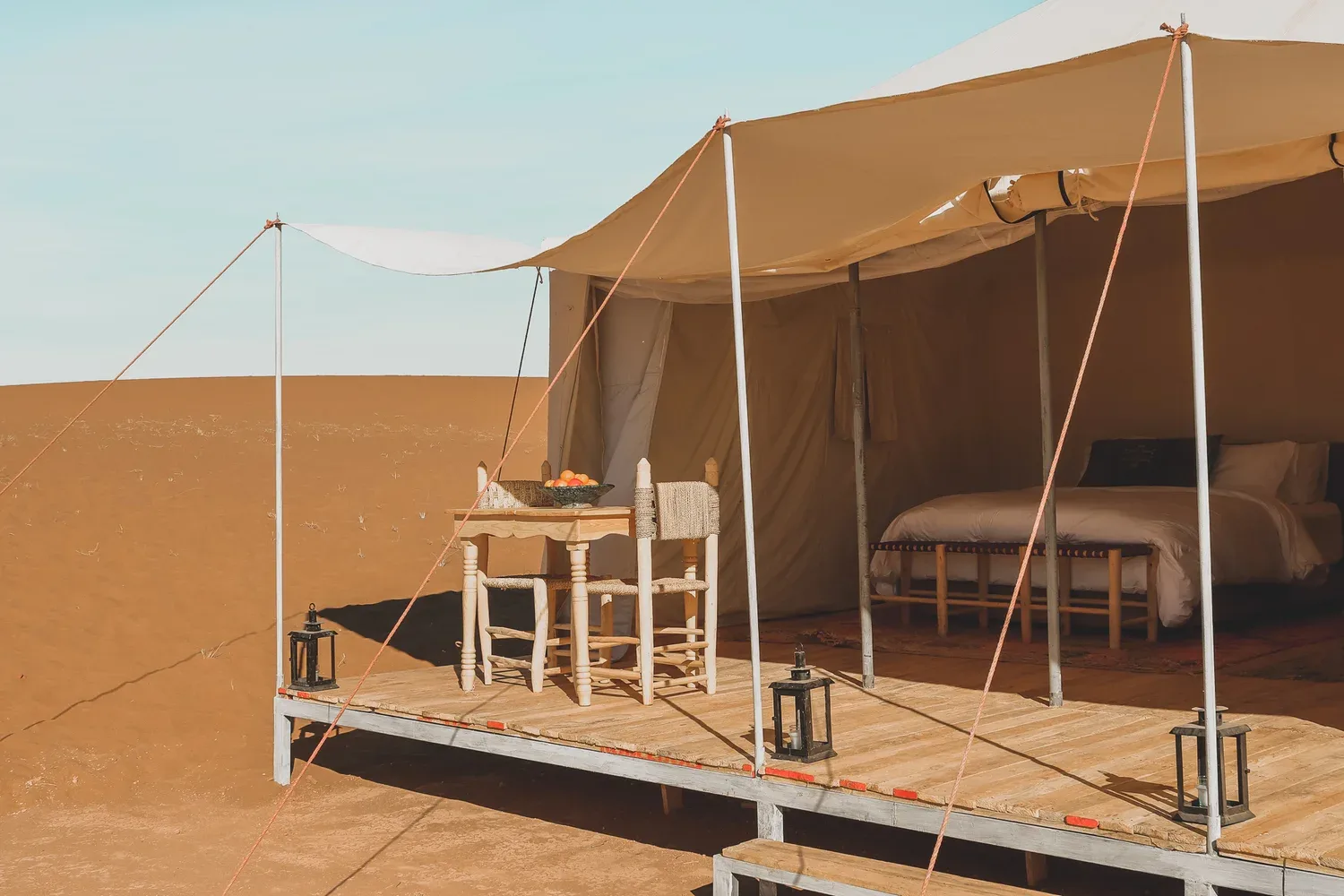
This is not a buffet. It is a meal, prepared for you, brought to your table on your terrace while the sun begins to warm the dunes.
Berber cuisine in the desert is fundamentally a cuisine of hospitality. It does not exist to be photographed. It exists to be shared.
For availability, contact the camp directly.
Bread broken by hand tastes different.


