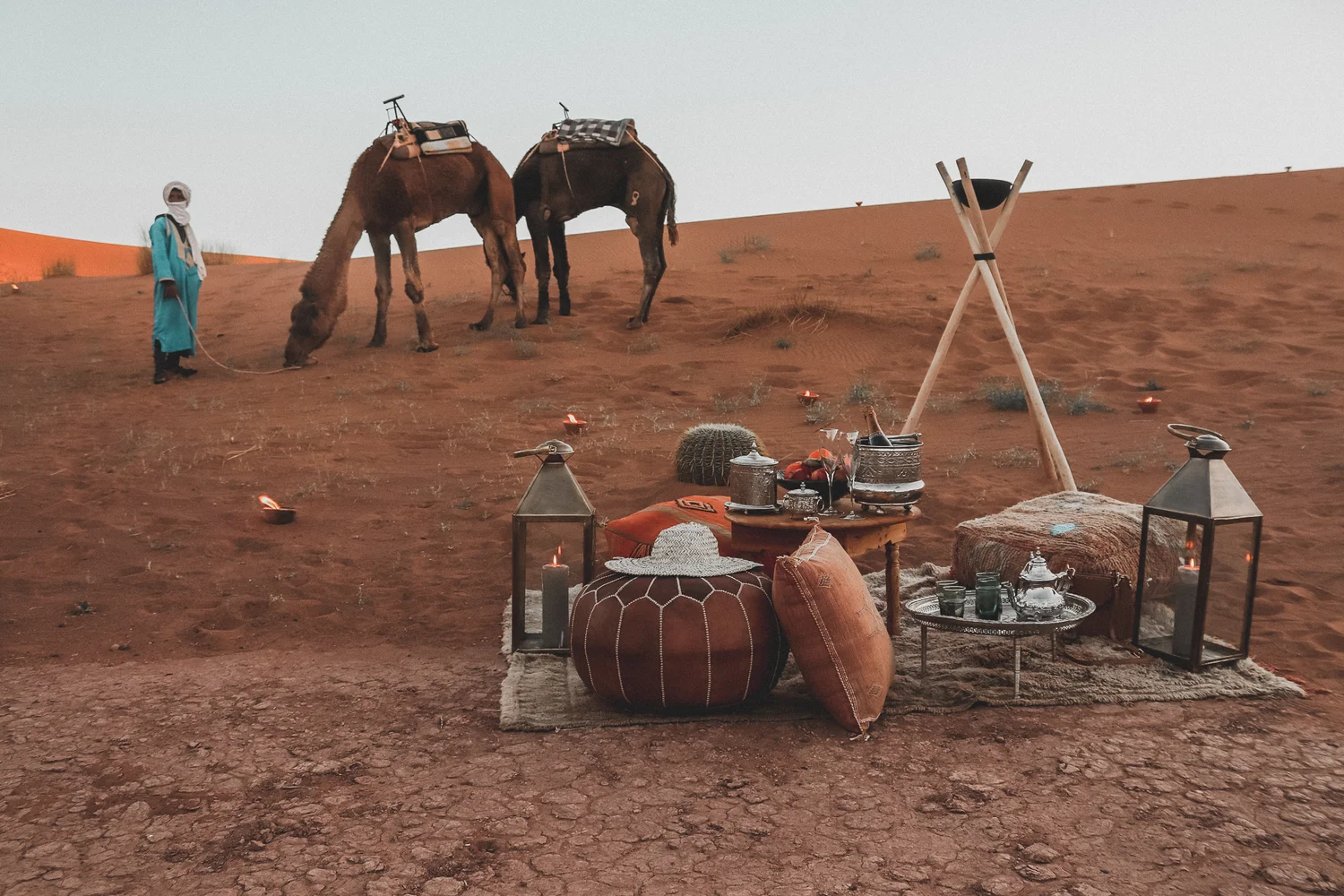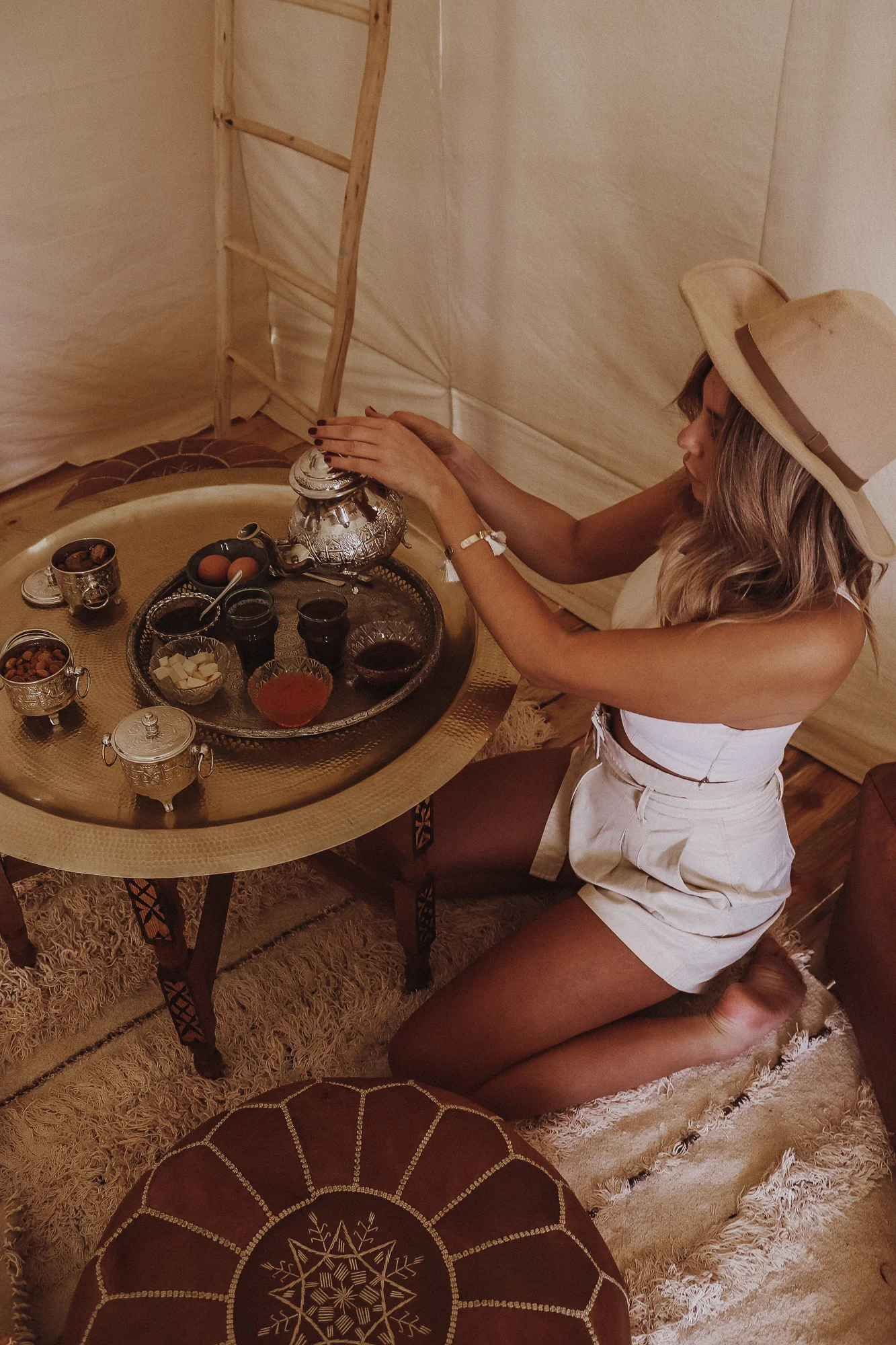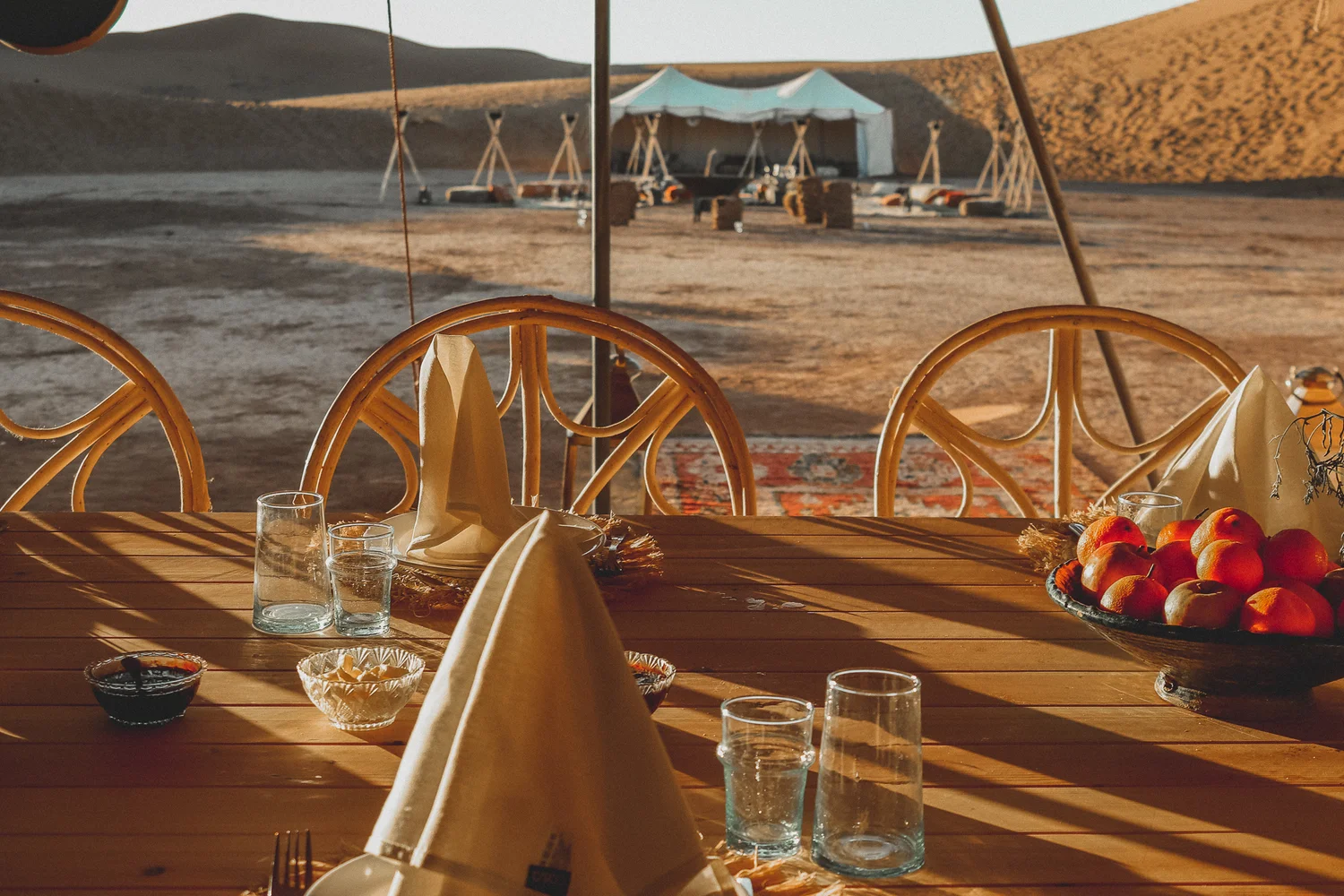
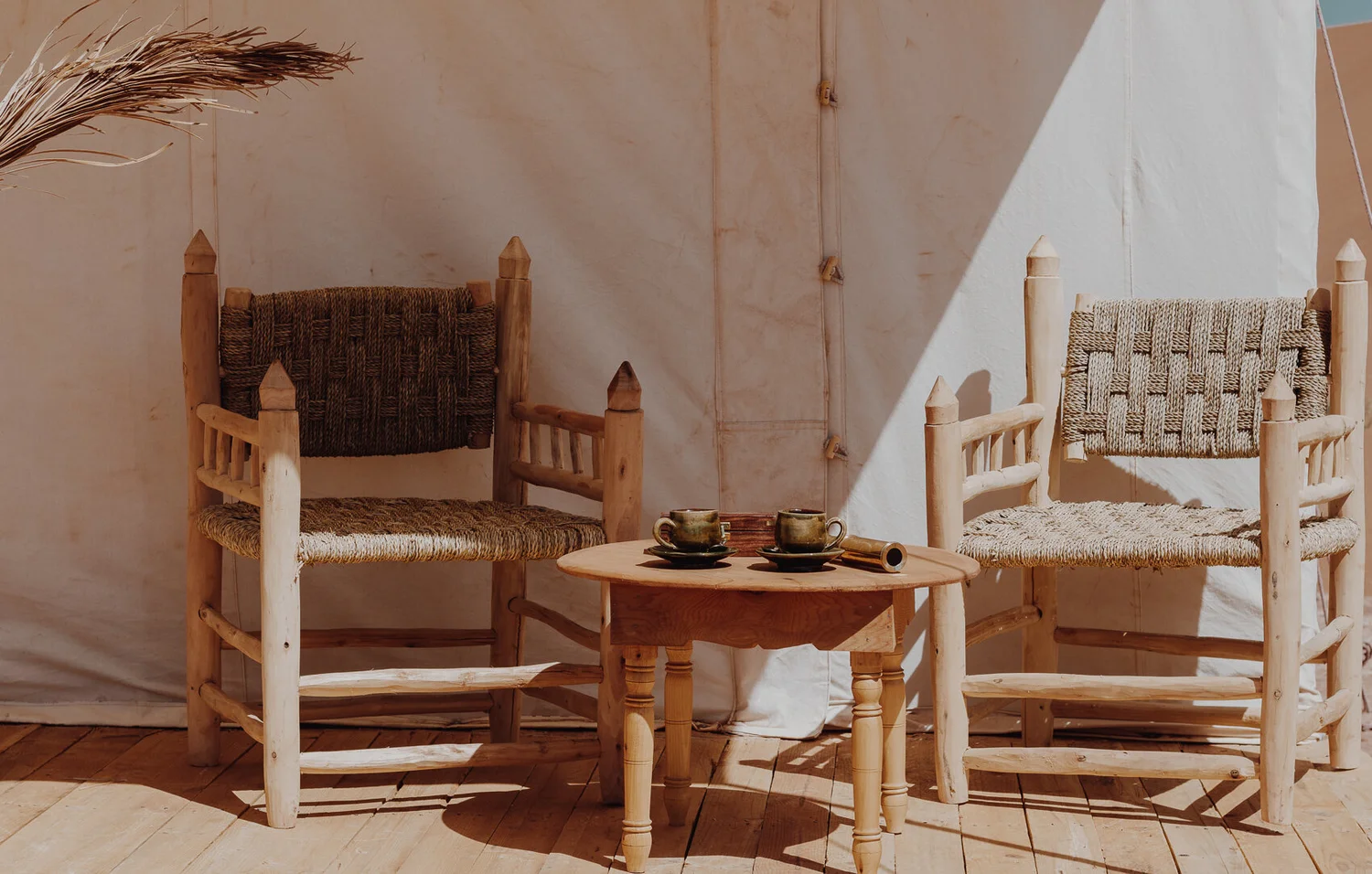
A large share of the women’s groups that come to us are in their forties and fifties. Their facilitators are often coaches, therapists or doctors, and a remark comes back about the venues they have used before: the schedule was designed for a thirty-year-old body and the accommodation was designed for a photograph.
We are a camp, not a clinic, and nothing here is medical. But we have learned what this particular group needs from a place, and most of it is unglamorous.
Temperature is the whole conversation
If a significant number of your group are managing hot flushes or disrupted thermoregulation, the sleeping arrangement stops being a comfort question and becomes the thing the retreat succeeds or fails on.
The relevant facts about a desert night, stated plainly: from October to April, nights at Erg Chegaga run from around two to eight degrees Celsius in midwinter and eight to fifteen in the shoulder months. That is cold. Tents have proper bedding and heating. What matters for this group is that the temperature can be adjusted individually rather than centrally, and that a woman who wakes at three in the morning too hot can step outside into cold air and go back to bed, rather than lying awake in a sealed room.
Several facilitators have told us this is the single reason they returned. It is worth asking any venue directly: can a guest change her own temperature at three in the morning without waking anybody?
Sleep, and what actually happens out here
We are careful about claims. What we can say is what guests consistently report and what the environment objectively provides: no artificial light, no traffic sound, no mobile notifications because there is no network in the camp, and a genuinely dark sky.
The common pattern across four nights is a difficult first night, a very long second night, and a noticeably different third and fourth. Whether that is the darkness, the silence, the absence of screens or simply the walking, we do not claim to know. We do know the pattern is consistent enough that facilitators build their schedule around it, keeping day two light and putting the demanding work on days three and four.
Pace, joints and the sand problem
Soft sand is roughly a quarter harder than the same distance on a path, and dune climbs are short but steep. For a group with a spread of knees, hips and recent surgeries, an itinerary that reads beautifully can be quietly punishing.
What we do about it: every activity has a shorter version and a seated version, the 4x4 is available for any excursion so nobody is choosing between pain and exclusion, and the camp itself is flat. Nobody has to climb anything to reach their tent, the dining area or the fire.
Ask any venue whether a guest who cannot walk on sand today can still do everything on the day’s schedule. If the honest answer is no, that woman will spend the week feeling like the one holding everyone back, and your retreat has a problem that no amount of good facilitation solves.
Food, without the lecture
Groups in this age range are, in our experience, both more interested in what they are eating and more tired of being told about it. What we provide is real food cooked by a chef on site: vegetables, olive oil, slow-cooked meat and fish, bread baked in the sand, fruit. Protein at every meal, because a group walking in sand and doing emotional work at the same time needs it and rarely gets enough at retreats.
Dietary requirements across a group of sixteen are handled quietly, in advance, without a conversation at every meal.
Alcohol: available or entirely absent, whichever you specify. A number of the groups in this category ask for the second, and we prefer to know in advance so that it is simply not present rather than declined at the table.
What a desert setting adds that a spa hotel does not
The honest version is that a good spa hotel does the pampering better than we do. What it cannot do is remove the world.
There is no wifi and no network in the camp, so nothing from adult children, ageing parents or work arrives on its own: reaching anyone means walking to a phone signal a short way from camp, about twenty minutes there and back. For this specific group, which is very often carrying all three at once, that distance is the actual intervention. Several facilitators have told us that the third day is when women stop making the walk, and something else starts.
The second thing is the sky. A Bortle Class 1 night with a telescope and someone who can explain what you are looking at reliably produces the quietest hour of the retreat. We have stopped trying to describe why.
The practical shape
When your retreat takes the whole camp, it is yours alone, closed to everyone else. Two to twenty guests, though this kind of work sits best between eight and fourteen. Four nights minimum, five better. Full board. October to April, with March, April, October and November the most comfortable for a group that would rather not be cold.
The camp is quoted as a whole rather than per person, so the rate does not change with who comes.
Before you write to us
Useful to include: group size, dates, how many in the group have mobility limits you are planning around, whether the retreat is dry, and whether you need a private space for one-to-one sessions. That last one is asked for often and is easy for us to arrange if we know in advance.
Send us those details and we will come back with something specific.
Related: the women’s retreat venue guide, the facilitator checklist for women-only groups and what happens to your sleep after four nights.