The women’s retreat market has a gap in the middle of it. At one end there is a great deal of wellness: yoga at sunrise, journalling, a sound bath, a very good dinner. At the other end there is genuine expedition travel, which is largely sold to and populated by men.
Between them sits a group of women who want something physically real, do not want to be the only woman on a trip designed by and for men, and are tired of being sold rest when what they actually want is difficulty.
That is who this format is for.
What makes it an expedition rather than a retreat
The distinction is not marketing. Three things change.
You move. A retreat has a base and radiates from it. An expedition covers ground, sleeps somewhere different, and arrives somewhere it did not start. Our format puts nights in bivouac in the dunes between nights at the camp, which means the middle of the week is genuinely out there.
You carry something. Not everything, and not the heavy things. A camel caravan takes the luggage, water, food and shelter, which is what makes walking all day realistic. But you carry your own day pack and you make your own decisions about layers, water and pace, which is a different relationship to a trip than being handed a towel.
Something is asked of you. Five to seven hours a day on soft sand, on consecutive days, with short steep dune climbs. Sand is roughly a quarter harder than the same distance on a path. Nobody is in danger and nobody is comfortable, and that is the design.
What the days look like
Arrival and the camp. A night at Umnya first, with a real bed and a hot shower, because starting an expedition tired is a bad idea and a long journey leaves people tired.
Into the erg. Walking east from camp into the dune corridors, with the caravan behind. A long halt in the shade at the hottest hours, which is not a break so much as the way the day is structured.
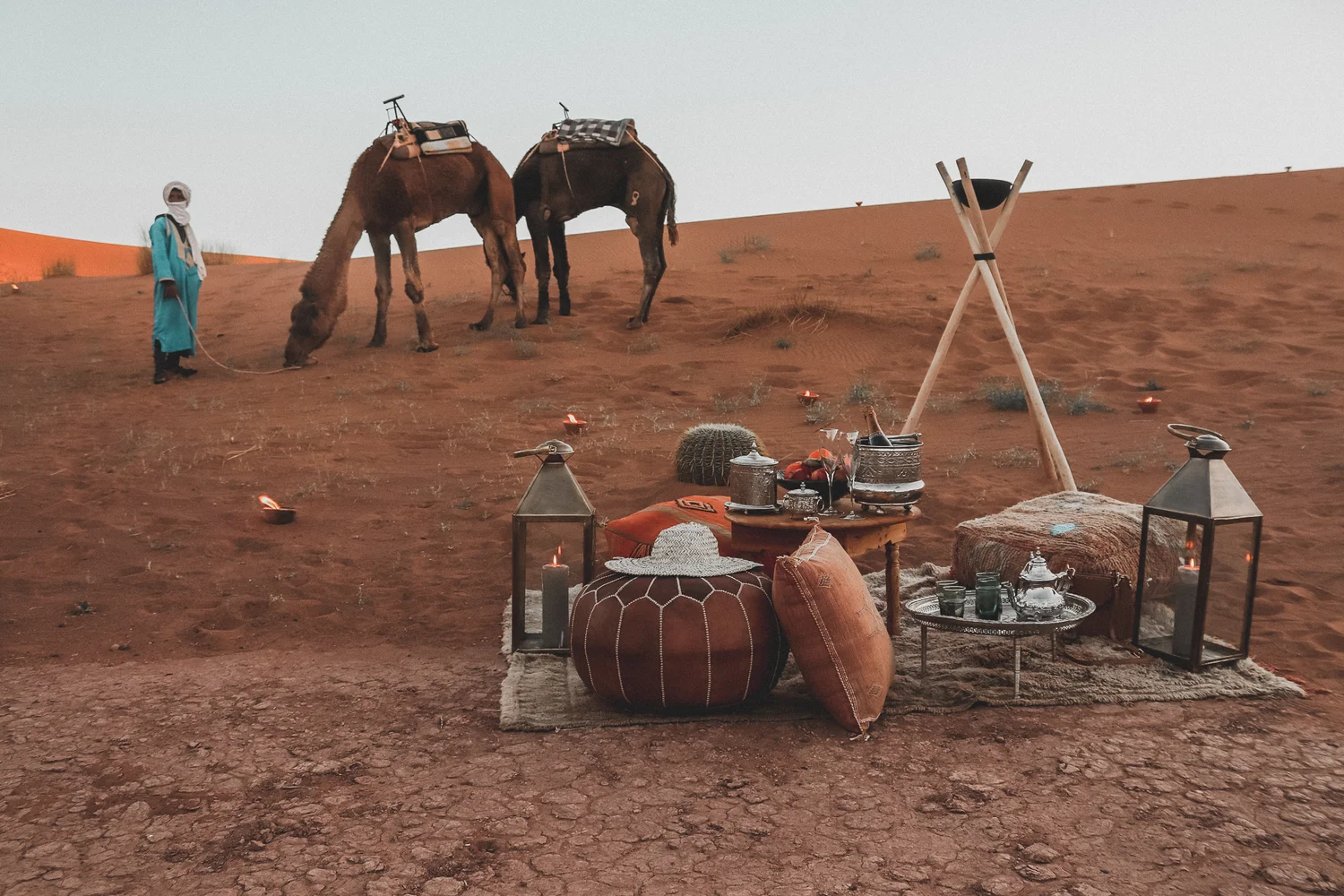
Bivouac. A mattress and proper bedding set up in a sheltered hollow before you arrive, a cook travelling with the group, dinner served on rugs by candlelight, and a private toilet tent. Sleeping in the open rather than under the shelter is an option, because of the sky.
The deep day. The longest walk, where by late morning there is no landmark in any direction and the guide is reading dune shape, sun angle and wind rather than following anything. This is the day people talk about afterwards.
Back to camp. Hot shower, real bed, a long dinner, the telescope after dark.
Why the women-only part matters practically
We host mixed groups too, and the difference is not about capability. It is about a set of small frictions that disappear.
Nobody is being waited for or waited on. Pace-setting stops being competitive. Conversations at the bivouac go somewhere different by the second night. And in a place with no doors, the practical realities of four days in a desert are simply discussed rather than managed around.
Our own staffing shifts for these groups. The hospitality side is run by a women’s team from Marrakech and Ouarzazate, and we have a rotating group of Moroccan women we work with specifically for women’s retreats, trained hospitality professionals, some from luxury hotels, fluent in Arabic, French and English.
Fitness, honestly
You need to be comfortable walking five to seven hours a day on soft sand on consecutive days. If you walk regularly and can manage a full day in hills without suffering, you will be fine. If you are unsure, the shorter three-day format exists precisely for that and there is no shame in it.
Ages across the groups we host run from late twenties to late sixties. The oldest guest to complete the full crossing was sixty-eight. Fitness matters far more than age.
What it is not
It is not a wellness retreat. There is no spa programme built into the walking days, and the massage is at the end rather than throughout.
It is not a silent retreat, although the deep day usually goes quiet on its own.
It is not a camel ride. The camels carry the load. You walk.
Group size and dates
Two to twelve, and every departure is private. Twelve is a hard limit: above it a bivouac stops feeling like a bivouac.
October to April. March, April, October and November are the strongest months.
Quoted rather than priced from a list, because the route, the number of nights and the group size all change what it takes to run.
To organise one
Tell us the group size, the dates, the spread of walking experience, and whether you want the three, five or seven day shape. If you are a facilitator bringing your own group, say what you need beyond the walking: a circle space at the bivouac, a private tent for one-to-ones, a dry retreat.
Related: the luxury desert trekking routes, the women’s retreat venue guide and the facilitator checklist for women-only groups.