
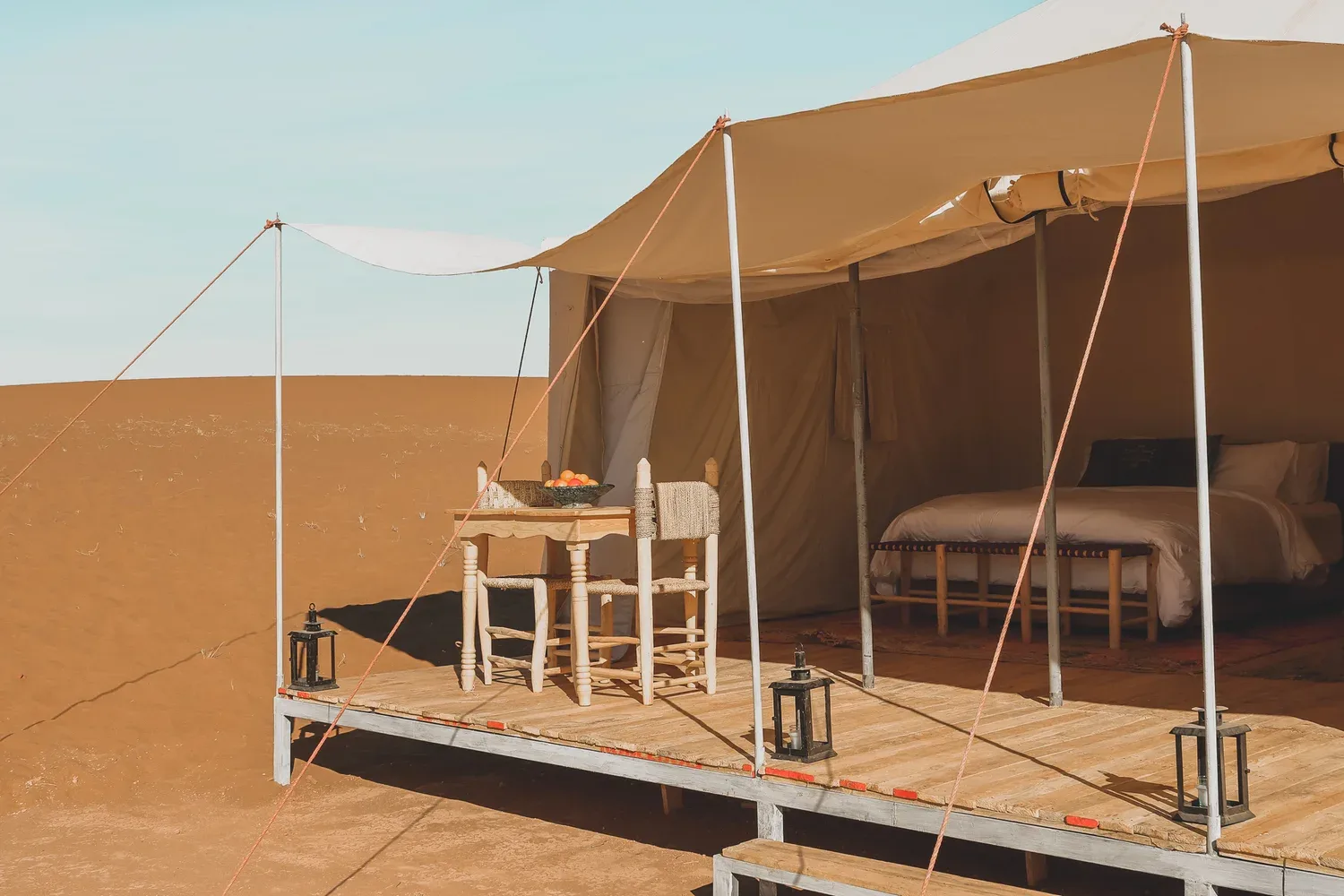
The question comes up regularly in messages from families in the planning stages: is the desert genuinely suitable for children? Safe enough, interesting enough for them, comfortable enough for parents?
The short answer is yes, from about age 5 or 6, and often better than expected. What follows is the longer answer.
Why children respond so well to the desert
Children do not arrive at the Sahara with the same filters as adults. They do not come exhausted by years of screen overload looking to “disconnect.” They arrive curious, and the desert answers them directly.
The dunes become a natural large-scale playground. Animal tracks in the sand (fennec fox, dung beetle, horned viper) become a treasure hunt. The night sky is a revelation that needs no prior explanation. Children look at the Milky Way for the first time and understand something without it needing to be put into words.
This is not a planned educational outing. It is exposure to an environment different enough from what they know to trigger genuine attention.
Activities for children at Umnya
The programme at the camp is not rigid. Families organize their days around the natural rhythm of their children, and the team adapts.
The moments families with children most often mention:
Sunrise on the dunes: a short walk from camp, 20 to 30 minutes, early enough to catch the raking light across the crests. Most children from age 6 manage it without difficulty and talk about it for a long time afterward.
Camel rides: a guided ride through the erg with the camp’s camels. Reassuring for young children because the animals are calm and accustomed to families. Duration is adjustable depending on age.
Practical astrophysics: the guided stargazing sessions at the camp adapt to the children’s level. The team explains what is visible, the constellations visible from this point on the planet, how to tell a star from a planet. Multiple families have told us this is what their children still bring up weeks after returning home.
Desert wildlife and flora: the erg is not empty. The camp team can guide a tracking session on the ground, explain the cycles of life in the desert, point out plants that have adapted their strategies to aridity. For children between 6 and 12, this is often a genuine discovery.
Berber cooking: children can join in the preparation of traditional bread baked in the embers. A simple, sensory activity that tends to stick in memory.
Safety: what families need to know
The camp takes family safety seriously and adapts it to the presence of children.
The tents are set up on stable, flat ground, away from dune crests. Midday heat is managed through a natural organization of activities: outings happen early in the morning and late afternoon, midday hours are for rest and shade. The camp has drinking water in abundance, sunscreen available on site, and the team is trained in basic first aid.
For children on regular medications, bring an adequate supply as the nearest pharmacy is in M’Hamid, 50-60 minutes by piste.
In the event of an emergency, evacuation to M’Hamid and onward to Zagora (hospital) is achievable within the hour.
The ideal age
Children between 5 and 7 engage fully with the sensory activities and freedom of space. They sleep well in the tents and adapt easily to the change of environment.
Between 8 and 12, intellectual engagement adds another layer: astronomy, Berber culture, the geology of dunes. Many children in this age range experience the stay as genuinely formative.
Teenagers often react in unexpected ways to the desert. The absence of phone signal and internet can initially feel like a constraint, then shift into something closer to relief. Several families have told us that the desert was where their teenagers had their longest conversations with them in years.
Why this is not an ordinary trip
A stay at Umnya with children is not one more box to tick on a family travel list. Most families who come with children are looking for something they cannot find elsewhere: time together, outside their usual rhythms, in an environment that imposes a natural presence to what is actually there.
The desert does not offer entertainment. It offers space. Children, who know how to fill a space, tend to do remarkable things with it.
The comfort framework remains fully intact: real beds, quality linens, generous meals, team on hand. There is no trade-off between authentic experience and family comfort. Both coexist.
What to bring
- Layered clothing: temperature swings between day (20-30 degrees C depending on season) and night (sometimes 5-10 degrees in winter) are significant
- Closed shoes for walking in sand
- Wide-brim hat and high-factor sunscreen (SPF 50 minimum)
- Personal medications in sufficient supply
- A headlamp per person for night outings
Planning a family stay with children? Contact our team for a tailored programme.


