
The short answer. If you suspect a sleep disorder, go to a doctor first and, if you want a residential stay, to a medical clinic that runs tests. If you sleep badly because your days are loud, your evenings belong to a screen and your bedroom is never fully dark, a wellness resort or a remote retreat will do more for you than a clinic. Then compare four things: how dark and quiet the place really is at night, what happens to your phone, how many nights you get once the journey is counted, and what the price includes.
Four kinds of sleep retreat, compared
The prices below are public “from” prices per person, as published by the operator or its booking agent and checked in October 2026, in the currency of the source. They move with the season and the room, so read them as orders of magnitude rather than quotes.
| Type of place | Typical length | What is usually included | Public prices (examples) | Sources |
|---|---|---|---|---|
| Medical clinic or health centre | 4 to 14 nights | Medical consultations, laboratory tests, sleep diagnostics, treatments, a set diet | SHA Wellness Clinic (Spain), Rebalance and Sleep Recovery, 7 nights: from US$6,268 sharing. Lanserhof Tegernsee (Germany), Essential Health Check-Up, 4 nights, not sleep specific: from £5,679 sharing (2026) | Compare Retreats, SHA; Healing Holidays, Lanserhof |
| Wellness resort | 5 to 7 nights, longer on request | Wellness screening, sleep tracking, massages, yoga nidra, full board, often transfers | Kamalaya (Thailand), Sleep Enhancement, 5 nights: from £2,759 sharing. Six Senses Vana (India), Better Sleep, 5 nights: from £2,899 sharing | Healing Holidays, Kamalaya; Healing Holidays, Six Senses Vana |
| City hotel or countryside retreat | 1 to 4 nights | In the city: a consultation, treatments, light therapy, a set menu. In the countryside: yoga, walks, rest, shared meals | The Emory (London), City Circadian Reset, 2 nights: £1,650, room not included. Sleep retreats in England listed on BookRetreats: from about US$330 to US$6,317, mostly 2 to 4 days | Maybourne, The Emory; BookRetreats, England |
| Desert camp or desert resort | 3 to 7 nights | Darkness, silence, days outdoors, a fixed rhythm; the programme varies widely | Six Senses Southern Dunes (Saudi Arabia), Sleep, 3 nights: from £1,999 sharing (2025 rates). Umnya Desert Camp (Morocco), The Sleep Programme, 4 nights: price on the programme page | Healing Holidays, Six Senses Southern Dunes; The Sleep Programme |
What the table does not show
The four types sell different things. A clinic sells a diagnosis: tests, a doctor, a written plan. A wellness resort sells care: treatments, a coach, a well run spa. A city package sells convenience: two nights close to home. A remote retreat sells conditions: a place where darkness, silence and an early evening are the default rather than an effort.
None of them is better in general. The right one depends on why you sleep badly, and on whether you need someone to look at the problem or simply need the obstacles removed for a few days.
How to choose: seven questions to ask before you book
1. Do you need a diagnosis, or a better routine?
Loud snoring, pauses in breathing that a partner has noticed, or insomnia that has lasted for months are reasons to see a doctor, not to book a retreat. A clinic with sleep diagnostics makes sense there. A retreat that is not a clinic should say plainly that it treats nothing. If it promises to cure insomnia, be careful.
2. How dark and how quiet is the place at two in the morning?
Ask what is outside the window: a road, street lights, a bar, another group. City hotels can offer blackout curtains but not a dark sky. In remote places, the Bortle scale gives a useful reference for the night sky: class 1 is the darkest, class 8 and 9 are city centres.
3. What happens to your phone?
Some retreats ask you to leave the phone in your room or in a box. Others are simply out of range. The two work differently, and we compare them in no network or phone in a box. For sleep, the only question that matters is whether the phone is out of reach in the last hour before bed.
4. What does a day look like?
A spa menu is not a sleep programme. Look for the things that general sleep advice keeps returning to: daylight in the morning, movement that tires the body kindly, an early dinner, an evening without screens, and a regular hour for bed. Ask for the timetable of an ordinary day.
5. How many nights do you really get?
Many people sleep less well on their first night in a new place. Count the journey, then count the nights on site. Four nights on site is a reasonable minimum if you want the second half of the stay to feel different from the first.
6. Do you want data, or would you rather not look?
Several resorts include sleep tracking. It can be useful, but some people become anxious about the numbers: researchers have a name for it, orthosomnia, first described in a 2017 case series in the Journal of Clinical Sleep Medicine. If you already check your score every morning, a few nights without it may be the point.
7. What does the price include?
Compare like with like: transfers, single supplement, treatments, taxes and service charges. Some city packages exclude the room. Some resort prices are per person sharing and rise sharply for a single traveller.
Umnya Desert Camp: when it is the right choice, and when it is not
We run one of the retreats in the table, so here is our own view, as plainly as we can put it.
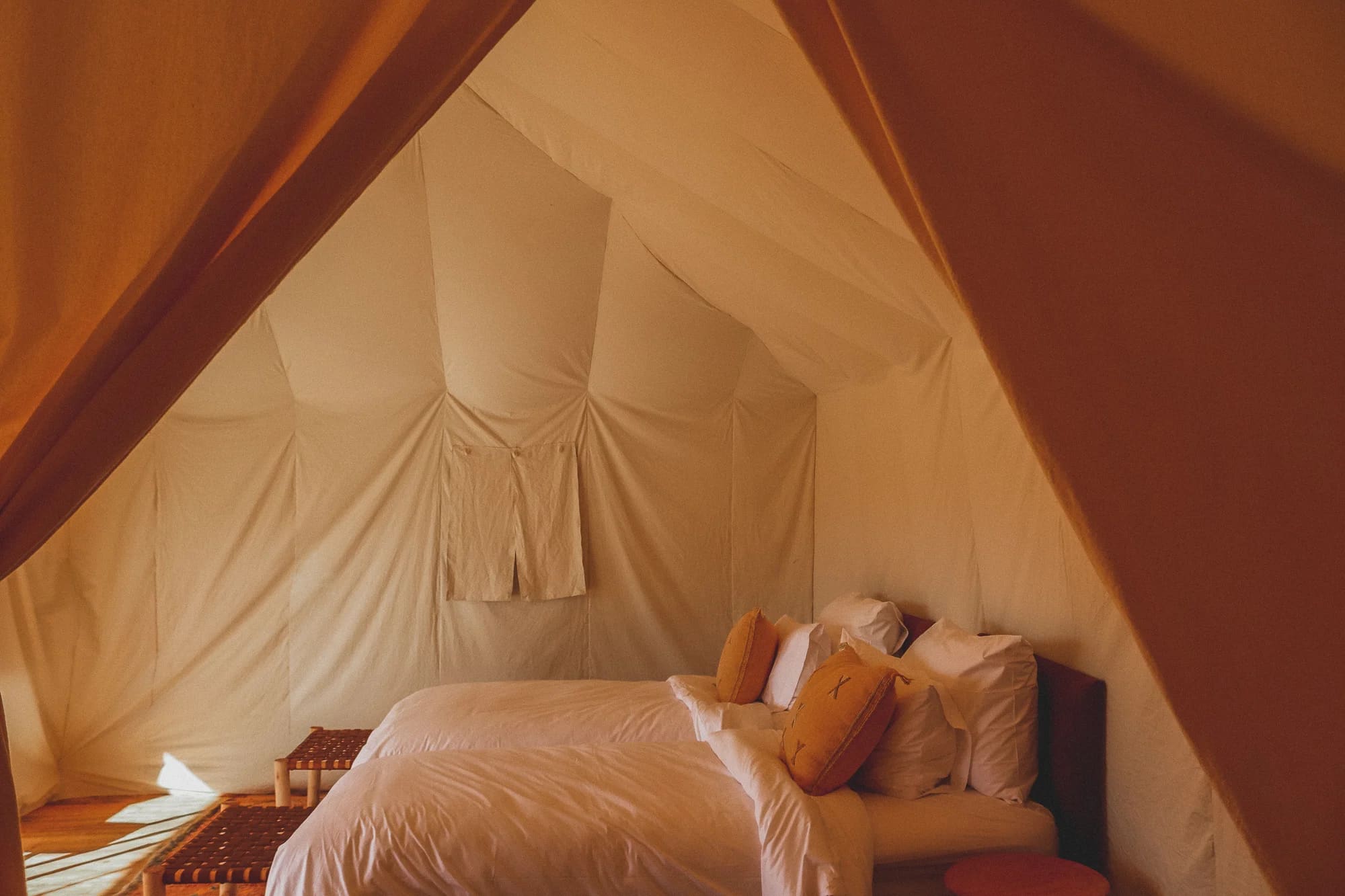
Umnya Desert Camp is a camp of eight tent suites, each with a real bed and a private bathroom, in the dunes of Erg Chegaga in southern Morocco. It has been open since 2019, from September to June. It sits 60 kilometres of piste beyond M’Hamid El Ghizlane, the last town on the paved road, about an hour and a half by 4x4. There is no network at the camp; a signal can be found a short walk away, about twenty minutes there and back. The camp runs on solar power, and the sky is rated Bortle 1.
It is a good choice if you sleep badly because your days are full and your evenings are lit by a screen; if you want darkness and silence that nobody has to enforce; if you are happy with a simple, repeated rhythm of sunrise, movement, rest, an early dinner and stars; and if you are travelling alone, as a couple or with friends who will share a tent.
It is not the right choice if you need a diagnosis or medical follow up: a clinic such as those in the first row of the table is built for that, and the camp is about two and a half hours from the nearest hospital, in Zagora. It is also not the right choice if you only have a weekend, because the journey takes time, or if you want a spa, a gym and room service.
The next date of The Sleep Programme runs from Monday February 8 to Friday February 12, 2027, with fourteen places; other 2027 dates are sent on request. The price is on the programme page. Guests come by road from Marrakech, or fly from Casablanca to Zagora, where the team meets them at the airport; a helicopter from Marrakech is also possible. For more on how the days are built, read our sleep retreat guide.
Frequently asked questions
What is a sleep retreat?
A sleep retreat is a stay of a few nights organised around the night: the place, the timetable and the food are chosen so that sleep has every chance. Some are medical and include tests; most are not and treat nothing.
How much does a sleep retreat cost?
Public prices checked in October 2026 run from £1,650 for two nights in a London hotel, room not included, to £2,759 to £2,899 for five nights at Kamalaya or Six Senses Vana, and from US$6,268 for seven nights at SHA Wellness Clinic. Retreats listed on BookRetreats in England start around US$330 for short stays.
How many nights should a sleep retreat last?
Four to seven nights on site. The first night in a new bed is often poor, and the rhythm of the days needs a few repetitions before it feels natural.
Is a sleep retreat a medical treatment?
Only if it is run by a clinic with doctors and diagnostics. Most sleep retreats, ours included, are not: they offer a better night, not a treatment. If you live with a sleep disorder, speak to your doctor before you book.
Should I choose a clinic or a remote retreat?
A clinic if you need someone to find out what is wrong. A remote retreat if you mostly need a few days in which everything that keeps you awake at home is absent.
Can I go to a sleep retreat alone?
Yes. Many guests come alone. Check the single supplement, which can be large in resorts, and whether the group shares meals, which some solo travellers like and others do not.
Are sleep retreats suitable for couples?
Yes, if both want the same thing. Couples usually share a room; ask whether the beds can be separated if one of you snores.
If you are still deciding between a sleep retreat, a digital detox and a silent retreat, read which one is for you and how to choose a silent retreat.