
Executive burnout does not look like the burnout popular literature describes. It is not the visible collapse. It is the gradual disappearance of the ability to recover: holidays no longer recharge, weekends are not enough, sleep no longer repairs. The machine is still running, but there is no one at the controls.
What follows is not a sales argument. It is an explanation of what the desert does to the nervous system, and why it is different from what a spa, thermal resort, or corporate wellness programme can offer.
The difference between managed calm and structural silence
A five-star spa offers what might be called managed calm: dimmed lighting, soft music, selected scents, staff trained to speak softly. It is an engineering of relaxation. It works for some forms of stress, and not at all for others.
The brain of an executive in burnout is not looking for soothing stimulation. It is looking for an absence of stimulation. These are not the same thing.
The desert offers what neuroscientists sometimes call “attentional restoration”: a near-total absence of external cognitive demands. No decisions to be made (outside the camp). No position to defend. No phone ringing. No hierarchy to navigate. The brain can enter recovery mode because nothing is requiring it to remain in operational mode.
This is structurally different from a spa, where calm is a surface layer on a still-functional environment. In the desert, the environment itself has changed.
What the science of the desert explains
Several decades of environmental psychology research, including the work of Rachel and Stephen Kaplan on Attention Restoration Theory, show that certain environments allow the prefrontal cortex to genuinely rest. These environments share common features: vast, natural, low in stimulation, making no demands for response.
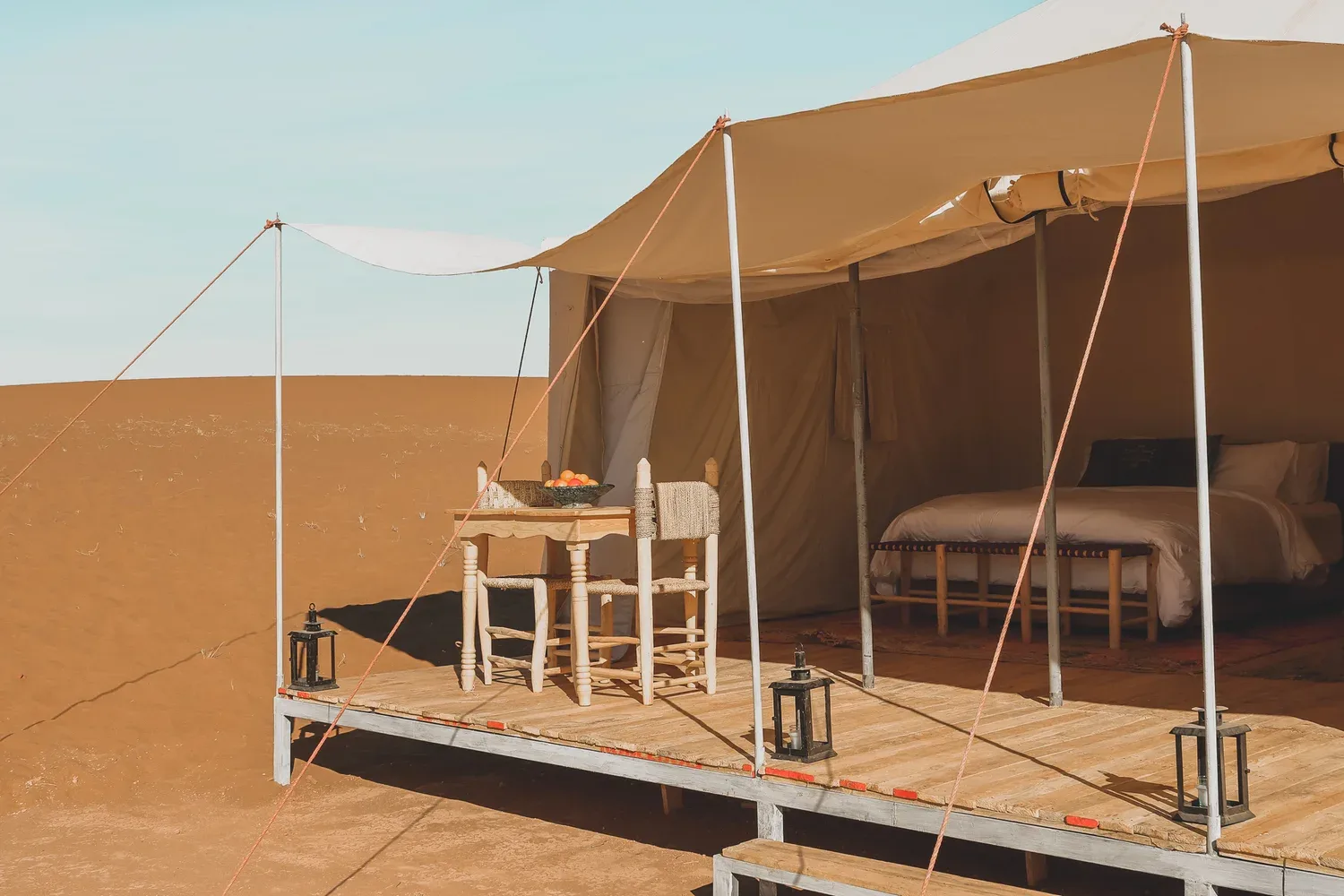
The Sahara meets all these criteria and pushes them to their extreme. Erg Chegaga extends for 40 kilometres without interruption. There is no road, no visible infrastructure, no other human presence within sight. The night sky (Bortle Class 1, the darkest classification possible) confronts the observer with a scale that makes professional concerns physically difficult to hold in the foreground.
This is not metaphor. It is applied neuroscience in a geographic context.
The circadian reset
One of the most common symptoms among executives with burnout is circadian desynchronization: difficulty sleeping before 1 am, waking exhausted, dependence on artificial light and stimulants to remain functional.
The desert is one of the most effective environments for restoring this rhythm, for a simple reason: there is no artificial electricity. The camp runs on solar power. When the sun sets, the light fades naturally. The temperature drops. Melatonin resumes its normal cycle. Most guests report sleeping more deeply by the second night at camp than they have in months.
This is not a placebo effect. It is physiology resuming its normal operation.
What the Umnya private retreat offers
For executives coming for recovery purposes, the camp offers a fully exclusive private retreat of 4 to 7 nights.
The format is deliberately unstructured:
- No imposed schedule
- No personal development workshops
- No coach
- A space, a high-quality service team, and exceptional Berber cuisine
What some guests add: yoga or meditation sessions with their own practitioners brought on-site, long reading or writing sessions in a silence that few environments can offer, or simply schedule-free days with sunrise walks and dinners under the stars.
Full privatization means the guest has no social obligations toward other visitors. For an exhausted executive, even managing small interactions with strangers represents a non-trivial energy expenditure. In the privatized camp, the entire human environment is in service of the guest, not the reverse.
When to come
The ideal window for a recovery retreat is October through mid-May. November through February offers the most favorable conditions: days between 18 and 25 degrees C, cool nights, near-total absence of sandstorm.
For most executives, the obstacle is not the desire to go but the difficulty of “allowing” themselves an absence of 5 to 7 days. What experience shows is that the return from 7 days in the desert is frequently worth several months of avoided sick leave and a restored decision-making capacity that is measurable in the weeks following the return.
What this is not
This is not a therapeutic stay. There is no doctor, no psychologist, no treatment programme. If you are in severe burnout or clinical depression, this stay does not replace medical care.
What the Sahara offers is something prior to therapy: an environment in which the nervous system can begin doing what it is designed to do when you stop interrupting it.
The executives who come to Umnya for this reason tend to describe the experience in the same terms: they had not expected quiet to feel that physical, and they had not expected four days to make that much difference. Coaches and practitioners planning a recovery programme for clients can start with our guide for retreat hosts.
To discuss a private recovery retreat, contact our team.


