
The camel is already standing when you wake up.
It’s chewing quietly in the dark, watching the guide prepare tea. The desert air at this hour is still and cold, with a quality that will be completely gone in two hours. You load the saddlebags. The camel waits. The trek begins.
Multi-day camel trekking in Erg Chegaga is not an extended tourist excursion. It’s a Berber practice that predates tourism by several centuries: the trans-Saharan salt caravans, the trade routes between Morocco and sub-Saharan Africa, the seasonal movements of nomadic families. What Umnya organises today continues that lineage, with guides whose families have ridden these routes for generations.
What the body goes through
The first day is adjustment. The position on a camel is not uncomfortable, but it isn’t natural either. The traditional Berber saddle is designed for long distances, not for immediate comfort. The distinctive lateral sway of the camel’s walk takes an hour or two to absorb. After that, the body finds its rhythm.
This is not intense cardiovascular effort. It is a test of posture and endurance. Four to five hours in the saddle per day is standard on a multi-day trek. Your legs don’t tire the way they do on a hiking trail. It’s the lower back, hips and inner thighs that take the load. Most travellers in reasonable general fitness adapt without significant difficulty.
What no one tells you: walking beside the camel is always an option. The best guides read fatigue before you articulate it.
The routes through Erg Chegaga
Erg Chegaga is Morocco’s largest erg. Its dunes reach 300 metres in places. The dune system extends more than 40 kilometres east to west, with corridors of compacted sand between the major formations that allow camel travel.
Standard trek routes depart from Umnya Camp northeast into the erg’s interior, then branch depending on duration. A two-night trek crosses the first dune ridges and reaches a hamada plateau with a full view of the erg. A three-night trek or longer reaches the erg’s interior zones, less travelled, where dune density is at its highest.
There is no marked trail. The guide reads the landscape: sand colour indicates compaction, ridge direction indicates prevailing wind, the presence of xerophytic plants indicates subsurface moisture. This reading of the desert is a skill transmitted orally across generations.
What to bring and what to leave behind
The desert rule applies: every kilogram matters. Camel saddlebags have limited capacity. Umnya provides a specific preparation list before each departure.
Essentials: serious sun protection (wide-brim hat, sunglasses, SPF 50+), layers for the nights (temperatures can drop to 5 degrees Celsius in peak trek season), a minimum two-litre water bottle, closed shoes for walking beside the camel on rocky stretches.
Leave behind: rolling luggage, fragile devices, expectations of hotel comfort. What you find instead: silence, slow progress through a landscape that changes in ways photographs don’t capture, and a quality of attention the desert installs gradually.
Nights between the dunes
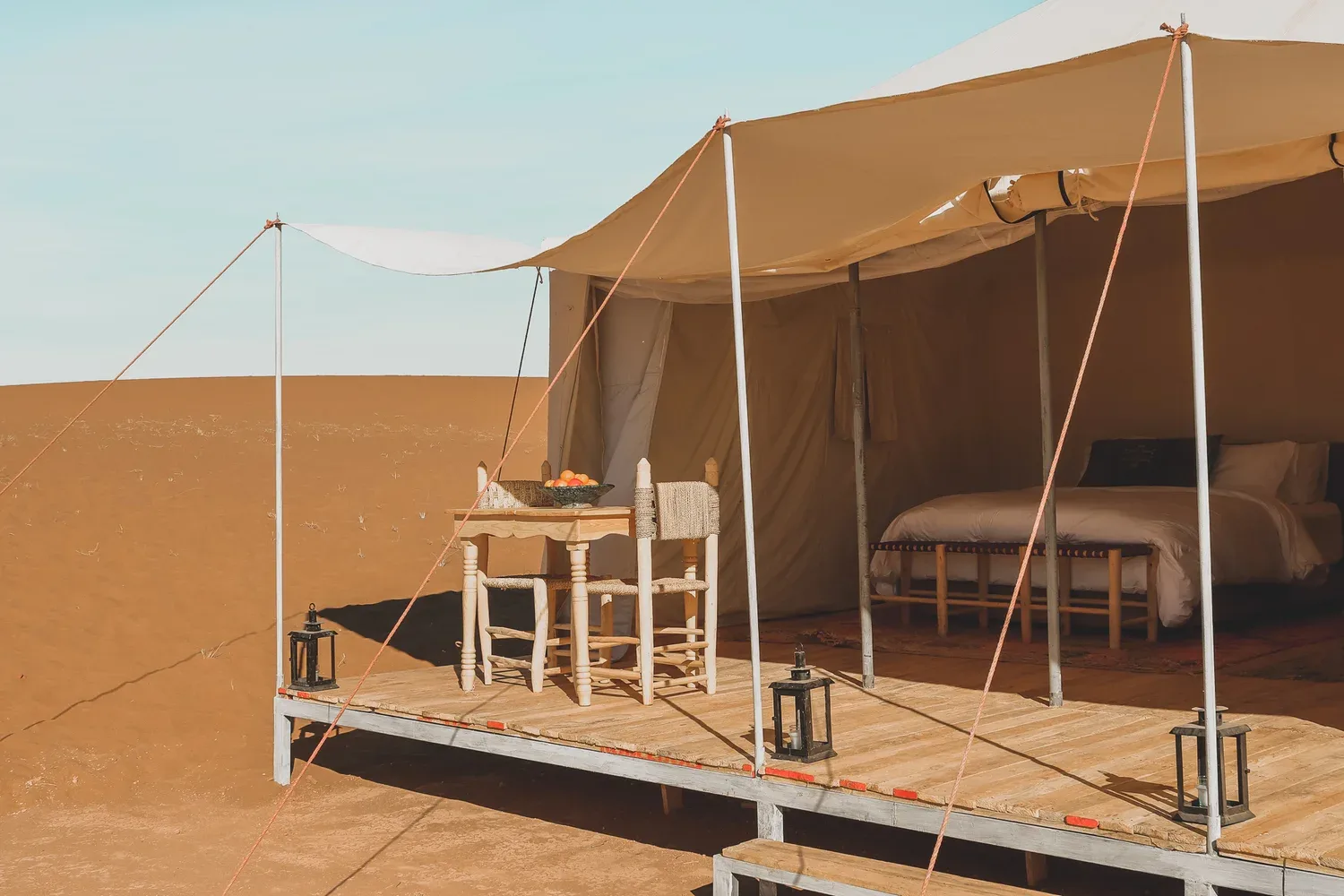
The night camp is set in a sheltered sand corridor. Tents are lightweight, with Berber wool blankets. The cook prepares on a wood fire: bread buried in embers, tagine on coals, tea poured high into small glasses.
The sky above Erg Chegaga is rated Bortle Class 1, the darkest category on the light pollution scale. In practical terms: the Milky Way casts a faint shadow on the sand. Stars are visible to the horizon in every direction. There is no anthropogenic sound.
The guides know the stars by their Arabic names. If you ask, they will show you.
How Umnya organises departures
Treks depart on request, by reservation. Each departure is private: your group, your camels, your guide. No sharing with other travellers.
The minimum recommended duration is two nights, to allow the desert enough time to open. One night is possible, but something essential is missing. Three or four nights, for those with time, turns an experience into something harder to categorise.
For available dates and logistics, contact the camp directly.
On the second night, the question of speed stops being relevant.


