
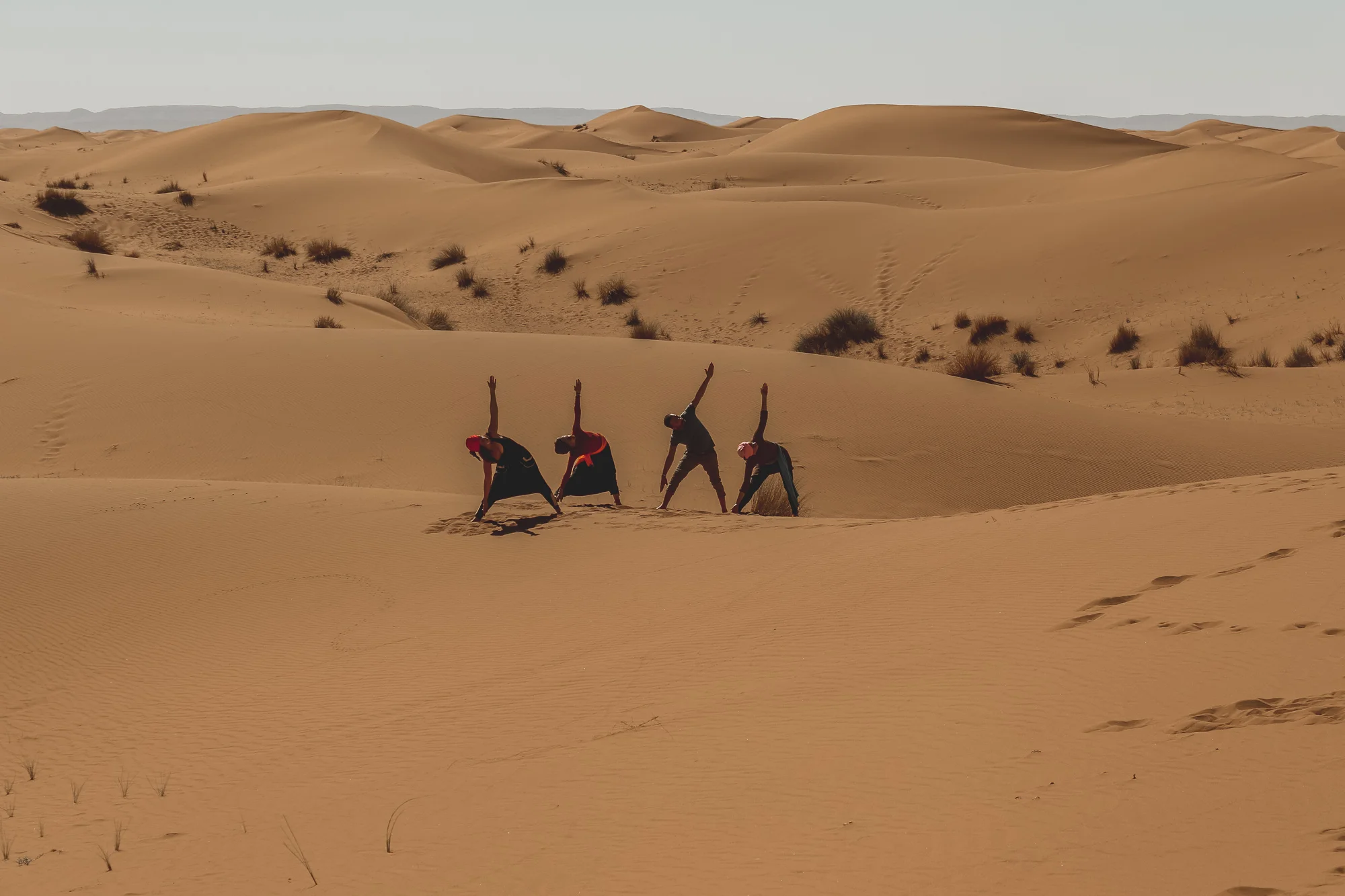
Pilates and Movement · Erg Chegaga · Morocco
Bring your students
to the Sahara
The whole camp for your group, eight tented suites, firm sand at first light. You teach your method. We carry the rest.
Describe Your ProjectWhy the Sahara
Sand gives nothing back
A studio floor is generous. It returns the push, it holds the alignment for you, it lets a student get through a plank on momentum. Sand does none of that. Every point of contact sinks a little, the base of support keeps moving, and the small stabilisers that a mirror lets people avoid have to do the work. Teachers tell us the same thing afterwards: cues that had gone stale in the studio suddenly land, because the body has no way to cheat them.
The second thing the desert does is quieter. There is no Wi-Fi and no network in the camp itself. No traffic, no notifications, no reason to check anything. Students who normally arrive distracted settle within a day, and the attention you usually spend gathering the room goes into the work instead.
Umnya Desert Camp sits in the Erg Chegaga, the most remote dune field in Morocco, sixty kilometres of piste beyond the last paved road. The night sky is Bortle Class 1, which means no light pollution at all. None of this is decoration around a retreat. It changes what a session feels like.
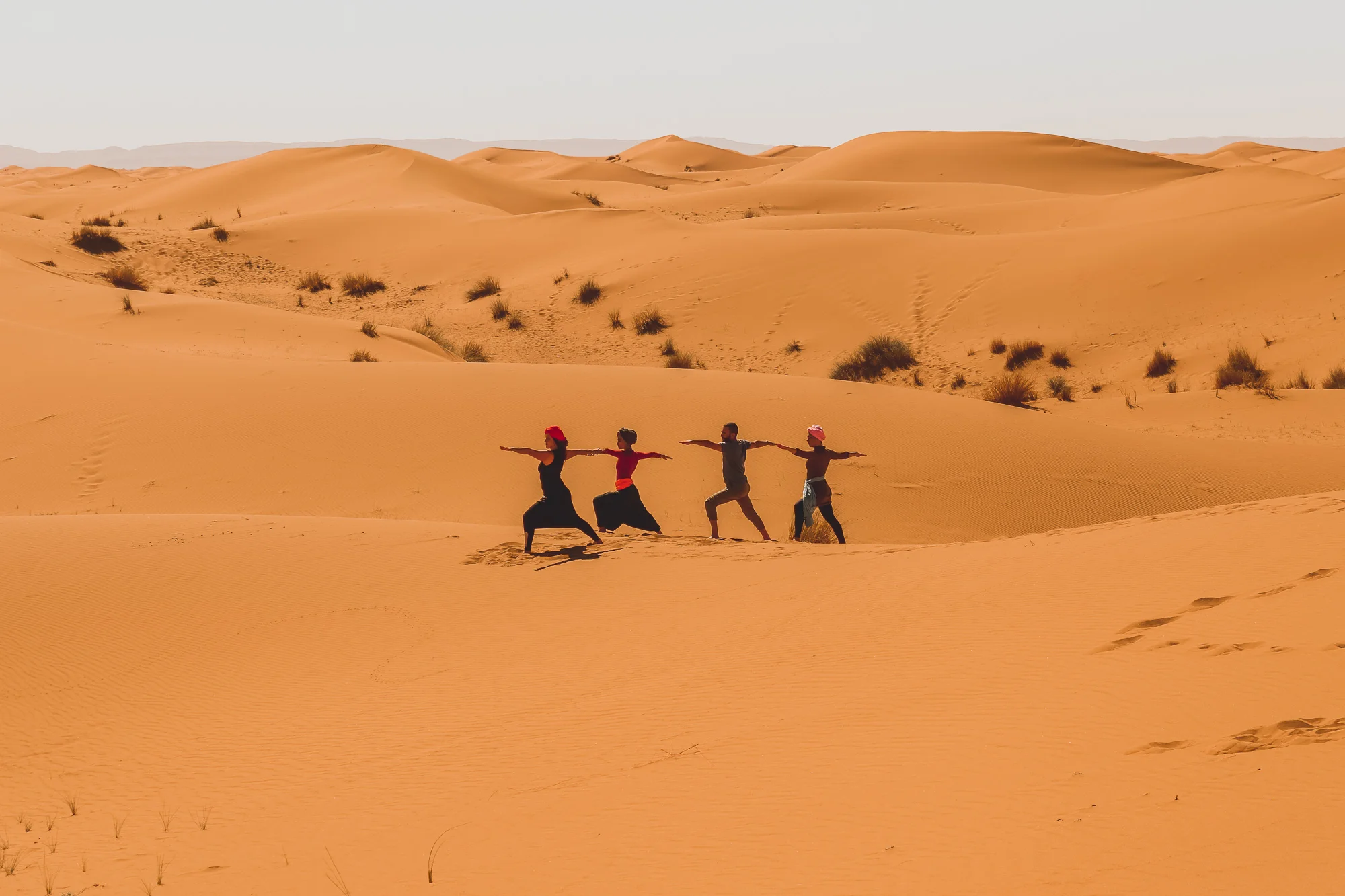
What the camp carries
You teach. We hold everything else.
Most teachers take the whole camp, from 2 to 18 guests and up to 20 with extra beds. When you do, it is yours alone, which means the schedule of the day is yours to set.
The Whole Camp
Eight tented suites, each with its own bathroom, hot water, electricity and a terrace facing the dunes. No shared dormitories and no other group on site.
Space for Mats
Firm sand at first light, wooden decks in front of the tents, and a covered majlis that takes the whole group. Mats laid out where you ask for them.
Three Meals a Day
Cooked at camp by our Berber kitchen. Tagines, fresh bread, amlou, seasonal fruit, mint tea. Vegetarian and other requirements arranged in writing before arrival.
Transfers and Logistics
Our drivers, our 4x4s, from Marrakech or from M'Hamid El Ghizlane. Luggage, water, the last sixty kilometres of piste, the arrival timed so nobody lands in the dark.
The Hours You Are Not Teaching
Camel walk at dusk, silent morning walk with a Berber guide, sandboarding, fire and stargazing under Bortle Class 1 skies. Your students are looked after while you rest.
Your Programme Stays Yours
We send no teacher of our own and we do not touch your curriculum. Method, sequencing, timetable and the terms you set with your students remain entirely yours.


Where a session happens
There is no studio, and no flat floor
We would rather you read that here than discover it after the piste. The camp has no reformers, no towers, no sprung or dance floor. What it has is three surfaces, and most teachers build the week around them.
Firm sand at first light, before the sun has loosened it, is the best outdoor hour of the day and the one that changes how a mat sequence feels. The wooden decks in front of the tents are level, shaded and small: useful for private work, assessments or a one to one. The covered majlis takes the whole group seated or on mats, and it is where anything unsuited to sand belongs, along with the middle of the day, when nobody should be working in the sun.
Mats are laid out wherever you want them, and we confirm the number in writing before you travel. If your method needs a particular surface or a particular piece of kit, write to us before you commit. We will tell you what can be organised and what cannot, rather than agreeing and hoping.
The shape of a day
A day when you are the one teaching
First Session, on the Sand
Cool air, long shadows, the surface at its firmest. The hour most teachers keep for the strongest work of the day.
Breakfast
Long and unhurried, outdoors or under cover. Bread, amlou, fruit, eggs, mint tea and coffee, served at the pace you set.
Your Students Are With Us
Dune walk with a Berber guide, camels, sandboarding, or nothing at all. This is the window teachers use to rest, prepare or take a session off.
Lunch, Then the Quiet Hours
The high sun settles the question of whether to programme anything. The majlis is cool, and most groups read, sleep or talk.
Second Session
Under cover in the majlis, on a deck, or back on the sand as the light goes long. Slower work, mobility, breath, recovery.
Sunset on the Dune
Twenty minutes up the big dune behind camp. A phone signal can be found a short walk from camp, about twenty minutes there and back, which groups discover on the first evening.
Dinner by the Fire
One long table, tagine, musicians when you want them and silence when you do not. Groups tend to say the week turned here.
Bortle Class 1
The Milky Way without a telescope. Some teachers close the day here with breathwork, most simply let people lie on the sand.
Season and weather
When to come, and what the desert does to a timetable
The Season
The camp is open from September to June and closed in July and August. From October to April the days run between 18 and 28 degrees, which is the range most groups want for two sessions a day. In December and January the days hold between 18 and 24 and the nights drop to between 2 and 8, so a morning on the sand asks for layers and a longer warm-up. If you are weighing one month against another, our note on the best time to visit the Sahara goes month by month.
Wind, Rain and the Plan B
Rain is rare and brief. Wind is ordinary, and a strong one moves sand, which can take the open dune out of the morning. The answer is the same in both cases: the session goes into the covered majlis, which holds the whole group, and the outdoor slot shifts by an hour or two rather than being lost. Teachers who plan one indoor option a day never have to improvise in front of their students.
Who brings a group here
Teachers with their own people
Pilates and Lagree instructors, barre and strength coaches, studio owners taking their regulars somewhere once a year, teacher trainers running a module away from the studio. The common thread is simple: you arrive with your own students, and you already know how you want the week to run.
The camp holds from 2 to 18 guests, and up to 20 with extra beds. It is quoted as a whole, case by case, never per person, so there is no minimum group you have to reach before we will talk. The useful number is the one you know you can fill. If you are still working out how the week holds together on paper, our note for retreat leaders sets out how organisers usually structure it.
The minimum stay is 2 nights. For a retreat that actually teaches, plan 4 or 5, which leaves two or three days that are not travel days. Send your dates and the shape of your group, and a written proposal follows within 24 hours. A deposit of 20 per cent holds the dates.
Getting your group here
Marrakech to Erg Chegaga
By Road
About 8 hours 45 from Marrakech: 7 hours 15 of tarmac through the Draa Valley to M'Hamid El Ghizlane, then 1 hour 30 of piste over the last sixty kilometres, in our 4x4s with our drivers. It is a long day, and worth telling your students plainly in advance. The detail of the route is set out in how to reach Erg Chegaga.
By Helicopter
From Marrakech Menara it is 1 hour 40, landing at camp, with five or six seats per rotation. Groups sometimes use it one way only, flying in on the first day so the opening session happens that evening, and taking the road back when nobody minds a slow return.
8
Tented Suites
2 to 18
Guests, 20 With Extra Beds
1
Bortle Class Sky
24h
Written Reply
As Featured In
Frequently asked questions
How many students do I need to bring for this to work?
Is there a studio, and what do we actually practise on?
Do you have reformers, towers or any Pilates apparatus?
What do you take care of, and what stays mine?
What happens if it rains, or if the wind gets up?
When is the camp open, and what should we expect from the weather?
How long is the journey, and how many nights should I plan?
Will my students be able to get online while we are there?
Tell us what you are planning
Describe Your Retreat
Your method, the dates you are considering, the group you expect to bring, and anything your sessions need from the ground up. A written proposal follows within 24 hours. If you want the wider picture first, hosting your retreat at Umnya covers how the camp works for a facilitator.
Private buyout
Ask for your dates
The whole camp for your group, from two guests to eighteen. Tell us when and how many of you: a written proposal for the whole camp comes back within 24 hours, with no commitment.
-
2019
Open since
-
4.8★
TripAdvisor
-
8 tents
The camp to yourselves
-
24h
A written proposal, no commitment
