For a senior leader, exhaustion comes with a second problem. The first is the exhaustion itself. The second is that nobody can be allowed to see it.
A chief executive who checks into a well known burnout clinic creates a piece of information that boards, investors and competitors all find interesting. A stay at a prominent wellness resort ends up on Instagram, if not through them then through another guest. And the third option, simply carrying on, is the most expensive of all, for the person and for the company.
There is a fourth option, and it sits at the end of a sand track in the Moroccan Sahara.
The discretion problem, looked at honestly
In most leadership cultures the conversation about exhaustion is ambivalent. People discuss it, but in the abstract. Specifics are unwelcome. A break therefore has to meet two conditions that normally contradict each other: it has to work, and it has to leave no trace.
Umnya Desert Camp meets both through its structure:
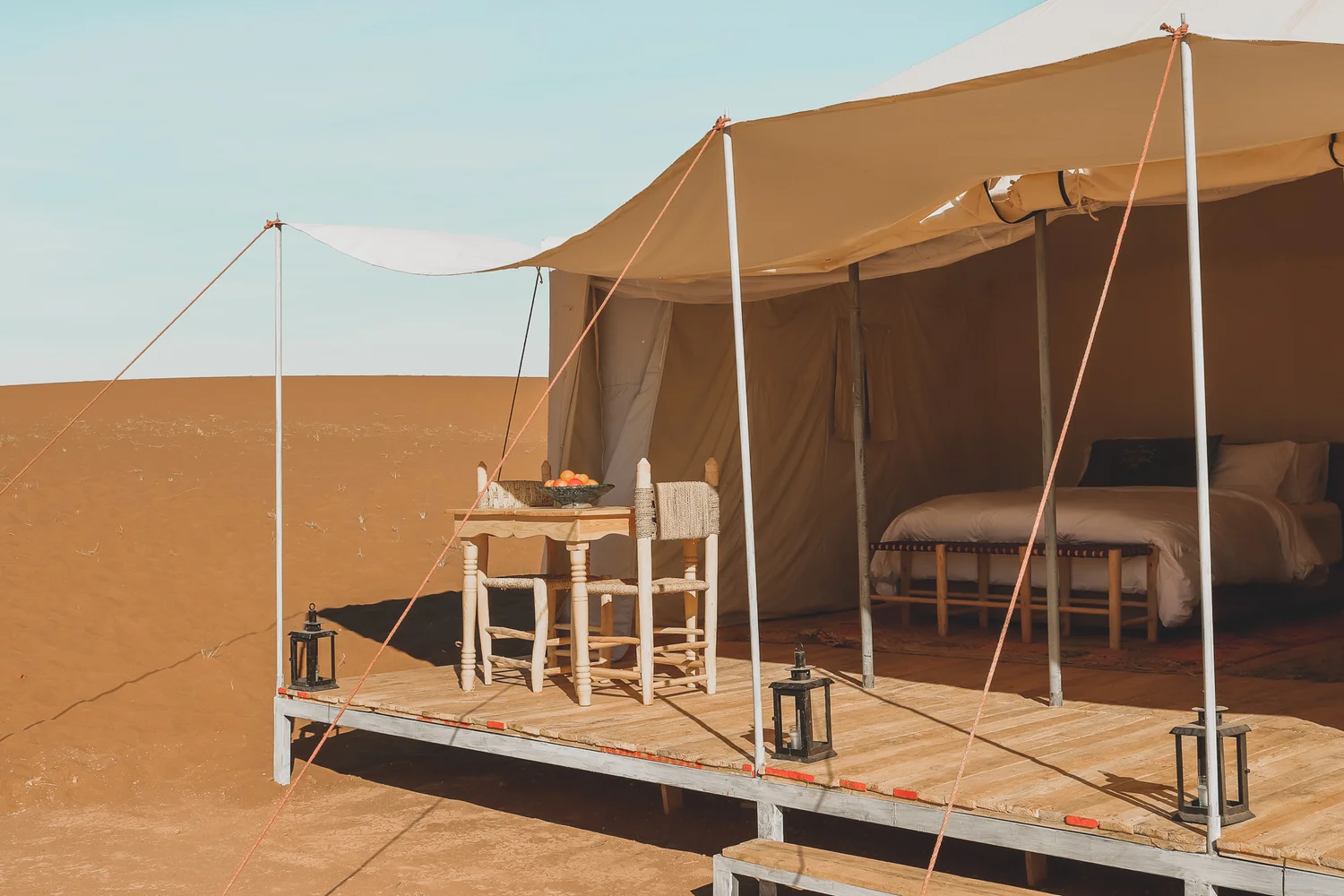
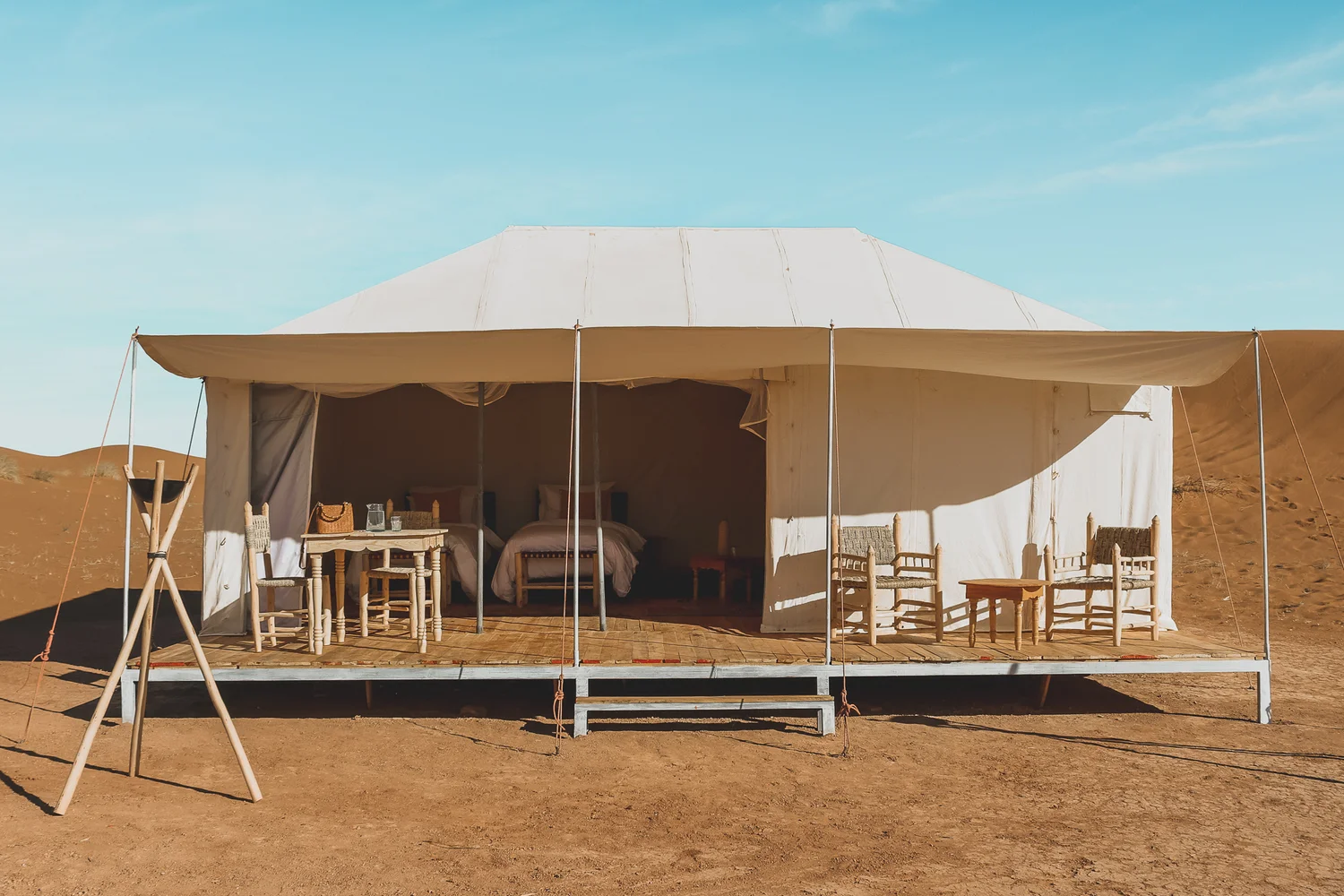
- Full privatisation. Eight tent suites, each with its own bathroom, for two to eighteen guests, and up to twenty with extra beds. One group at a time, always. Who comes is your decision. No other guests, no lobby, no chance encounters.
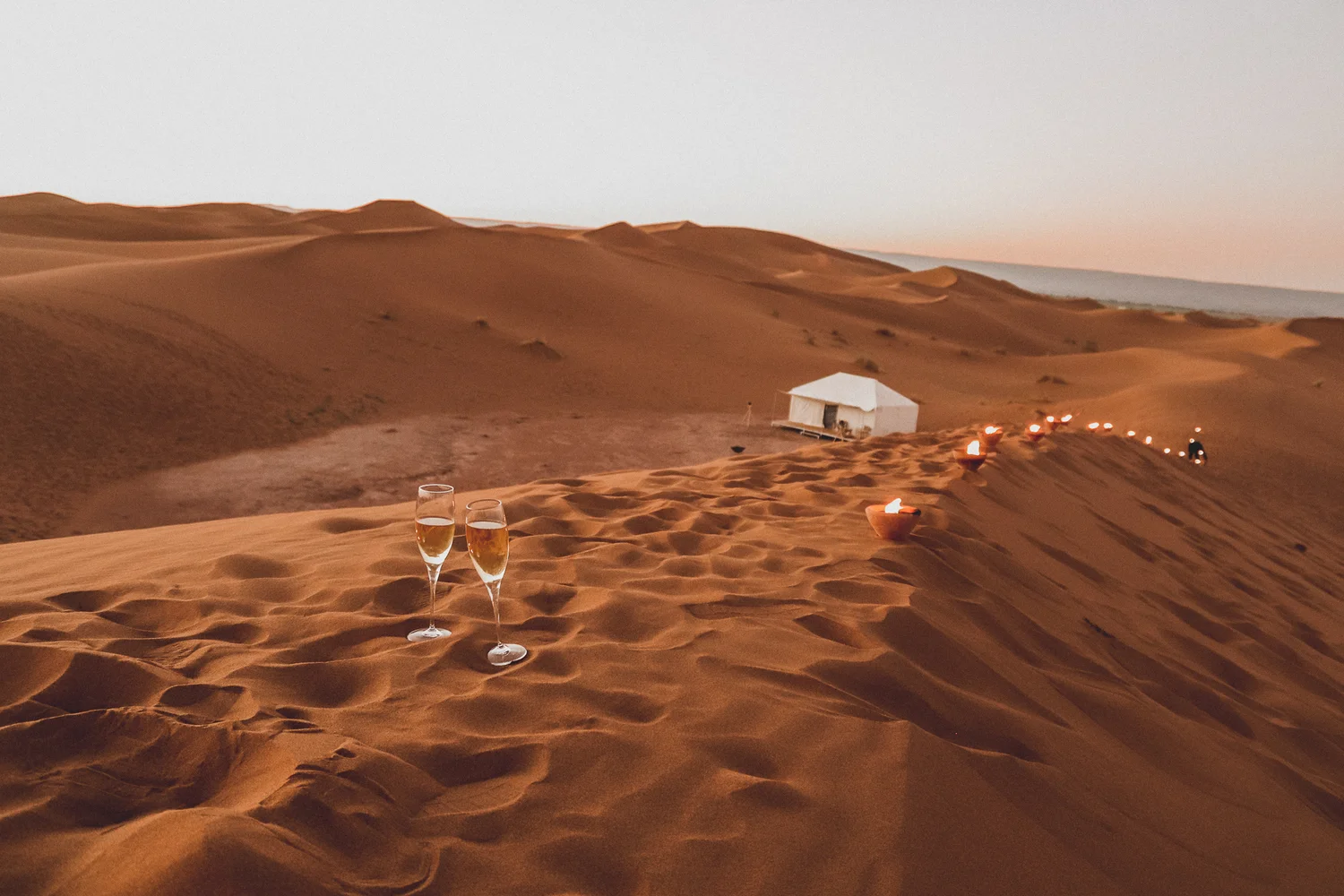
- No visibility. The camp sits at Erg Chegaga, sixty kilometres beyond M’Hamid El Ghizlane, the last village on the road. There is no passing trade and there are no photographers. Seen from outside, your stay is a trip to Morocco, nothing more.
- No signal. There is no mobile coverage in the dunes, apart from the top of the great dune, about twenty minutes there and back. That protects the rest as much as the discretion: no location data, no spontaneous posts, no availability that would have to be explained.
More on how privatisation works on the Private and Exclusive page.
What the desert does with exhaustion
We have described elsewhere, at length, why the desert works for executive burnout. The short version, with no promise of a cure:
Exhausted leaders rarely suffer from a shortage of comfort. They suffer from a nervous system that can no longer leave alert mode, because daily life sets it off again every few minutes. Email, phone, decisions, responsibility. Rest begins only when those triggers are not reduced but removed.
The Sahara removes them structurally. No reachability, no appointments, no artificial light, no noise. The day is organised by the sun rather than by the calendar. Guests tend to describe deeper sleep from the second night, and a slower mind from the third day. Not because something is being done to you, but because nothing is acting on you any more.
There is one further factor that leaders often underestimate: the absence of an expected role. In the camp you are not a chief executive. The team does not know what you run, and nobody is curious. For people who have embodied a function in every room for years, that turns out to be an unfamiliar kind of relief.
What a desert break is not
Honesty requires the boundary. Umnya is not a clinic and not a medical programme. A severe depressive episode or an acute collapse belongs in the hands of a doctor.
The desert break is meant for the stage before that, which is where most exhausted leaders actually are: still functioning, but with a shrinking capacity to recover. Holidays no longer recharge, weekends are no longer enough, sleep no longer carries. At that stage a radical change of surroundings is often worth more than any programme, and it can be arranged without a label attached to it.
On request we host stays alongside external coaches or therapists whom you or your group bring along. The camp provides the setting, the professional side stays in your hands and inside your own relationship of trust. Our page for retreat hosts describes how that collaboration works in practice.
The shape of a week nobody counts
A format that has served executive breaks well runs five to seven nights.
Arrival: discreet and efficient. A flight to Marrakech, then a private helicopter straight to the camp, about one hour forty in the air. The alternative is the land route through the Draa valley, roughly eight and three quarter hours from Marrakech including an hour and a half of track, which many guests choose deliberately as decompression.
Days one and two: nothing. That is meant literally and it is the hardest part. Sleeping, eating, sitting on dunes. The system winds down.
Days three to five: structure returns, but a different one. Walking in the morning, reading and quiet in the middle of the day, fire in the evening and a Bortle class 1 sky that reorders your priorities without saying a word. Anyone who wants to can add breathwork or sessions with the coach they brought.
The final days: integration. In our experience leaders start thinking clearly again from day five, often more clearly than they have in months. Many make decisions in this phase that they had been putting off for a long time. A notebook belongs in the luggage.
Reachability in an emergency: the camp manager carries a satellite phone, and there is coverage at the top of the great dune, about twenty minutes there and back. There is no wifi. A defined channel for genuine emergencies can be arranged, so that the absence holds without being reckless. That is usually the point which reassures boards and assistants.
What the people around you learn, and what they do not
A practical note from our experience with executive guests: communicating this internally is easier than most people expect. “A week in Morocco, largely offline, emergency channel in place” is a completely plausible description of a holiday and raises no questions. It requires neither a diagnosis nor an explanation, and it is true. On request, assistants receive a precise schedule from us with windows of reachability, without the calendar having to say anything more than “travel”.
Why abroad, why Morocco
For guests flying in from Europe the location has three unglamorous advantages. First, distance: far enough that nobody drops by, close enough for a short flight and no jet lag. Second, improbability: you do not run into business contacts in the Sahara, whereas in Gstaad or Ibiza you might. Third, the season: the camp is open from September to June and closed in July and August, and from October to April the days settle between 18 and 28 degrees under clear nights, at exactly the time of year when the sky back home is grey.
Three ways leaders use the format
Alone or as a couple. The classic version: a week, the camp to yourselves, with a partner if you wish. No programme, a great deal of sleep, long walks. For many guests the first week in years in which nobody wants anything from them.
With someone you trust. Some leaders bring their long standing coach, therapist or sparring partner. The camp provides the setting in which conversations become possible that ordinary weeks give neither time nor space for. The sessions happen on dunes rather than in consulting rooms, and the evenings belong to silence.
As a small circle. Two to four entrepreneurs or board colleagues who trust one another share the camp. No mastermind programme, no agenda, simply the rare combination of company and quiet among people you never have to perform for. If you want a structured group format, the piece on the CEO mastermind retreat in the Sahara covers it.
All three versions have one thing in common: from the outside they stay invisible. There are no participant lists, no name badges and no organiser advertising references.
The first step
We treat enquiries for executive stays with the same discretion as the stay itself. An email through our contact page with your dates and the number of people is enough. You receive a written answer within 24 hours and a proposal made for you: a single price for the whole camp, set case by case, with no obligation to get on a call, no newsletter, and no name landing in a system that does not need it.
The Glamping in Morocco page gives an impression of the camp itself. The rest is hard to describe and easy to experience: it is very quiet here. That is the whole point.
If the length of stay is still open, how many nights in the desert shows what each additional night brings and what a day in the camp really looks like.
For a leadership team rather than a circle of friends, the page on the executive offsite describes the working majlis, the confidentiality agreement and invoicing to the company.