
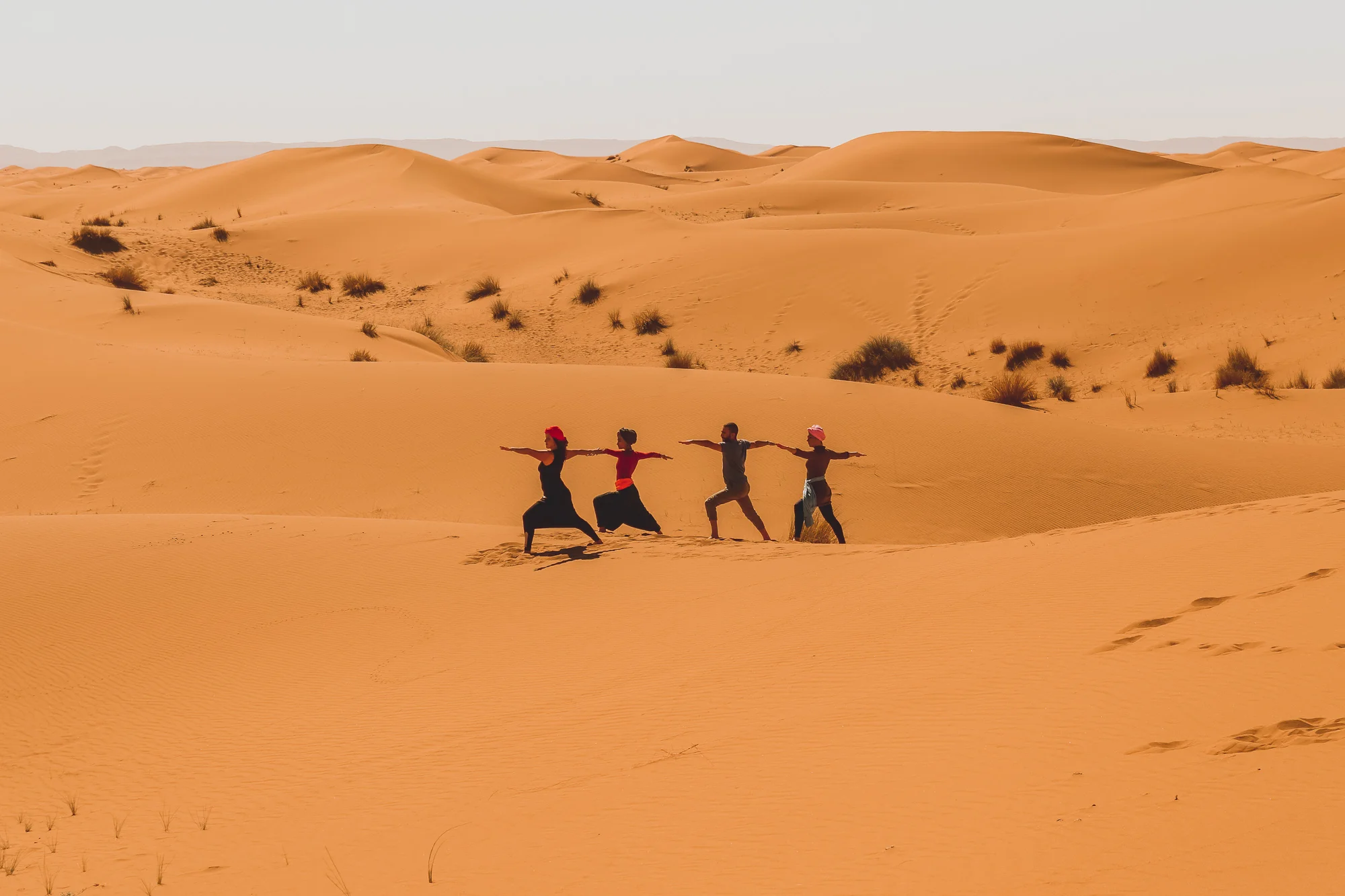
Women's Empowerment Retreat Morocco
What the desert offers that nowhere else does
There are many places that call themselves retreats. Renovated farmhouses, Bali villas, Tuscan hillsides with group dinners and structured programmes. They are not bad. But they all share a common property: they are watched. Other guests at breakfast. Staff who know your name by day two. A social layer that requires, constantly and lightly, a version of yourself.
The Sahara removes this entirely. Erg Chegaga sits sixty kilometres from the nearest paved road. There is no mobile signal because there is no signal tower within range. At full camp privatization, which is how this retreat is designed to run, there are no other guests. The camp team is there, and invisible when you don’t need them. The desert itself is simply there: forty kilometres of dune in every direction, a horizon that does not contain a building or a vehicle or another human being.
What this produces, structurally, is the removal of audience. And the removal of audience turns out to change something that is difficult to name but easy to feel. Within twenty-four hours, most women describe a specific lightening. Not relaxation, but something more precise. The performance stops, because there is no one to perform for.
The morning walk
Each day begins the same way: at 5:30am, a single knock on the tent canvas.
Your Berber guide is outside. He will walk with you through the dunes for ninety minutes before the camp wakes. The route follows the dune crests toward the east. He does not speak during the walk, not from lack of English, but from a different relationship to silence in this landscape. He navigates by stars and sand texture. He stops when there is something to see: fox tracks in the pre-dawn dark, a shift in the wind that changes the dune surface overnight.
The sunrise over Erg Chegaga takes forty-five minutes from first light to full morning. Purple into red into orange into white. The dunes are split between lit and shadow in a way that photographs reliably fail to capture. Most people stop walking on their own at some point during this sequence. The guide stops too.
This walk, silent, structural, without agenda, is what many guests identify as the axis of the experience. Not the dinners, not the stargazing (which is extraordinary), not the yoga. The walk in the dark, with a guide who knows this place the way most people know their own street, and the particular silence of a desert that has been silent for longer than the concept of silence has existed.
The group dynamic
In a group of women in a place where there is no audience and no schedule, something different happens to the conversation. It does not happen on day one. Day one is still social: careful, polite, the normal work of strangers establishing territory. By day two, this dissolves. Not because of a facilitated exercise or a sharing circle, but because the desert erodes the conditions that make performance necessary.
The conversations that emerge by day three are different in kind. Not therapeutic: most women are not here for therapy and don’t want it. But honest in a way that is rare outside very old friendships or very specific circumstances.
This works for solo women who arrive without knowing anyone else in the group. It works for duos: two friends, two colleagues, two sisters who haven’t spent a week together since childhood. And it works for groups that arrive as a whole: a team, a cohort, a group of women at a professional inflection point who want to think clearly together somewhere that isn’t a conference room.
Stargazing
Erg Chegaga has a Bortle Class 1 sky rating, the highest classification for darkness. This is not a marketing claim; it is a light pollution measure. At this classification, the Milky Way is not a faint smear but a full-colour band with structural detail visible to the naked eye. Saturn’s rings are visible through the camp telescopes. Shooting stars average several per hour.
The session runs after dinner, in the open desert several hundred metres from the tents. An astronomer, part of the Umnya team, runs it without agenda, following what guests are curious about. It lasts until people are cold or sleepy, which in winter months is usually around midnight.
Many guests say they didn’t understand what a Bortle Class 1 sky actually meant until they saw it. It is one of those things that exceeds the description.
Sleep
The cold at night in the desert, genuine cold, below 10°C in winter, produces a quality of sleep that most guests have not experienced since childhood. The tent is insulated and warm. The silence is absolute. There is no light pollution. The body, having walked and eaten and looked at an unmediated sky, tends to shut down completely and stay down for eight or nine hours.
This is not trivial. Many women who come to this retreat are operating on sleep deficits that have become normalized. The desert normalizes something else instead.
Who this is for
This is not a beginner retreat. It is not designed for someone who needs to be persuaded that silence is valuable, or that walking in the desert is preferable to lying by a pool. That woman would be happier somewhere else.
This is for women who already know what they need and have not been able to get it. Who have tried the meditation app, the weekend getaway, the yoga holiday, and found that the machinery of ordinary life reasserted itself within seventy-two hours. The structural difference here is not the quality of the meditation instruction or the food (both are good), but the fact that the desert is genuinely, physically unreachable by the ordinary machinery of life. There is no signal. There is no road. The distance is real.
It is also for women who do not have a specific crisis to work through, but who have recognized, quietly, that they are tired in a way that sleep does not fix, and that they need a certain quality of emptiness before they can think clearly again.
How to come
Solo: arrive alone, join whichever women are at the camp during your dates, or arrange a private experience with the guide and camp team as your only company.
As a duo: two women traveling together. Full privatization strongly recommended: the camp is yours.
As a group with a facilitator: you bring a coach, therapist, yoga teacher, or programme leader. We provide the space, the logistics, the food, the treks, and the stargazing. The content is yours. We ask to be briefed on format in advance to ensure the camp team supports rather than interrupts the programme.
The retreat runs October through April. Minimum stay is three nights; most guests extend to five. The camp accommodates up to eight women for this format; full privatization, no other guests for the duration of your stay, is available and strongly recommended for groups of five or more.
For the morning trek in detail: Walking with Nomads, Silent Sunrise Trek.
