5:30am. A knock on the canvas.
Not a loud knock. More like a single tap, the kind that assumes you are already half-awake. Which you probably are. The cold does that.
At this hour, the Sahara is not warm. The tent walls hold their chill from the night. Your breath is visible. You reach for the fleece left at the foot of the bed, find it, pull it on without getting up. Through the canvas you hear nothing: no wind, no birds, no generator, no other guests moving. Just the particular silence of a desert that has been quiet for millions of years and sees no reason to change.
The guide waits outside. He has been awake longer than you. He will not knock again.
The first steps
Outside, the sky is the colour of deep water, not black, not blue, something between the two that doesn’t have a name in English. You can see the silhouettes of the dunes. You can see stars, still, in the part of the sky away from where the sun will come.
Your boots make a sound on the sand that you have never made before, because you have never walked on sand exactly like this. It is softer than beach sand, finer, and it compresses slightly before giving way. The sound is a low, dry whisper, not a crunch, not a scrape. Each step announces itself and then disappears.
There is no other sound within sixty kilometres.
The guide sets the pace without speaking. This is not the silence of a language barrier. He speaks French, English, some Spanish. He simply does not speak here. You understand within the first hundred metres that this is intentional, and that the right response is to follow.
What Brahim communicates without words
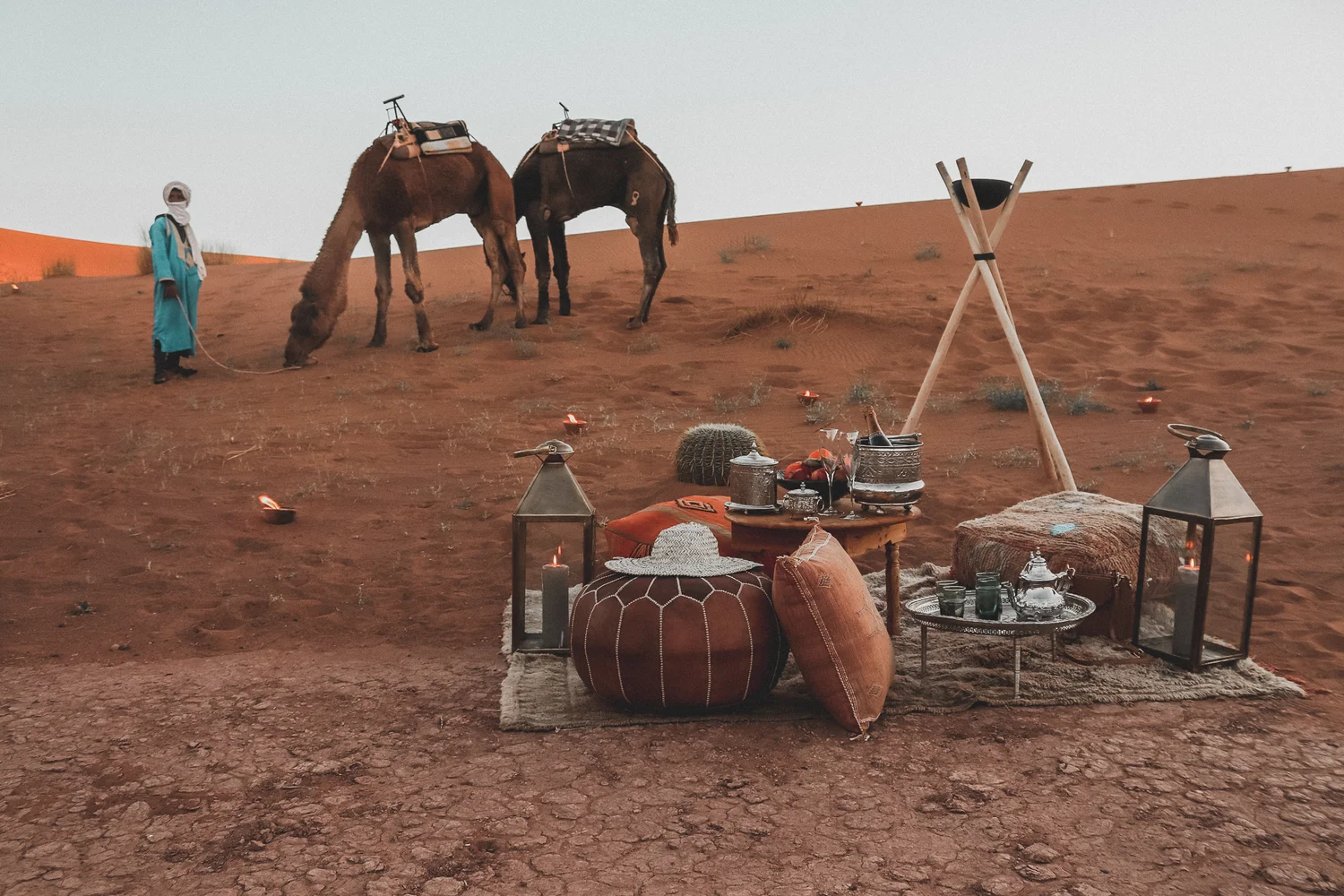
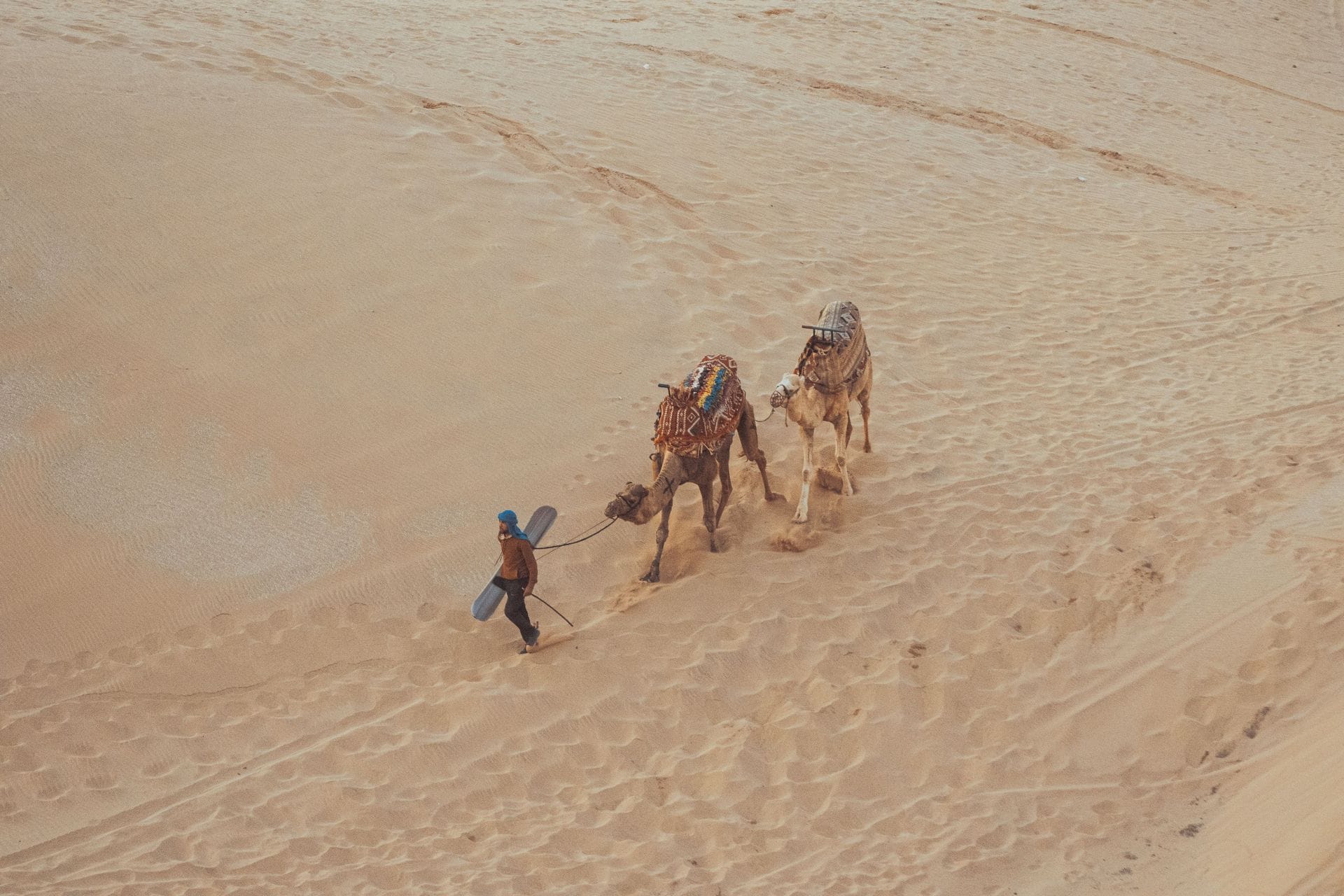
The guides at Umnya are Berber, from families who have lived in and around Erg Chegaga for generations. Their relationship to this landscape is not romantic: it is technical, intimate, and entirely practical. They know which dune slopes hold firm in the morning cold and which will give way underfoot. They know where the wind came from last night by looking at the ripple patterns in the sand.
When Brahim, or whichever guide you walk with, raises a hand, he means stop. Not urgently. Just: look. There, forty metres ahead, the prints of something small. Fennec fox, probably, out before dawn. The track moves in a straight line and then disappears where the wind has smoothed the surface. He has spotted this in the half-dark without slowing down.
When he adjusts direction with a slight angle of his shoulder, he is navigating. Not by GPS, but by the quality of the horizon, by the stars still visible in one quadrant of the sky, by something learned over years that cannot be explained in real time. You follow, and trust that he knows exactly where the camp is from here, even though you no longer do.
This is what walking with a nomad actually means. Not a guided tour. A different way of reading the same place.
What the sunrise looks like over Erg Chegaga
You have probably seen photographs of Sahara sunrises. Disregard them.
The photographs compress what takes forty-five minutes into a single frame, and they tend to be taken at the moment of maximum drama: the orange band, the long shadows on the dunes. What the photographs leave out is everything that comes before, the progression of colour that begins almost imperceptibly and then accelerates.
It starts purple. A bruised violet along the eastern horizon that you might miss if you are looking at your feet. The sand stays dark, but the skyline separates, sky becoming slightly lighter than dune. Then the violet opens into red, a deep arterial red that flattens the dunes into silhouettes. The stars on that side of the sky are gone now. On the opposite side they are still sharp.
Then orange. Not a smooth transition: orange arrives with a quality of announcement. The dune crests catch it first, and for a few minutes the slopes are split: one face burning in early light, the other still in cold shadow. The shadow lines are hard and precise in a way that photographs never quite render. This is when most people stop walking on their own.
The guide stops too. This is permitted.
The final phase is white. The sun clears the horizon and the colour drains out of the light almost immediately: the soft palette of the pre-dawn hardens into the flat white brightness of the Sahara morning. The dunes are gold and cream. The sky is blue. The moment is over. It took forty-five minutes and felt like ten.
What the body does when it walks in silence for ninety minutes
Walking in sand engages muscles that most people do not use on pavement. The calves work. The stabilisers in the ankle and knee. After thirty minutes, a mild warmth arrives in the legs that is distinct from fatigue, something more like being switched on.
The mind, deprived of input, does something unexpected. It does not race. It does not produce useful thoughts about problems at home. It wanders, loosely, without agenda, and then, usually around the forty-five-minute mark, it becomes quiet in a way that is different from distraction or sleep. Present without effort. Observing.
This is not a claim about meditation. It is a physical observation. When there is nothing to look at except dunes, and nothing to hear except your own breathing and the sound of sand, and no phone to reach for because there is no network out here, the nervous system makes a different set of choices. It settles. The only usable signal is 4G from the crest of the great dune, twenty minutes there and back on foot, which most guests walk once a day or not at all.
Several guests describe this as the most rested they have felt in years, despite having walked ninety minutes before breakfast.
What women specifically say about this
Groups of women who do this walk together describe the experience differently from mixed groups or solo travelers. The comparison that comes up most often is not to other outdoor experiences. It is to permission.
The desert, specifically, asks nothing of them. There is no audience. There is no performance required, not of capability, not of composure, not of anything. The guide is not evaluating them. The dunes are not evaluating them. The silence is indifferent in the best possible sense.
One guest, a surgeon from Lyon who came with three colleagues, put it this way the morning after: “I have not been somewhere that didn’t require anything from me since I was seven years old.”
Another, who came alone and extended her stay from three nights to six: “There is a specific weight that lifts, that I didn’t know I was carrying, because I carry it everywhere.”
This is not particular to any personality type or professional background. It seems to be structural. The desert removes the conditions under which performance happens, and something underneath surfaces.
Practical information
The morning trek departs at 5:30am from October through April, at 6:00am in May. Duration is 1.5 to 3 hours depending on the route, the group, and conditions. It is included in every stay at Umnya, not an optional add-on, not an extra cost, but part of how mornings work here.
The walk is not strenuous. Proper footwear makes a significant difference (trail running shoes or light hiking shoes, not sandals). The cold at departure is real in winter months, so a warm layer for the first twenty minutes is always recommended.
A private variation of the walk is available for guests who want a longer route, a specific direction, or time alone with a guide without other guests. This can be arranged in advance or on the morning itself. Teachers and facilitators who want to build a program around these walks can bring a group and host a retreat here, or structure the whole stay as a hosted retreat week.
For guests interested in a longer trekking program, such as multi-day routes, camel-supported expeditions, or the full Erg Chegaga crossing, see the Trekking & Hiking Retreat at Umnya.
For women traveling specifically for the desert environment, alone, with a friend, or as a group, the Women’s Desert Retreat is designed around exactly this kind of experience: the silence, the walking, and the particular clarity that comes from being somewhere that expects nothing.
The guide knocks once. That is enough.