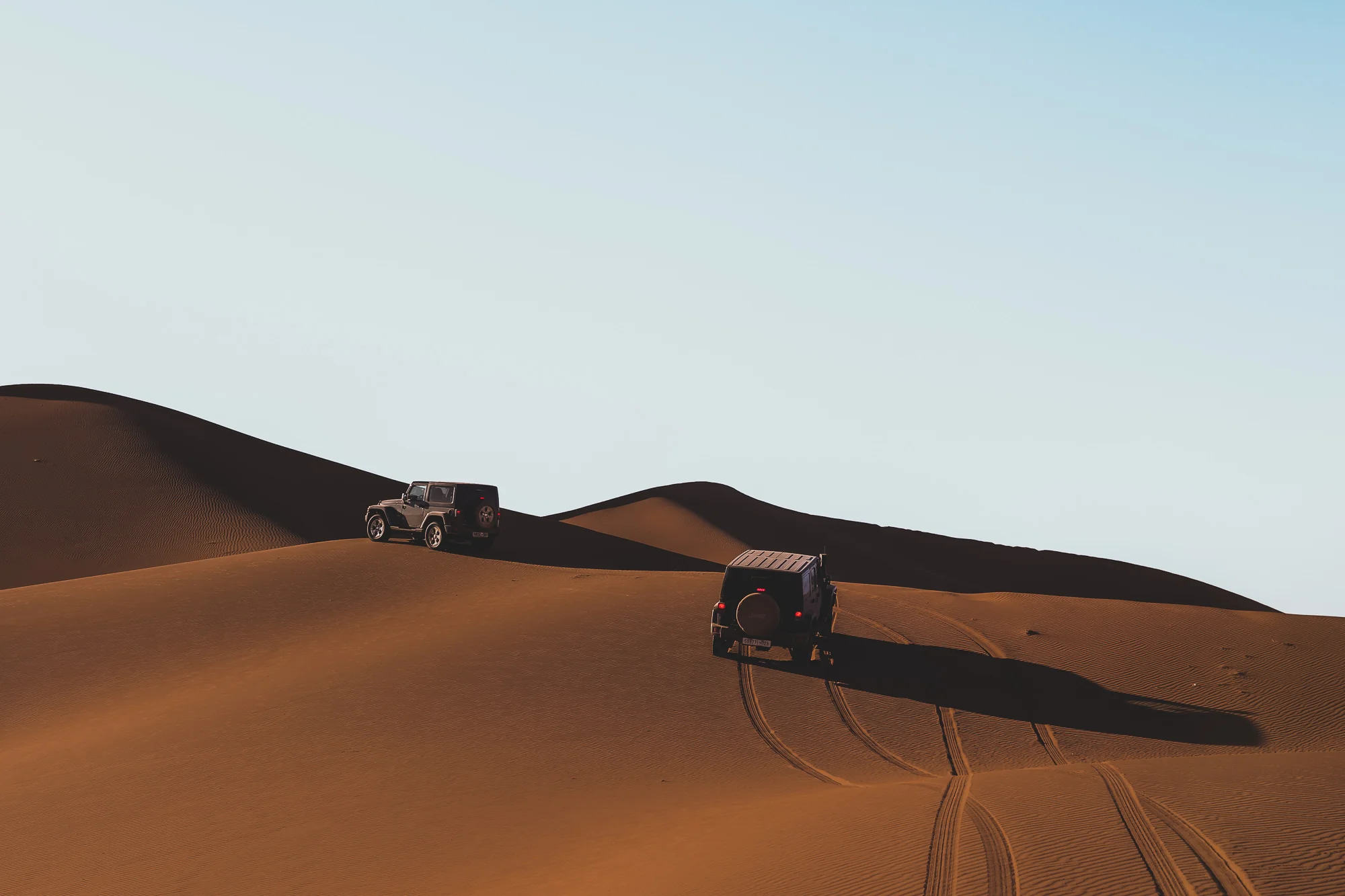
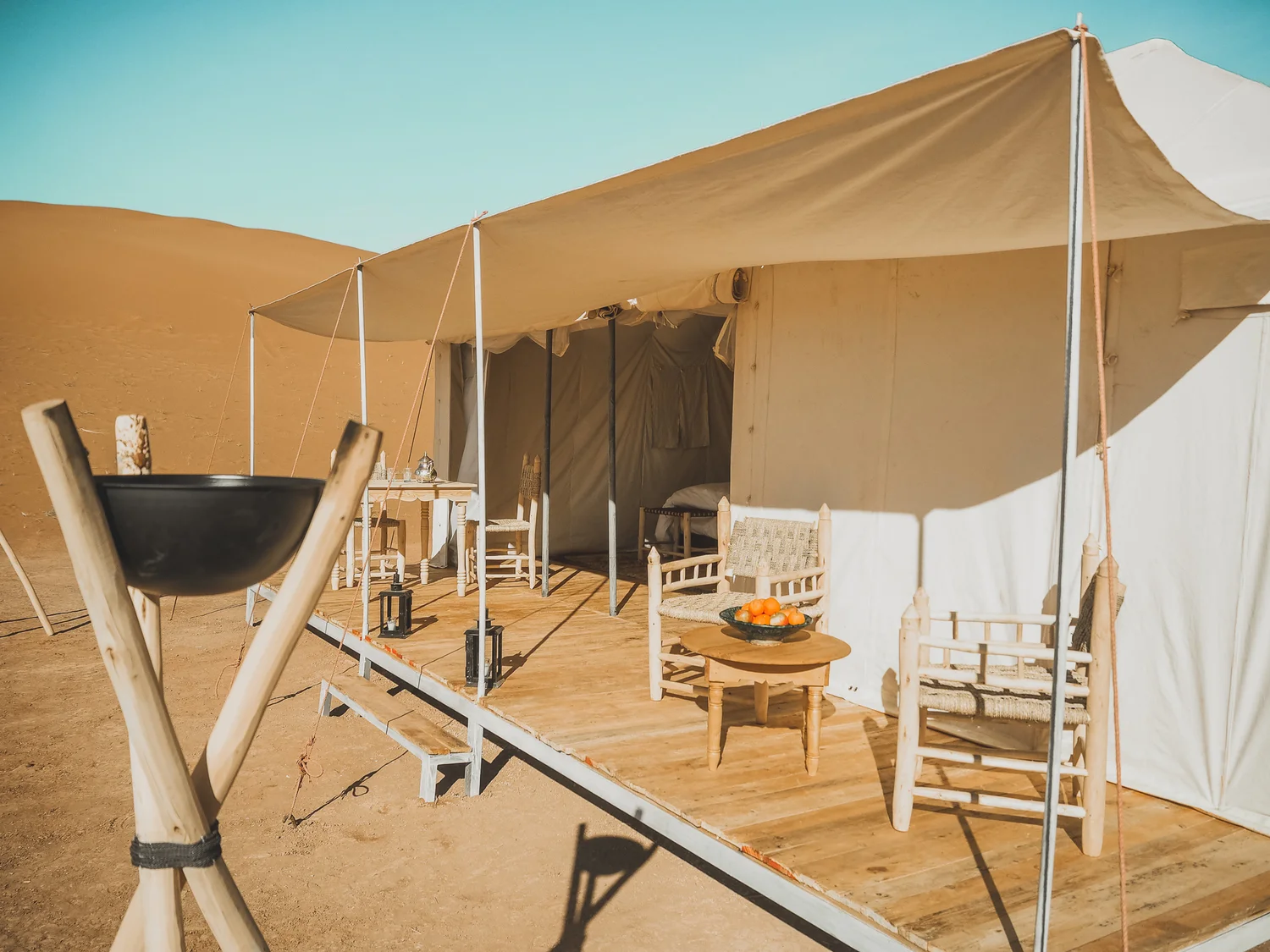
The Sahara has a rhythm that no travel app can fully capture. Temperature charts will tell you it gets hot in July, but they won’t tell you how the pre-dawn silence in February wraps around you like something ancient, or how the October light turns the Erg Chegaga into hammered copper an hour before sunset.
We host guests at Umnya Desert Camp throughout the year. Each season brings something distinct, something worth knowing before you pack your bag.
Spring: March to May: The Sweet Spot
If you can only come once, come in spring. Daytime temperatures hover between 22°C and 32°C, warm enough that the desert feels alive, cool enough that you can walk the dunes for hours without retreat. Evenings are gentle. The light at golden hour is extraordinary: low-angled, amber, relentless in its flattery.
March and April occasionally bring light rain to the region, which transforms the normally barren piste into something briefly, almost impossibly, green. Wildflowers appear along the edges of dry riverbeds. Migrating birds pass through the palmeries of M’Hamid. The desert, for a few weeks, is quietly, improbably lush.
May is the last generous month before summer presses in. Nights remain cool enough for long conversations around the fire. Stars are vivid on clear nights, and nights are reliably clear.
What to expect in spring
- Daytime: 22 to 34°C
- Nights: 10 to 18°C
- Crowds: Moderate, Easter and school holiday periods fill quickly
- Stargazing: Excellent visibility, especially in March to April
Autumn: September to November: The Undiscovered Season
September still carries summer’s heat in its bones, but by mid-October the desert finds its equilibrium again. There is something specific about autumn in the Sahara: the air is dry, the light is crystalline, and the sense of space is absolute. The summer crowds, such as they are in this remote corner of Morocco, have dissolved.
October and November are perhaps the most underrated months to visit. Days are warm but walkable. Nights are cool and deeply clear. The Milky Way arcs over the camp with an immediacy that catches first-time desert guests completely off guard.
We find that guests who come in autumn tend to linger. Something about the quality of the silence.
What to expect in autumn
- Daytime: 20 to 30°C (October), up to 35°C (early September)
- Nights: 8 to 15°C
- Crowds: Low, one of the most peaceful periods at camp
- Stargazing: Outstanding, some of our best nights of the year
Winter: December to February: For the Bold Traveler
Winter in the Sahara is not what most people imagine. The days are bright, blue-skied, and often pleasantly warm, reaching 18 to 22°C by early afternoon. But the nights are another matter entirely. Temperatures regularly drop to 2 to 5°C, and on exceptional nights the thermometer dips below freezing. We have seen frost on the tent canvas.
We have also seen the most extraordinary skies of any season.
Cold air is dry air, and dry air is transparent air. The winter sky above Erg Chegaga is not simply clear, it is dimensional. Stars that summer guests see as distant points become, in January, identifiable objects. The Orion Nebula is visible to the naked eye. The Milky Way’s core hangs over the dunes with an almost physical presence.
Come in winter if you are a stargazer, a photographer, or simply someone who wants the desert entirely to themselves. Bring layers, good layers, more than you think you need. We provide extra blankets and warm tajine to keep you comfortable, but the cold is real and the beauty is absolute.
What to expect in winter
- Daytime: 16 to 22°C
- Nights: 2 to 8°C (can drop below 0°C in January)
- Crowds: Very low, except around New Year
- Stargazing: Exceptional, clearest skies of the year
Planning a festive escape? Read about our Christmas & New Year in the Sahara experience.
Summer: June to August: For Those Who Know
We will be honest: summer in M’Hamid is not for everyone. Temperatures regularly exceed 40°C and can touch 45°C in July. The midday sun is not a companion, it is a force to be reckoned with and respected.
And yet, we have guests who return every August. They are the guests who understand that the extreme heat quiets everything. No tour groups. No casual visitors. An otherworldly stillness descends on the desert from noon until five in the afternoon, and in that stillness, there is a kind of meditation that cannot be manufactured in milder seasons.
Mornings are spectacular, cool before 8am, magical light, long shadows across the dunes. Evenings, once the sun releases its grip around 7pm, are genuinely beautiful. Summer in the Sahara asks something of you. If you are willing to give it, it returns something remarkable.
What to expect in summer
- Daytime: 38 to 45°C
- Nights: 22 to 28°C
- Crowds: Minimal, the most solitary experience possible
- Stargazing: Good visibility, though heat creates some atmospheric shimmer
The One Thing Every Season Shares
Regardless of when you visit, the Sahara at night is always extraordinary. M’Hamid El Ghizlane sits far from any significant light pollution, the nearest city, Zagora, is 90 kilometers away, and even Zagora barely registers on the Bortle scale this far south. What you see above Umnya on any clear night is the sky as it was before electricity.
That experience, lying on your back on a dune crest, watching the stars wheel slowly overhead while the desert holds its breath, does not depend on the season. It depends only on choosing to come.
Ready to find your season? Write to us at Umnya Desert Camp and we will help you choose the dates that suit your travel style, the experience you are looking for, and the rhythm of the desert. Every guest is different. Every stay is curated accordingly.
If stargazing is important to you, our complete astrophotography guide covers which months give the best sky. For a closer look at what daily life at camp looks like, read what to expect at Umnya. And if you are considering M’Hamid for the first time, our M’Hamid travel guide covers everything practical.